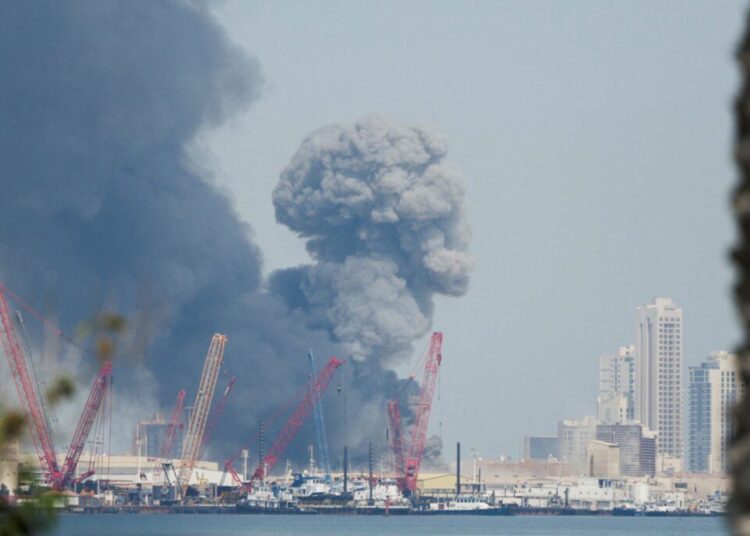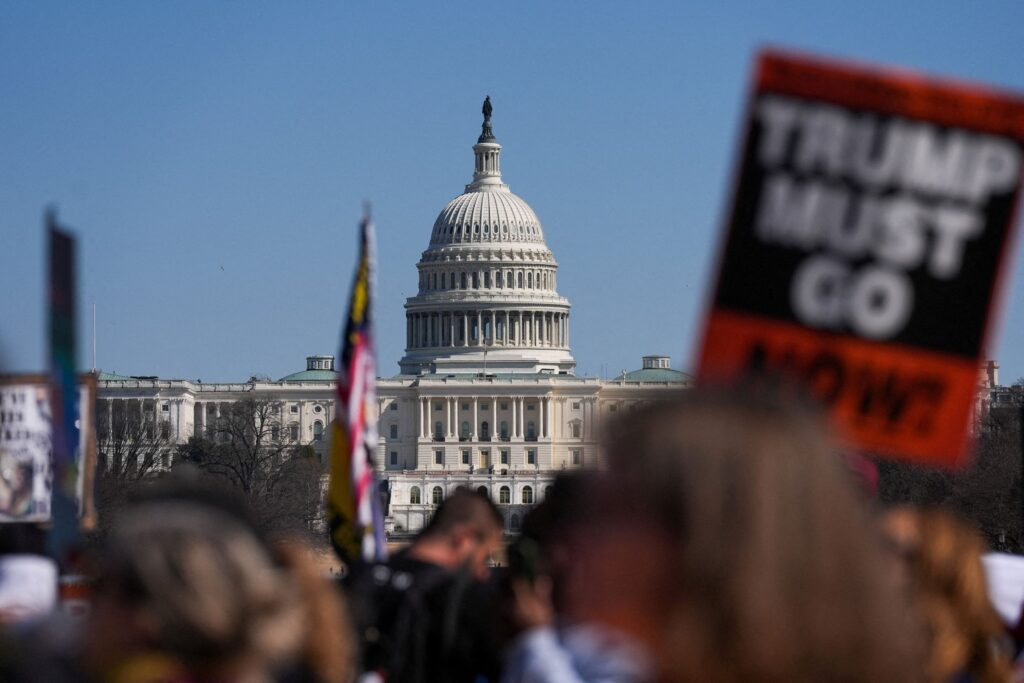
Top Democrats on Saturday called for Congress to return immediately to Washington and vote on whether to halt further military action in Iran, after President Donald Trump foreshadowed a possible extended conflict intended to force regime change in Tehran.
The House and Senate were expected to hold such votes in coming days, but Trump’s decision to attack injected fresh urgency into those plans.
“I’ll get on the next plane flying,” said Rep. Gregory W. Meeks (New York), the top Democrat on the House Foreign Affairs Committee. Senate Minority Leader Charles E. Schumer (D-New York), House Minority Leader Hakeem Jeffries (D-New York) and other Democrats also demanded urgent action to restrain the president.
Senate Majority Leader John Thune (R-South Dakota) and House Speaker Mike Johnson (R-Louisiana) did not immediately comment on calls for Congress to return. Both issued statements in support of the strikes, which the U.S. undertook alongside Israeli forces.
The votes will be the latest test of a long-shot — and so far unsuccessful — strategy that Democrats have employed to stop Trump from ordering military strikes without authorization from Congress, including military strikes in at least seven countries, a deadly campaign against suspected drug smugglers from Latin America, and threats against Greenland and Cuba.
Democrats — along with Sen. Rand Paul (R-Kentucky) and Rep. Thomas Massie (R-Kentucky) — have forced votes on a record number of war powers resolutions over the opposition of most Republicans, who control both chambers. They have portrayed them as a way for Congress to reclaim its constitutional power to declare war — but all have failed, and there are signs the strategy is coming under strain.
Sen. John Fetterman (D-Pennsylvania) and Rep. Josh Gottheimer (D-New Jersey) said ahead of Saturday’s strikes they opposed the resolutions. Rep. Jared Moskowitz (D-Florida) said he was willing to vote for such a resolution after strikes began but not while negotiations were ongoing to curb Iran’s nuclear program.
“Committed Democrat here,” Fetterman wrote Saturday on X. “I’m a hard no. My vote is Operation Epic Fury.”
Sen. Tim Kaine (D-Virginia), one of the architects of the war powers strategy, had sought to force a vote on the Iran resolution before the strikes, warning that the U.S. might find itself in a “full-blown war” if lawmakers waited. In a statement Saturday, he called the attacks a “colossal mistake” and demanded the Senate return to vote.
Some Democrats have invoked the specter of the Iraq War — although President George W. Bush sought and received authorization from Congress before the U.S. invasion in 2003. Trump has not asked for authorization to strike Iran or other countries.
“This is one of the most dangerous efforts that Trump is undertaking in the second term: trying to normalize war without Congress, trying to normalize the idea that a president can just do whatever they want when it comes to foreign policy,” Sen. Andy Kim (D-New Jersey) said in an interview Saturday.
War powers resolutions are one of the few ways for Democrats — as well as Republicans concerned Trump has not come to Congress — to push back.
The War Powers Resolution, which Congress passed in 1973 over President Richard M. Nixon’s veto in response to the Vietnam War, lets a single member of Congress force a vote on withdrawing U.S. forces from a conflict or blocking strikes when hostilities are imminent. But the hurdles to enacting such resolutions are high because the Supreme Court ruled in 1983 that presidents could veto them, which Congress can override only with a two-thirds majority in each chamber. No war powers resolution has ever overcome a veto.
Congress passed two resolutions during Trump’s first term: one to cut off U.S. support for Saudi Arabia’s war in Yemen and another to block Trump from striking Iran after the U.S. killed a top Iranian general, Qasem Soleimani. Trump vetoed both — but Kaine said he believed the symbolic rebuke had an impact on the administration, which refrained from further provoking Iran.
Republicans have been more reluctant to support such measures since Trump’s return to office. Sixteen House Republicans voted for the Yemen resolution in 2019, and six voted for the Iran resolution in 2020, but no more than three have supported a war powers resolution during Trump’s second term.
Some Democrats attribute the shift to fear. Sen. Adam Schiff (D-California) said one Republican senator had expressed concern to him that Trump would punish the senator’s state if the senator voted for one of the resolutions.
The resolutions that have come closest to passing would have forced the administration to cease hostilities with Venezuela after U.S. forces captured the country’s president, Nicolás Maduro. The House version failed 215-215 after Rep. Wesley Hunt (R-Texas) rushed in from the airport to ensure it didn’t pass.
Five Republicans — Sens. Lisa Murkowski (Alaska), Susan Collins (Maine), Josh Hawley (Missouri), Todd Young (Indiana) and Paul — voted with Democrats to advance the resolution in the Senate. But Hawley and Young flipped days later after entreaties from the White House — and after Trump derided them, writing on social media that they “should never be elected to office again.”
Young said voting for the resolution was ultimately “a fool’s errand” because Trump would veto it. He withdrew support after Secretary of State Marco Rubio agreed to testify publicly about the administration’s Venezuela strategy.
“We also got him to commit his professional reputation to seek formal congressional authorization should troops have to go back into the country. That’s not nothing,” Young said in an interview.
Other Republicans have dismissed the argument that even failed votes on war powers resolutions make a difference, saying Democrats are merely venting frustration at a president they despise.
“Messaging is a wonderful thing, but actually doing something is much more powerful,” said Sen. James E. Risch (R-Idaho), the chairman of the Foreign Relations Committee.
It’s not clear how many Republicans would support the Iran resolutions in addition to Paul and Massie. But one Republican who has not backed other war powers resolutions since Trump returned to office, Rep. Warren Davidson (Ohio), had said he would vote for it unless the administration provides a classified briefing to present its arguments for a strike. “War requires Congressional authorization,” Davidson wrote on X. “There are actions short of war, but no case has been made.”
Anna Kelly, a White House spokeswoman, said in a statement before the strikes that Trump had been “incredibly transparent with Congress” and would continue to keep lawmakers apprised “as he restores American strength and protects our national security.”
Some Democrats have voiced concern that forcing war powers votes could backfire.
Sen. Chris Coons (D-Delaware), a senior member of the Foreign Relations Committee, said earlier this year that he saw “real risk” in forcing failed war powers votes.
Danish officials made a similar argument last month in a private meeting with senators contemplating a war powers vote to block Trump from attacking Greenland, a semiautonomous territory of NATO ally Denmark. Such a vote would not be particularly helpful as a demonstration of broad U.S. support if it passed only narrowly, they said, according to two people familiar with their remarks.
In an interview before the Iran strikes, Kaine acknowledged concerns that failed votes could give tacit approval to Trump but said he thought it was important to put lawmakers on record.
“The volume level of concern is going up. Trump is having to work it harder to whip votes against these resolutions,” Kaine said. “When the volume level of concern goes up on the Republican side, then the behavior starts to adjust.”
Kadia Goba contributed to this report.
The post Democrats demand immediate vote to restrain Trump on Iran appeared first on Washington Post.