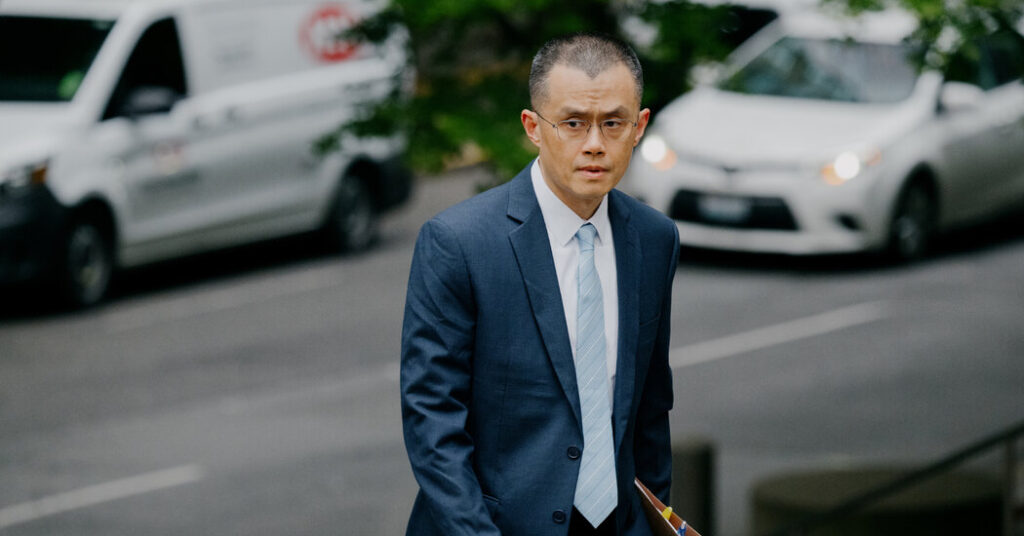
Changpeng Zhao was in a bind.
Federal prosecutors had threatened to bring charges over a flood of criminal activity taking place on Binance, the giant cryptocurrency exchange that Mr. Zhao founded. During legal negotiations in 2023, they accused him of money laundering and terrorist financing, and demanded that Binance pay $6.8 billion, one of the largest corporate penalties ever.
Mr. Zhao, crypto’s wealthiest billionaire, consulted more than a dozen high-priced lawyers, who often gave conflicting advice, according to a draft of his unpublished memoir, “Freedom of Money,” which was obtained by The New York Times. He thought the Justice Department’s demands were unreasonable and mentally prepared for life as a fugitive, unable to travel without risking arrest.
“The D.O.J. prioritized victory over justice,” Mr. Zhao wrote. At times, he added, he worried that prosecutors would “pull tricks” and “screw with me.”
In the end, Mr. Zhao, 49, cut a deal and pleaded guilty to a single count of violating an anti-money-laundering statute. In 2024, he was sentenced to four months in prison; President Trump pardoned him last fall.
Now Mr. Zhao is back on top of the crypto industry and preparing to tell the story of how he rose, fell and rose again. Last month, he said on social media that he would self-publish the book in February or March. The draft reviewed by The Times may not be the final version. But the nearly 300-page manuscript offers a vivid, albeit one-sided, account of the secret negotiations leading to his guilty plea, a rare window into one of the most complex white-collar prosecutions in recent years.
Mr. Zhao also details his brief stint as the wealthiest inmate in U.S. history, a humbling comedown for a jet-setting tech mogul accustomed to meeting with world leaders. He takes potshots at his former rival Sam Bankman-Fried, who ran the FTX crypto exchange, and describes a previously unreported run-in with Immigration and Customs Enforcement that almost forced him to stay in U.S. custody beyond the end of his sentence.
Mr. Zhao is worth more than $60 billion, according to Forbes, and remains a powerful crypto figure. Binance, the industry’s largest trading platform, has forged a business relationship with the Trump family’s crypto start-up, even as the exchange faces new scrutiny for possible sanctions violations by its customers.
The memoir draft does not shed light on Mr. Zhao’s campaign for a pardon or Binance’s links to the Trumps. But it is full of attacks on the Justice Department that echo some of Mr. Trump’s rhetoric, as well as stories about Gary Gensler, the former chair of the Securities and Exchange Commission.
In one chapter, Mr. Zhao wrote that he was appalled that Mr. Trump had been prosecuted for keeping classified files at his Palm Beach, Fla., club.
“If an employee took company files to read in the bathroom, I would be inclined to give him a bonus,” Mr. Zhao wrote.
Binance did not respond to a request for comment, and the Justice Department declined to comment.
“We’re thrilled The New York Times is so interested in CZ’s personal memoir, ‘Freedom of Money,’ which is one of the year’s most anticipated books — even if they’re writing based on material that is neither in CZ’s book nor in his words,” Mr. Zhao’s lawyer, Teresa Goody Guillén, said in a statement. “We’re excited for readers to experience CZ’s real words once the finished book is published soon.”
In the draft, Mr. Zhao describes his upbringing in China, where he lived until age 12, before his family moved to Canada. As an adult, Mr. Zhao returned to Asia and joined the crypto industry, starting Binance in 2017.
The company soon became the world’s most popular exchange, allowing customers to convert traditional currencies into digital coins.
In 2018, Mr. Zhao wrote, he was introduced to Mr. Gensler, who was teaching a class about crypto at the Massachusetts Institute of Technology. Mr. Zhao offered him a job as a Binance adviser, which Mr. Gensler declined.
In March 2019, Mr. Zhao and Mr. Gensler met for sushi at the Okura, a hotel in Tokyo. When Mr. Zhao learned that Mr. Gensler was expected to become the S.E.C.’s chair, he sent him a congratulatory email.
“Thank you,” Mr. Gensler responded, according to the manuscript. “I hope all is well with your family and you, particularly in these unusual times.”
That was the end of the cordiality.
Mr. Gensler went on to start an enforcement campaign against the crypto industry that included a lawsuit accusing Mr. Zhao and Binance of securities violations. (The case was withdrawn last year after Mr. Trump took office.)
In the lead-up to those legal battles, Mr. Zhao’s biggest industry rival was Mr. Bankman-Fried of FTX. They met in 2019 at a conference in Singapore, where Mr. Bankman-Fried hosted a dinner at an aquarium, followed by an after-party.
“I left early due to the loud atmosphere,” Mr. Zhao wrote.
At first, Mr. Zhao thought Mr. Bankman-Fried, who is about 15 years younger, seemed like “a smart young kid.” But their relationship frayed.
One of Mr. Bankman-Fried’s allies in Washington was disparaging Binance in political circles, Mr. Zhao wrote. He also heard that Mr. Bankman-Fried had attacked Binance at a private retreat with U.S. policymakers.
It was a battle that Mr. Zhao won. After concerns surfaced over FTX’s finances in 2022, Mr. Zhao wrote a series of social media posts that set off the equivalent of a bank run, exposing a hole in FTX’s accounts.
Mr. Bankman-Fried turned to Mr. Zhao for help.
“Did our relationship deteriorate to such a point that we don’t talk anymore?” Mr. Bankman-Fried wrote to him, according to the manuscript.
Seeming nonchalant, Mr. Bankman-Fried asked for a couple of billion dollars “as if he were asking for a bologna sandwich,” Mr. Zhao recalled.
Mr. Zhao briefly agreed to bail his rival out, before withdrawing from the deal. FTX declared bankruptcy, and Mr. Bankman-Fried was eventually sentenced to 25 years in prison for fraud.
A representative for Mr. Bankman-Fried declined to comment.
Meanwhile, Mr. Zhao’s own legal problems mounted. U.S. authorities were investigating whether Binance allowed criminals to transact on the platform, financing terror groups and channeling funds to sanctioned countries.
Mr. Zhao put together a legal team to negotiate with the Justice Department. By then, he had settled in the United Arab Emirates, where he was granted citizenship in 2023. It was a useful passport for visa-free travel, Mr. Zhao wrote, “not to mention it was a non-extradition country.”
The prosecutors wanted Binance to pay a $6.8 billion fine. Binance countered with $500 million, Mr. Zhao wrote, before settling on a $4.3 billion penalty. After assurances from his lawyers, the manuscript said, he accepted that returning to the United States would resolve his legal issues for good.
Final details were under negotiation until the last minute, even as Mr. Zhao prepared to board a flight to the United States. He sat outside the gate, the draft said, waiting for the go-ahead.
Ultimately, Mr. Zhao received a four-month sentence, far lighter than the penalties imposed on some other high-profile executives in the government’s crypto crackdown.
Showing glints of humor, Mr. Zhao devoted more than 20 pages to his time at the low-security prison in Lompoc, Calif., about 150 miles from Los Angeles. The guards asked him for Bitcoin investment advice, he recalled, and he shared a cell with a man who had been convicted of a double murder.
“The most lethal thing about him wasn’t his murder conviction, it was his snoring,” Mr. Zhao wrote.
In prison, Mr. Zhao, who is not a U.S. citizen, became preoccupied with a new legal threat. Immigration and Customs Enforcement said it would take custody of him after his release, which could force him to spend months in a detention center at the end of his sentence.
Mr. Zhao was released to a halfway house in Southern California in August 2024. A few weeks later, he wrote, the local police showed up to arrest him.
They put him in handcuffs and ankle cuffs, he wrote, and took him to a holding facility. Soon he learned the reason: ICE had put Mr. Zhao under a so-called detainer, saying he had overstayed his visa — while he was in prison.
ICE lifted the detainer after Mr. Zhao’s lawyers intervened, according to the manuscript. But he spent the last two weeks of his sentence under police custody.
ICE did not respond to a request for comment, and The Times could not independently confirm the details of Mr. Zhao’s detainment.
The next chapter is titled simply “GTFO.”
On the day of his release from custody in September 2024, Mr. Zhao’s sister, who is based in California, picked him up. They drove to a nearby airport, where a private plane was waiting to whisk him out of the United States.
From when he left detention to when his plane took off, only 26 minutes elapsed, Mr. Zhao wrote.
David Yaffe-Bellany writes about the crypto industry for The Times from New York. He can be reached at [email protected].
The post Crypto’s Richest Man Details His Secret Talks, Prison Time and Humbling Comedown appeared first on New York Times.