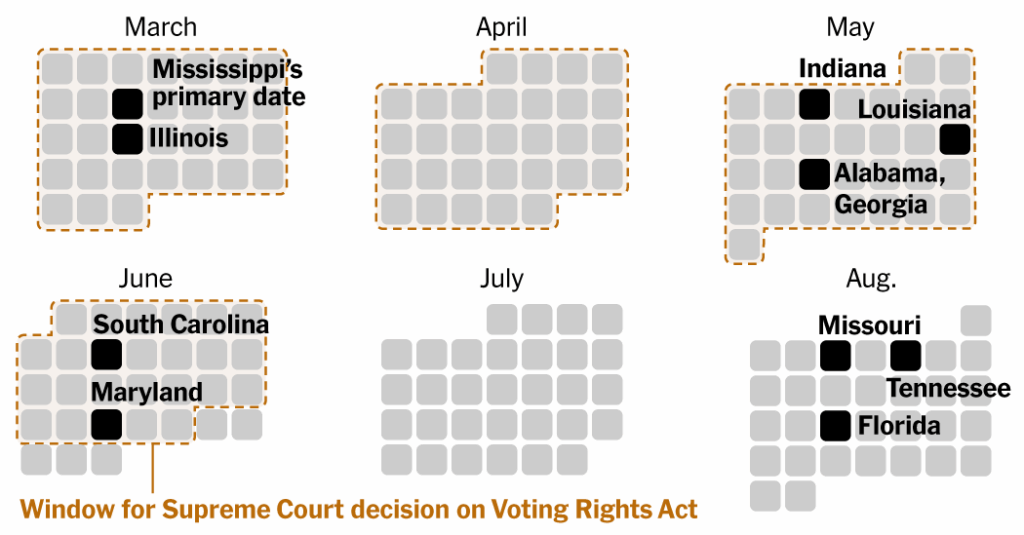
A looming Supreme Court decision on a critical provision of the Voting Rights Act could shift the long-term balance of power in the House toward Republicans. But how significantly it could affect this year’s midterm elections depends heavily on one variable: when the court rules.
The provision, Section 2, prohibits election or voting practices that discriminate on the basis of race. That guidance has led to the creation of majority-minority districts that are meant to help voters of color elect candidates of their choice.
If the court fully struck down the provision, Republican-led states across the South could try to eliminate those districts, many of which are occupied by Democrats. This would take the national redistricting war that started in Texas last year to an entirely new level.
Some states might seek to quickly redraw their congressional maps before the November midterms. The states most likely to do this have at least one protected district and one party in full control of state government.
How the court rules will, of course, also determine the political impact. If the court upholds Section 2, as it did in a 2023 decision finding that Alabama had unlawfully diluted Black voters’ power in drawing its voting map, there could be minimal effects.
During oral arguments, several justices appeared skeptical of keeping the status quo and open to further limiting the role race can play in drawing voting maps. But the court could choose a middle road, issuing a nuanced, narrow decision with an unpredictable impact.
Should the justices strike down Section 2, the clearest way to assess the midterm effect is to look at the primary calendar. If the decision comes after a state has started its primary election and voters have begun to cast their ballots, it will be next to impossible for that state to change its map.
Most states offer early voting periods during which voters may cast a ballot either through the mail or in person. Once those early votes have been cast, the election has begun, making it effectively impossible to throw out a state’s map and draw a new one.
States also have clear filing deadlines for candidates to be placed on ballots, and those deadlines often fall months before a primary election. Once filing deadlines have passed, they are difficult to work around. But legislatures do have the ability to change these deadlines — and they can even move primary dates, as many did in 2020 during the coronavirus pandemic. In an era of partisan redistricting efforts, nothing appears off limits.
The Supreme Court normally issues major rulings by late June or early July, but the opinion could come any time before then. The midterm primary calendar stretches from March, when states like Texas and North Carolina vote first, to mid-September, when Delaware holds the final intraparty contest.
If the Supreme Court struck down Section 2 in the coming weeks, before most states have held their primary contests, Democrats would be in danger of losing roughly a dozen majority-minority districts across the South, according to an analysis by The New York Times. If the court were to strike down the provision at the end of its term, the immediate political impact would be more limited. Only a few states with late-summer primaries would be able to draw new maps, and even then, they would face logistical hurdles.
Not every state with majority-minority districts would be able to redraw its map for partisan reasons. Many states have separate commissions draw their maps, taking the power out of the hands of politically minded legislators. These states include California, Ohio, Michigan, New York, New Jersey, Colorado and Arizona.
If such states wanted to redraw their maps, they would probably need to follow the path that California went down last year, making a constitutional amendment and putting it before voters. Some states require a waiting period for that process, which would rule out any 2026 effect.
Other states face simple political realities like split governments. For example, while Nevada’s House map is already significantly gerrymandered in Democrats’ favor, the state has a Republican governor and a Democratic-controlled Legislature, so redrawing its map is a political impossibility.
Additionally, a ruling striking down Section 2 of the Voting Rights Act would not guarantee that states could redraw their maps with abandon. Constitutional protections like the 14th Amendment still remain, and they have continued to be cited in gerrymandering litigation.
But in such a partisan atmosphere, any Supreme Court ruling that weakens protections against redistricting could be used as a political impetus by state legislatures to draw new maps. States where legislators have rejected such moves are not prohibited from trying again, and a new Supreme Court decision could provide political cover or motivation to revisit the issue.
Taylor Robinson contributed reporting.
Notes on certain states
In Alabama, absentee voting will begin on March 25 for people who meet certain criteria. Early voting dates in Illinois vary by county, but the earliest date is Feb. 5. In Kentucky, absentee voting will begin on May 6 for people who meet certain criteria. In Michigan, optional early voting can begin as early as July 6. New Hampshire does not offer early voting, but absentee ballots will be accepted starting Sept. 7. Only some counties in North Dakota offer early voting. In Oregon, April 29 is the first day ballots will be mailed to voters. Absentee and mail ballots are available in Pennsylvania as early as 50 days before its primary, though some counties’ ballots may be delayed by legal challenges or other factors. In Vermont, June 27 is the earliest day ballots will be permitted to be mailed to voters.
Nick Corasaniti is a Times reporter covering national politics, with a focus on voting and elections.
The post Could the Supreme Court’s Voting Rights Act Decision Affect the Midterms? appeared first on New York Times.