As millions of pages from the government files pertaining to Jeffrey Epstein continue to be surveyed, the scandal has taken shape both as ladder and maze — a hierarchy of crimes with the serial sexual violation of young girls at the top, devious financial machinations a few rungs down and the web of willed ignorance and sycophancy beneath it all.
That only one person — Ghislaine Maxwell — has been prosecuted for involvement with Mr. Epstein’s abuses has left the recent toppling of members of the elite professional class look like karmic retribution for failures of judicial reckoning. The shunting aside of this implicated academic, or that executive or statesman, has emerged, in some sense, as its own bourgeois vigilantism. Activating the ongoing assault is at once the mass revulsion over Mr. Epstein’s sins and a broader anger at the impunity so often enjoyed by the rich now tagged as the complicit — a knotty army of the enabling.
What we mean by complicity — how and when it ought to be redressed — has never been subject to a clear consensus, either within the framework of legal doctrine or the tenets of moral philosophy. What is striking about the Epstein fallout is the way in which, absent any meaningful civic accountability, complicity has been identified along a full spectrum of personal choice and vocational judgment call — in all the accepted invitations to dinner at his Manhattan townhouse, in the solicitations made of him for the support of various educational causes, in the welcome receipt of his power brokering.
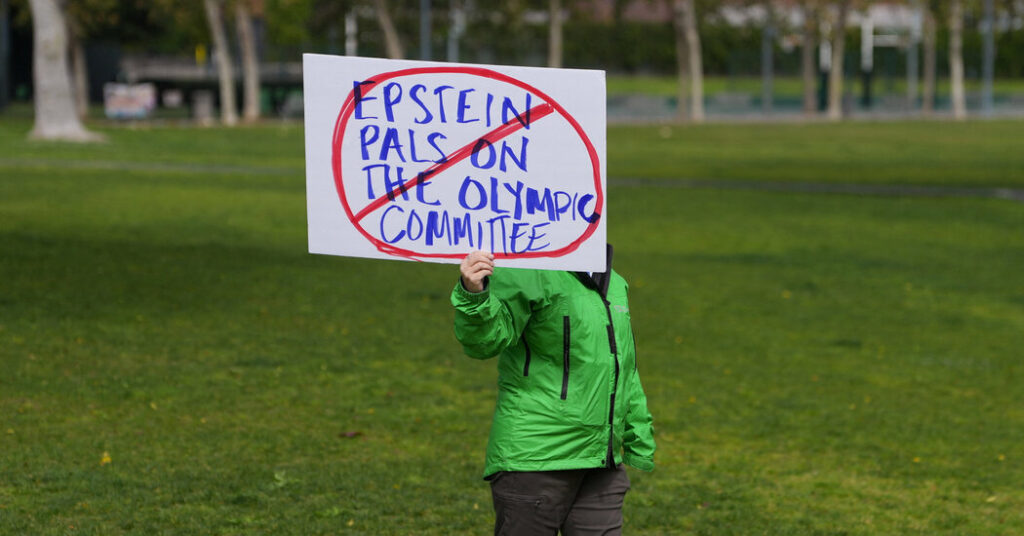
In some cases, the links seem even weaker, with complicity merely standing in for nebulous adjacency. Last week, for example, Mayor Karen Bass of Los Angeles called for Casey Wasserman, a prominent entertainment executive, to resign as head of the committee overseeing the 2028 Olympics there. This followed his self-exile from the talent agency he founded, after clients like Chappel Roan began to leave in response to the surfacing of erotic emails he exchanged with Ms. Maxwell more than 20 years ago. Mr. Wasserman was deemed guilty by association, though to what particular trespass was not altogether obvious.
Consider, as well, the position of Letty Moss-Salentijn, a quadrilingual Columbia dental school professor and, until this month, a vice dean who served on 45 university committees since she joined the faculty in 1968. In a recent statement regarding its handling of Mr. Epstein’s relationship to the dental college, the university — under the boldface heading “Actions Being Taken Now” — said that Dr. Moss-Salentijn “would step down from her administrative role.” No specific instance of wrongdoing was cited.
Correspondence from the recent trove of emails suggest that she helped transition Mr. Epstein’s girlfriend Karyna Shuliak to the dental school when she enrolled in 2012. Ira Lamster, a former dean, had alerted admissions officials that she had hoped to attend, right as he was pursuing Mr. Epstein for “a major gift.” Dr. Moss-Salentijn was among those officials and reported to Dr. Lamster, who left the university nine years ago. Her disciplining comes as Columbia has called the process of accepting Ms. Shuliak “irregular,” even though she had studied some dentistry in Belarus and apparently did well enough here to receive a postgraduate dental degree from Columbia last spring, six years after Mr. Epstein died in federal custody.
None of this is to suggest that the Epstein story has arrived at some inevitable chapter of overreach. To the contrary, some of those who operated at the center of his universe have continued along, tethered to their privileges. Seven years ago, the Guerrilla Girls, a group of activists who have fought sexism in the arts since the 1980s, began campaigning for the removal of the billionaire investors Leon Black and Glenn Dubin from the board of the Museum of Modern Art because of their deep financial entanglements with Mr. Epstein. Both men were eventually accused of sexual assault in court documents by women in Mr. Epstein’s orbit. Mr. Black and Mr. Dubin adamantly denied the allegations; both remain MoMA trustees.
Moral Ostriches
Whatever might motivate someone to say yes to a party at the mansion of a convicted child sex offender did not compel Tina Brown to summon a driver when a publicist asked her to attend an event at Mr. Epstein’s house with Woody Allen and Andrew Mountbatten-Windsor when he still held a royal title, an invitation she greeted with distaste in extremis. Similarly noting Mr. Epstein’s “loathsome reputation,” Axel Dumas, the chief executive of Hermès, rejected multiple requests to meet with him, putting Mr. Dumas on the short list of those who foresaw the problems of proximity.
Saba Bazargan-Forward, a philosophy professor at the University of California, San Diego who works in normative ethics, would slot those who instead found themselves besotted by Mr. Epstein’s lifestyle and connections, under what he characterizes as the “moral ostrich” category of human failing, the thought being that those at the Epstein periphery ought to have been asking morally relevant questions and possibly knew that they should, but dismissed them because they valued plausible deniability above all.
An uncynical view about the mind-set of his guests might accommodate the idea that Mr. Epstein, who returned to New York after a jail sentence in Florida, deserved the opportunity to rehabilitate himself. Restorative justice and second acts are, after all, fashionable preoccupations of the cosmopolitan. But as Christopher Kutz, a Berkeley law professor who has written extensively on complicity, pointed out, there was no “forgiveness” driving any of this social energy, just a willingness to “overlook” Mr. Epstein’s dangerous transgressions.
“You could imagine someone saying, ‘Well, he did his time in ’09 and I just went to some fancy dinners; it’s not my job as a civilian to punish him.’ But shame is the sanction we have,” Professor Kutz said.
Among moral philosophers, the study of complicity only recently exited a fallow period that had endured more or less since the 13th century, according to Gregory Mellema, an emeritus professor at Calvin University. In “Summa Theologica,” Thomas Aquinas articulated nine variants of complicity — among them flattery, silence and the refusal to denounce. But the field has always fallen short in the prescription of consequence.
Professor Bazargan-Forward has worked to push the thinking along, closer to some semblance of solution. His theory follows the logic of reparations: that someone benefiting from an injustice has a compensatory duty to its victims.
By his account, anyone who profited from knowing Mr. Epstein, whether because he or she received sex, money, social cachet or professional currency, owes something to the abused women who made possible the vast extension of his influence. From this vantage it no longer matters whether someone dubiously claims to have had no idea what terrible things Mr. Epstein was up to, because the paradigm takes measure only of the result: If you landed in a “better” position by knowing Jeffrey Epstein it is your responsibility to make restitution.
I asked Professor Bazargan-Forward whether the meting out of penalty ought to end with the transfer of money, presuming the behavior under scrutiny was merely reprehensible and not lawbreaking. He does not think it should. In some instances, he argues — when the privileges accrued by an affiliation with Mr. Epstein took the form of an exclusive job or an elevating access to an important person — the beneficiary has “a strong, but not exceptionless moral obligation” to quit the relevant job or sever the attendant relationship. By continuing to live with sullied benefits, Professor Bazargan-Forward argues, you continue to function in a mode of exploitation.
But this sort of recourse depends on moral self-initiative in a culture motivated instead by a fear of damning optics. In its recent Epstein announcement, Columbia made a promise of financial restitution, explaining that it would contribute the $210,000 he gave the dental school to groups supporting victims of sexual exploitation. How many individuals and institutions are likely to follow in kind in a society with so little investment in legacy or shame?
Enraging Validation
Academic administrators supplicate themselves to the charitable impulses of the very rich all the time, and the money they are after has rarely been acquired virtuously. How much this ought to weigh on the souls of advancement offices has long been debated in philanthropy. Among ethicists, utilitarians tell us to commit to actions that will produce the greatest good for the most people. So if it takes tainted money to finance transformative scientific innovation or scholarships, or to keep a library open, then the cost-benefit calculation ought to come out on the side of uncomfortable compromise.
Perhaps that is the bargain that Leon Botstein, the longtime president of Bard College, was making as he looked to Mr. Epstein to grow his school’s endowment. Maybe the appreciation he expressed for their friendship and shared interest in vintage timepieces was entirely insincere. That is the substance of Mr. Botstein’s defense — that his engagement with Mr. Epstein, whom he has since called “a truly evil man,” was “in service of one agenda, which was fund-raising for Bard.”
Claims of transactionalism in the name of a higher calling have spared almost no one from the criticism that taking Mr. Epstein’s money equated with the ugly business of reputational cleanup, a turn at the laundromat amounting to its own collaboration. As a former Bard parent, Daisy Bolle, told a local news outlet at a small campus protest calling for Mr. Botstein’s resignation last week, “It’s time to go. Someone has to be held accountable for the disgusting things that happened with Epstein.”
Should that someone be a figure like Mr. Botstein? This is the question now before Bard’s board of trustees, which announced last week that it had hired outside counsel to review the ties between Mr. Epstein and a president who has successfully kept a small liberal arts college going as others like it have evaporated under the pressure of declining enrollment and an evolving hostility toward the humanities.
The trustees have also asked their lawyers to examine how donors are vetted. But these exercises in self-reflection expose the insular and overlapping networks of the very rich, the difficulty of ever really knowing how a gift has been sourced, and which personal relationships might warrant interrogation and which do not.
Despite whatever commitment to charity and right-mindedness, no billionaire seems to operate at a comfortable distance from the causes of so many of our social maladies. Feeling powerless to dismantle the structures that have permitted so much damaging excess, those who live far outside the nexus of Harvard and Wall Street, Washington and Palm Beach believe they have found in the Epstein files an enraging validation, proof that the ruling class functions with so little respect for the actual rules that it cannot even be bothered to capitalize and punctuate. To them, the notion of complicity isn’t complicated at all.
Ginia Bellafante writes features, profiles and social criticism for The Times.
The post What Does ‘Complicity’ Mean for Epstein’s Friends, and Mere Acquaintances? appeared first on New York Times.