“They say I’m the death squad. True. That’s true,” former President Rodrigo Duterte of the Philippines said in one video clip. “I have a death squad,” he said in another. In a third, he addressed drug dealers and users: “Either I get what I want, or you perish. What does that mean? That means killings.”
Prosecutors at the International Criminal Court have tried this week to use Mr. Duterte’s own words, in part, to persuade judges to order him to face trial on charges of crimes against humanity, which he denies. The accusations stem from a devastating crackdown on drugs over several years, 2011 to 2019, while he was a mayor and then president. Rights groups say that police officers and vigilantes who were part of the crackdown killed tens of thousands of people, including children.
The prosecution’s strategy was almost theatrical in its simplicity. It submitted 20 of Mr. Duterte’s speeches to make its case. But Mr. Duterte’s defense also used his words, submitting 35 other speeches to argue that a trial was without merit.
On Thursday, the lead defense lawyer, Nicholas Kaufman, said that prosecutors had failed to mention that the speeches to security forces presented as evidence also included what he said were exhortations by Mr. Duterte to follow the law.
“The order is simply this: Go out. Arrest them if you can,” Mr. Duterte said in an excerpt read by Mr. Kaufmann. Mr. Duterte, he said, urged violence only if the police were in danger.
In another excerpt, the lawyer noted, Mr. Duterte said, “Do not kill if you’re not in danger of losing your life.”
The hearings concluded on Friday and will determine whether there is enough evidence to proceed to a trial. Mr. Duterte was arrested in March in Manila and handed over to the I.C.C. on three counts of crimes against humanity. A three-judge panel has 60 days to make a decision.
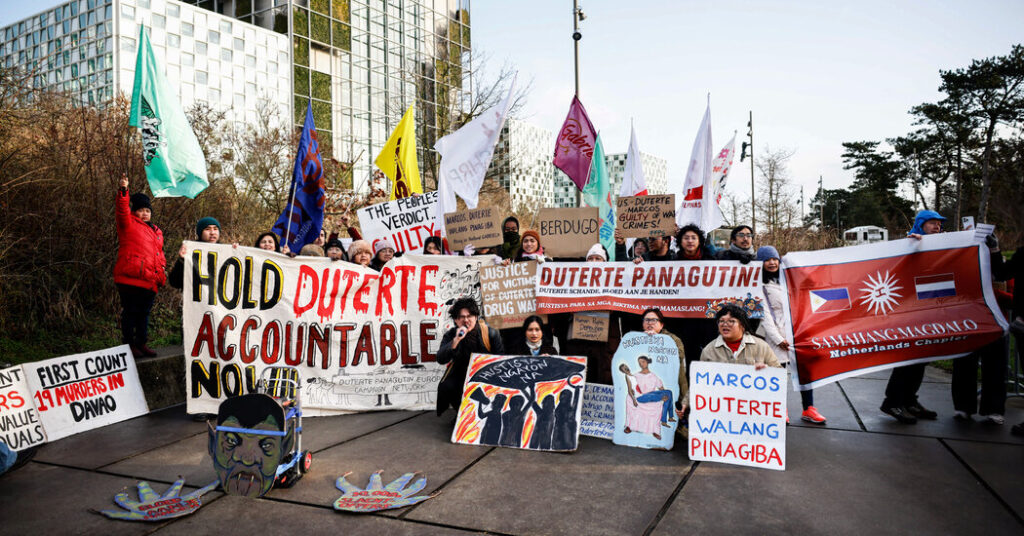
The hearings are procedural but have attracted an intense following in the Philippines, with people congregating to watch the broadcast from The Hague.
In the courtroom, the judges sat at the front while prosecutors and defense lawyers faced one another across long desks. In the public gallery directly above them, relatives of the victims of what Mr. Duterte called his drug war sat behind a glass partition, listening through headsets. Some of the victims’ relatives said later that it was hard to maintain composure during the proceedings. Some wept; some held back tears. They feared being removed from the court for showing too much emotion.
Mr. Duterte built a political career on a promise to lower drug crime, but the extent of the drug problem in the Philippines was never clear. In 2016, Mr. Duterte said there were 3.7 million people addicted to drugs in the country, but a government survey the year before found that the number of drug users was less than half that, according to an investigation by Reuters. He was the mayor of Davao City for more than two decades and won the presidency in 2016, promising a nationwide crackdown.
Mame Mandiaye Niang, a deputy prosecutor, told the judges that Mr. Duterte had played a “pivotal” role in extrajudicial killings of suspected drug dealers and drug users, first as the mayor of Davao, where he is accused of running the so-called Davao Death Squad, and then as president. He directed killings through a chain of command, Mr. Niang said, rewarding the killers financially or with promotions and shielding the operations from legal accountability.
In September 2016, three months after he took office, Mr. Duterte gave a speech to troops. He described his constitutional power to pardon as his “weapon against crime,” promising that if security forces killed hundreds of people, he would pardon them.
The prosecution and defense cast the speech in starkly different terms: to one it was an order to kill from a lawyer who knew the power of his words; to the other it was a politician engaging in hyperbole.
The charges are based on 49 incidents involving dozens of victims. The court’s jurisdiction extends only partway through Mr. Duterte’s term, which ended in 2022, because he withdrew the Philippines from the treaty that established the court. He has said that his detention is unlawful.
Mr. Duterte, 80, was permitted to be absent from the courtroom during the four days of hearings, at his lawyers’ request. They said he was too frail to attend, but prosecutors said court-appointed medical experts had found him fit to attend.
On Friday, Joel Butuyan, a representative of the victims and their families, was allowed to make a statement to the court.
“Mr. Duterte did not only order the mass killing of people suspected of being drug personalities,” Mr. Butuyan said. “He smeared them with accusations of being rapists, murderers, and dangerous criminals.”
Still, as Mr. Butuyan acknowledged, Mr. Duterte has a large base of supporters in the Philippines and its diaspora, some of whom have been protesting near the prison in The Hague where he has been held for nearly a year.
The post Were Duterte’s Speeches Orders to Kill or Hyperbole? appeared first on New York Times.