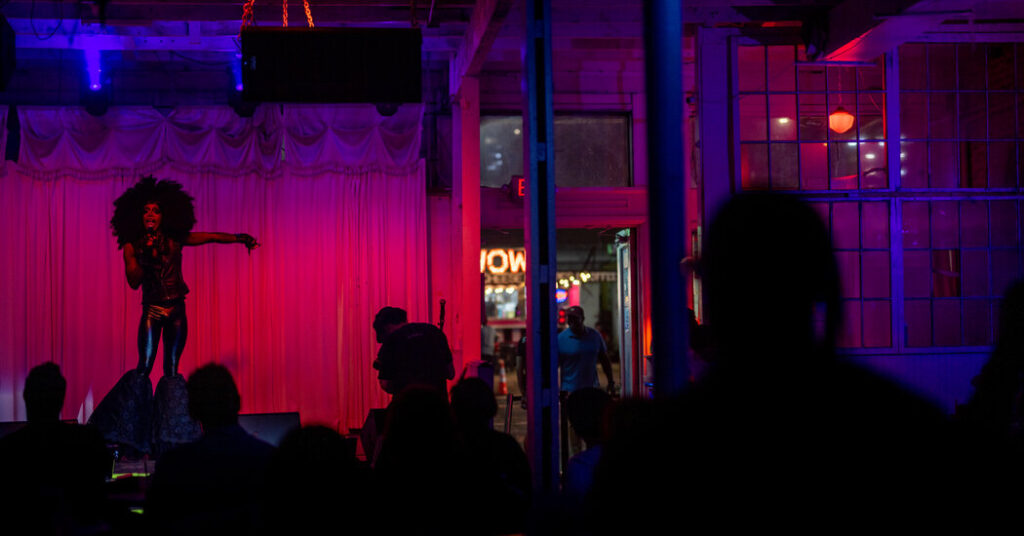
A Texas law that restricts drag shows can go into effect next month, a federal appeals court ruled this week, allowing the state to impose fines up to $10,000 on business owners who host certain drag performances in the presence of children.
But the appeals court did not decide on the law’s constitutionality, and the precise parameters of what is and is not allowed under the law will continue to be debated.
As written, the law purports to “regulate sexually oriented performances” and has been touted by Gov. Greg Abbott of Texas and other supporters as a ban on public drag shows. The law has been on hold for more than two years after a federal judge in Texas declared it unconstitutional.
On Wednesday, the U.S. Court of Appeals for the Fifth Circuit sent the case back down to the district court to conduct more legal analysis in light of recent Supreme Court decisions. While the district court reconsiders the plaintiffs’ challenge, the law can go into effect on March 18.
The court’s decision allows the attorney general to fine individuals up to $10,000 if they allow sexual performances on public property or in the presence of children. Performers can be sent to jail for up to a year, according to the law.
In a statement on Thursday, the governor’s spokesman, Andrew Mahaleris, said, “The governor is thankful that the Fifth Circuit rejected the trial court’s order halting this common-sense law, which protects children from explicit content in public.”
Ken Paxton, the attorney general of Texas, did not respond to questions about whether he intends to enforce the law as soon as next month. In a November news release about the case, he said he would “always work to shield our children from exposure to erotic and inappropriate sexually oriented performances.”
The Texas law was passed amid a broader conservative backlash against discussions and demonstrations about gender and sexuality and at a time when drag shows were under particular attack. In 2023, more than a dozen states introduced bills focused on restricting drag shows, though not all of them were signed into law, and district court judges have generally blocked them when challenged in court. Florida and Tennessee have partially enforceable laws curtailing drag shows, but lawsuits challenging those measures remain ongoing.
Debates about restrictions on young people’s exposure to L.G.B.T.Q. topics have recently heightened in Texas. The state passed a bill last summer banning K-12 student groups based on gender and sexuality, such as pride clubs, and regents for the Texas A&M University System, one of the nation’s largest public universities, voted in November to limit how instructors can talk about gender identity. A federal appeals court last week blocked the ban on L.G.B.T.Q. clubs, but the ruling applies only to three school districts.
In its decision Wednesday, the appeals court did clarify that not all drag performances would be restricted under the law.
The court dismissed two groups that were originally part of the lawsuit, ruling that they did not have standing to sue since they were not harmed by the law. That move, in effect, narrowed the scope of the law. One of those groups, a nonprofit called Woodlands Pride based outside of Houston, hosts an annual pride festival that includes drag performances that the organization referred to as “family friendly” and vendors who distribute condoms and sexual lubricant, according to legal filings. The court said the organization did not engage in any conduct prohibited under the law. Another plaintiff, Abilene Pride Alliance, was dismissed from the suit for similar reasons.
Brian Klosterboer, who represents the plaintiffs as a lawyer with the American Civil Liberties Union of Texas, said the court clarified that “family-friendly” drag performances remain fully legal in Texas. But he worried the ruling would still produce a chilling effect on drag performers.
“It’s a convoluted law, and it’s scary,” he said, adding that the law’s language makes it unclear what exactly is illegal.
The law does not explicitly ban drag shows and instead restricts “sexually oriented performances,” a term critics say is overly broad. Included are “visual performances” that feature nude actors or a range of behaviors, including actual or simulated contact between one person and the “buttocks, breast or any part of the genitals” of another; the exhibition of sexual acts; and “the exhibition of sexual gesticulations using accessories or prosthetics that exaggerate male or female sexual characteristics.”
In their original complaint, the plaintiffs — a group of L.G.B.T.Q. organizations, drag production companies and a drag performer — argued that the law was so vague it could criminalize ballet, cheerleading, synchronized swimming or theater, and threaten the livelihoods of Texans.
Pooja Salhotra covers breaking news across the United States.
The post Texas Can Soon Enforce Law Aimed at Restricting Drag Shows appeared first on New York Times.