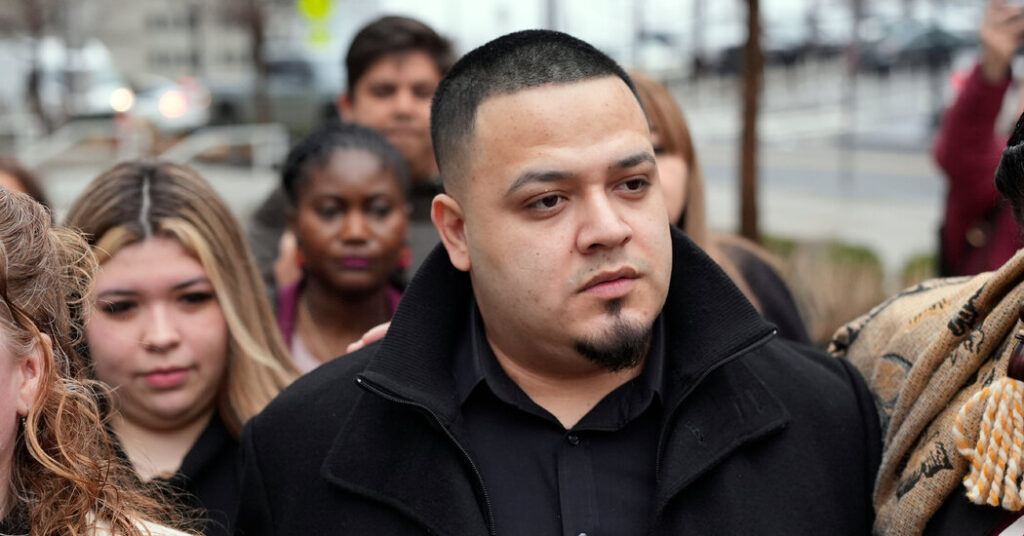
A top federal prosecutor in Nashville offered a detailed description on Thursday of his decision to indict the immigrant Kilmar Armando Abrego Garcia, disclosing new facts about the origins of the case in an effort to persuade a judge that the charges had not been brought out of vindictiveness by the Trump administration.
During more than three hours on the witness stand, the prosecutor, Robert E. McGuire, repeatedly insisted that no one in the administration had forced him to file charges against Mr. Abrego Garcia after he was returned to the United States in June from a wrongful deportation to El Salvador. But Mr. McGuire’s testimony in Federal District Court in Nashville nonetheless painted an extraordinary picture of senior Justice Department leaders peering over his shoulder, hurrying him along and sometimes knowing more about the case than even he — the man who was supposedly in charge of it — did.
In one remarkable episode, Mr. McGuire described sitting in the sun on his deck on a Sunday afternoon in April and receiving a call from a federal agent who pitched him on opening a criminal case against Mr. Abrego Garcia, who was still being held in prison in El Salvador.
It was the first time that Mr. McGuire had ever heard that federal authorities were considering opening an investigation into Mr. Abrego Garcia. But within two hours, he testified, he received an email from a senior Justice Department official, Aakash Singh, referring to a key witness in the case. It was an indication, he acknowledged, that the department’s leadership in Washington was already well versed about the inquiry that he himself had only just learned about.
His testimony was the latest twist in the long-running case, which has moved up and down through several courts and has come in many ways to symbolize both President Trump’s aggressive deportation agenda and the White House’s hardball approach to those who have criticized it.
In August, after Trump officials had spent months attacking Mr. Abrego Garcia with a barrage of personal insults, his lawyers accused the Justice Department of filing the charges against him as an act of retribution for his decision to fight his initial expulsion to El Salvador. The lawyers pointed out that Mr. Trump and some of his most senior aides had repeatedly assailed Mr. Abrego Garcia as a “wife beater,” a “gangbanger,” a “monster” and an “illegal alien terrorist.”
While vindictive prosecution motions are notoriously difficult to win, Judge Waverly D. Crenshaw Jr., who is overseeing the case, ruled in October that there was a “realistic likelihood” that the Trump administration had acted vindictively by charging Mr. Abrego Garcia with conspiring to smuggle undocumented immigrants into the United States.
Judge Crenshaw’s initial ruling forced the Justice Department to hand over internal emails about the case, including some that appeared to contradict Mr. McGuire’s early assertions that top department leaders played no role in his decision to bring charges. Among the emails were several from Mr. Singh, who made clear that indicting Mr. Abrego Garcia was “a top priority” for his boss, Todd Blanche, the deputy attorney general.
Mr. McGuire was questioned under direct examination by Stanley Woodward, Jr., a senior Justice Department official, and he spent most of his testimony trying to defend — or at least explain — those emails. Some of them suggested that Mr. Singh wanted to move the investigation along rapidly. Only three days after Mr. McGuire had opened his inquiry, Mr. Singh was already asking how close he was to filing charges and whether they could “sketch out” a draft complaint.
In another email, written in May, Mr. McGuire informed Mr. Singh that he was getting close to presenting the case to a grand jury. Mr. Singh responded that they should “keep a close hold” on the move until they got “clearance.” The statement seemed to suggest that he was waiting for approval from his own superiors at the Justice Department.
Even though there appeared to be pressure from above to file an indictment, Mr. McGuire adamantly asserted that the final decision to bring the charges was his alone. He said he came to that decision because he believed Mr. Abrego Garcia had committed crimes and that if the facts had proved differently, he would have stood up to his bosses in the Justice Department even if it meant being fired.
“That would have been an easier thing to swallow than sacrificing my integrity,” he said.
Mr. McGuire emerged from the hearing as a man in a tight spot, caught between his professional ethics and the clear desires of what he described in one of his emails as the “high command” of the Justice Department. His situation echoed that of many other senior federal prosecutors who have faced withering pressure from department leaders and from the White House to bring charges against people who have run afoul of Mr. Trump.
Several U.S. attorneys have been forced from office or have opted to resign because of the strain — among them, Erik S. Siebert, the former top prosecutor in the Eastern District of Virginia who declined to bring charges against two of the president’s most reviled political adversaries: James B. Comey, the former F.B.I. director, and Letitia James, the New York attorney general.
While Mr. McGuire chose in the end to indict Mr. Abrego Garcia, he faced opposition from his own peers, including the chief of his office’s criminal division, Ben Schrader, who resigned his post on May 21, the day the indictment was filed.
Discussing Mr. Schrader for the first time in public, Mr. McGuire said he called him on the same Sunday evening that Mr. Singh had written about the witness in the case. He described Mr. Schrader as a trusted friend and colleague whose opinion he had sought once he had been placed in the “hot seat,” as he put it, of leading the politically charged investigation into Mr. Abrego Garcia.
Mr. McGuire testified that he was deeply upset when Mr. Schrader said he planned to quit the U.S. attorney’s office if charges were filed.
“I didn’t want to lose him,” he said. “I didn’t want the department to lose him.”
Judge Crenshaw ended the hearing without making a ruling on the question of whether the prosecution was in fact vindictive — a decision that would lead to the case being dismissed. He asked both sides to summarize their arguments in court papers and to submit them to him in a month.
In theory, the judge could rule after reading those papers. But he could also decide he needs more information and summon top officials like Mr. Singh to take the witness stand, just as Mr. McGuire did.
Alan Feuer covers extremism and political violence for The Times, focusing on the criminal cases involving the Jan. 6 attack on the Capitol and against former President Donald J. Trump.
The post Testimony Offers New Details on Justice Dept. Role in Abrego Garcia Prosecution appeared first on New York Times.