“When was the last time you went to a harp show?”
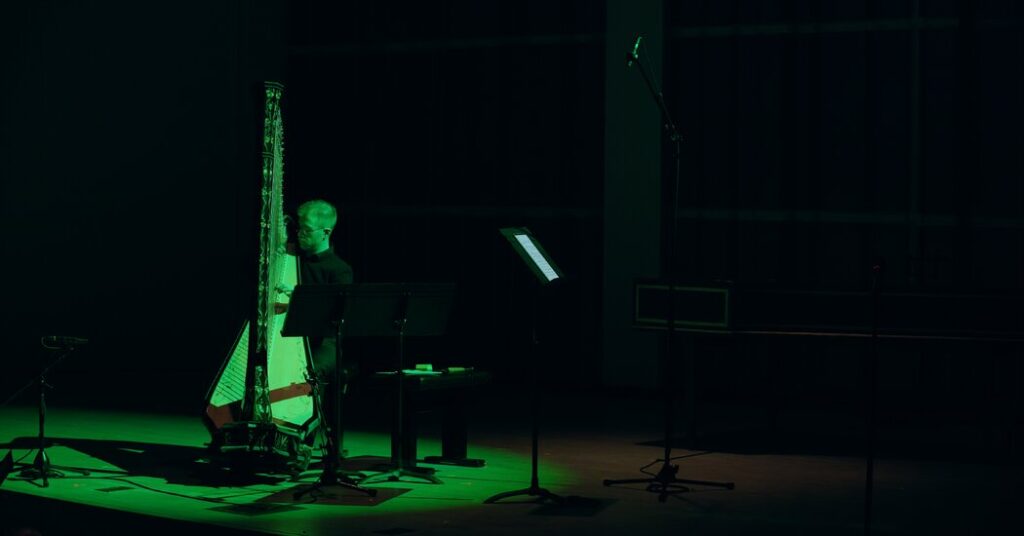
Last year, the harpist Parker Ramsay posed that question — more of a challenge, really — in an essay. His performance on Thursday at Merkin Hall provided something of an opportunity to take up the gauntlet. Also showing off his chops as a harpsichordist, he juxtaposed deeply old and brand-new music in a program meant to give him curatorial carte blanche. (Alas, if only this venue had an organ, perhaps we could have heard another facet of Ramsay, who served as the organ scholar at King’s College, Cambridge in England.)
Thursday’s concert was supposed to feature world premieres of works by Georg Friedrich Haas and Christopher Trapani. It was announced from the stage, however, that because of the recent snowstorm that ensnarled much of the Northeast and an ensuing lack of rehearsal time, Trapani’s “Luci Bizantine” would not be performed.
Ramsay began the evening at the harpsichord in a succession of short, mostly 17th-century works: Jan Pieterszoon Sweelinck’s “Ricercar Nono Tono”; Riccardo Rognoni’s Diminutions on “Ancor Che Col Partire (Cipriano de Rore)”; sonatas by Johann Schmelzer and Dietrich Buxtehude and Georg Muffat; and Michelangelo Rossi’s Toccata Settima. While Ramsay can celebrate coloristic and dynamic contrast when he plays the harp, the fundamental sonic limitations of the harpsichord — an instrument that cannot alter its loudness or sustain sound — gave him a rigorous framework in which to highlight tonal, harmonic and rhythmic invention.
For many of these selections, he was joined by the violinist Miranda Cuckson and the cellist Jay Campbell. Unlike Ramsay, who has shaped a dual-gear career in both Baroque and modern works, Cuckson and Campbell are better known as contemporary music specialists. Hearing the two of them play this music was a little like listening to people you thought you knew suddenly chatting away in a foreign language: It reveals a whole new side of their personalities. Cuckson in particular proved an adept polyglot, especially in Schmelzer’s sweet and tender Sonata IX in A minor.
Partly because of the omission of Trapani’s premiere, Haas’s “Annäherung” for violin and harp was the evening’s main event. Ramsay and Cuckson translate the German title as meaning something like “convergence” or “proximity,” and in this piece, their individual parts orbit each other before drawing near and playing in sync. In Cuckson’s case, she really did move around the venue as she played, eventually meeting Ramsay onstage. That sense of constant shift and unmoored movement spun out rhythmically and harmonically as well, as the duo traded skittering figures and sustained sections.
Haas’s enduring fascination with microtones dictated that Ramsay’s harp bore a unique tuning: The middle of his instrument was tuned to the standard of A at 440 hertz, but each of its shorter strings was successively pitched a few degrees higher than normal, and the lower strings a bit flatter. Cuckson, too, sometimes matched the harp’s tunings and at other times floated in her own microtonal realm.
If Haas’s central idea was to traverse the meaning and possibilities of proximity, that too was the driving intellectual force of this wide-ranging program. It wasn’t a full harp show, but Ramsay’s exploration of his instrument’s sonic and artistic potential was illuminating, and deeply satisfying.
Parker Ramsay
Performed on Thursday at Merkin Hall, Manhattan.
The post Review: A Harpist Merges Old and New, With Help From Friends appeared first on New York Times.