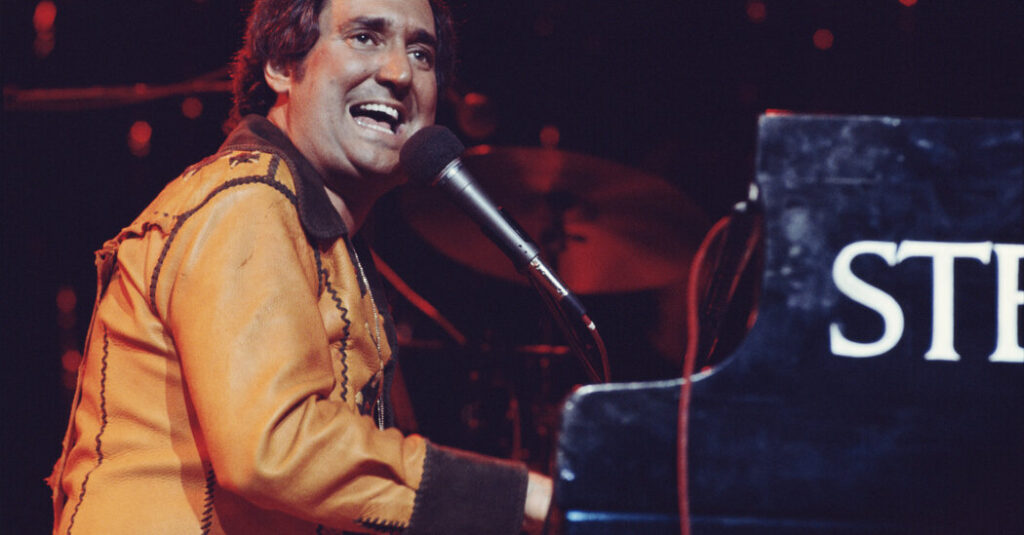
Neil Sedaka, who went from classical music prodigy to precocious songwriter to teenage idol to pop music fixture in a celebrated career that spanned seven decades, died on Friday in Los Angeles. He was 86.
His death was confirmed by his publicist, Victoria Varela. Mr. Sedaka was reported to have been taken to a hospital on Friday morning. No other details were immediately provided.
Mr. Sedaka co-wrote and sang some of the definitive teenage anthems of the late 1950s and early ’60s, hits of the pre-Beatles rock ’n’ roll era that include “Calendar Girl,” “Happy Birthday Sweet Sixteen” and “Breaking Up Is Hard to Do.”
He also co-wrote hits like “Stupid Cupid” and “Where the Boys Are” for Connie Francis and, much later, “Love Will Keep Us Together” for the Captain and Tennille.
Mr. Sedaka intersected in his career with a remarkably diverse array of musicians — the classical pianist Arthur Rubenstein and the violinist Jascha Heifetz as well as Carole King, Elton John and the Captain and Tennille, to name just a few.
He combined a genius for melody, the commercial instincts of a pop savant, a boyish high tenor and an unabashed enthusiasm for performing onstage. And he had a story that was both universal and indelibly rooted in a specific place: the Brooklyn of the 1950s and its Jewish culture, which played a disproportionate role in the early history of rock ’n’ roll.
In an interview with the Jewish newspaper The Forward in 2012, Mr. Sedaka reminisced about contemporaries like Ms. King, whom he dated in high school; Neil Diamond, who lived across the street; and others, like Barbra Streisand and Barry Manilow, who had similar influences.
“We all lived in Brooklyn,” he said. “It was a wonderful time. It must have been something in the egg cream. We used to hang out in the sweet shop and have egg creams and potato knishes.”
Neil Sedaka was born on March 13, 1939, in Brooklyn, one of two children of Mac and Eleanor (Appel) Sedaka. His father, a taxi driver, was of Sephardic Jewish background; his mother was Ashkenazi. The family name was a variation of the Hebrew word “tzedakah,” meaning charity.
Growing up in the Brighton Beach section of Brooklyn, he displayed a musical talent so obvious that his second grade teacher encouraged his parents to get him a piano. His mother took a job at a department store to help raise $500 for a secondhand upright.
At age 9, Neil received a scholarship to the Juilliard School of Music prep school in Manhattan. In 1956, he was one of 15 young musicians selected by Mr. Rubenstein, Mr. Heifetz and others to perform selections by Debussy and Prokofiev on WQXR, the classical-music radio station then owned by The New York Times.
His path toward a career as a classical pianist seemed to be on track, but he was veering toward another one. When he was 13, he and a 16-year-old neighbor in his apartment building, Howard Greenfield, began writing songs together, Mr. Sedaka composing the music and Mr. Greenfield the lyrics. He kept their exertions secret so as not to horrify his mother, who had much higher aspirations for him.
By Mr. Sedaka’s estimation, they wrote a song a day for three years before their pace slowed down. They pitched them to music publishers and record producers in Manhattan and soon set up shop in cramped quarters at the famed Brill Building, which became a Mecca for pop music songwriters.
In the summer of 1958, when Mr. Sedaka was 19, Connie Francis had a Top 20 hit (it reached No. 14 on the Billboard Hot 100) with his and Mr. Greenfield’s “Stupid Cupid.”
The two men continued to churn out pop songs for the likes of the crooner Bobby Darin, but Mr. Sedaka soon found bigger success as something of a baby-faced performer. His first single, “The Diary,” entered Billboard’s Hot 100 in December 1958 and eventually reached No. 14. He had his first Top 10 hit the next year with “Oh! Carol,” which he and Mr. Greenfield wrote about Ms. King.
An impressive string of hits followed, and by the early 1960s, Mr. Sedaka was a major pop star. His “Breaking Up Is Hard to Do” reached No. 1 in August 1962.
“I had to keep pinching myself to believe it,” he told Rolling Stone in 1975. He used to drive down Kings Highway in Brooklyn with the top down in his first car, a white convertible Chevy Impala, ecstatic to hear his songs blaring out of the radio, he said.
From 1959 to 1963, he sold more than 25 million records and toured nationally and internationally. But it didn’t last. His career cratered with the British invasion of 1964, relegating him to an oldies act before he was out of his 20s.
In 1970, Mr. Sedaka moved to England, where he was still popular, and kept writing (with a new lyricist, Phil Cody) and performing, trying to rebuild his career. He credited Elton John with resuscitating that career in 1975 by bringing him to his label, Rocket Records, for which he made two well-received albums, “Sedaka’s Back” and “The Hungry Years.”
That same year, he rerecorded “Breaking Up Is Hard to Do” as a ballad — a version that topped the Billboard easy listening chart and reached No. 8 on the Hot 100. It was one of the few songs recorded in two different versions by the same artist to reach the Top 10. He also released two other singles on Rocket that reached No. 1: “Laughter in the Rain” in 1974 and the rocker “Bad Blood” (with backing vocals by Mr. John) in 1975.
Mr. Sedaka continued performing well into his 80s and even returned to his classical roots, composing his first symphonic piece, “Joie de Vivre,” and his first piano concerto, “Manhattan Intermezzo.” Both were recorded with the Philharmonia Orchestra of London.
Survivors include his wife, Leba Strassberg, whom he married in 1962; a daughter, Dara, a singer with whom he collaborated in 1980 on the hit single “Should’ve Never Let You Go”; and a son, Marc, a screenwriter.
The thrill that Mr. Sedaka had gotten driving down Kings Highway, listening to his songs on the car radio, never seemed to go away. Touring England in 2014, he reminisced to The Manchester Evening News about playing places like the Golden Garter in Manchester when his career was in post-Beatles eclipse. People were eating fish and chips and talking while he performed, he said, but his impulse to make music and get people to respond remained much the same.
“There’s something about that adrenaline rush when you get a standing ovation,” he said. “You can be ill, but on that stage, you become a different person.”
Ash Wu contributed reporting.
The post Neil Sedaka, Singing Craftsman of Memorable Pop Songs, Dies at 86 appeared first on New York Times.