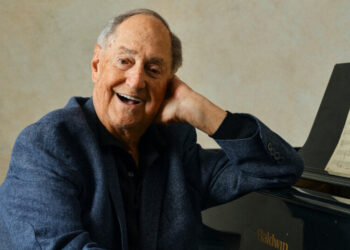
Neil Sedaka, the buoyantly up-tempo singer, pianist and songwriter who sidestepped a promising classical career in the 1950s to write and perform pop hits such as “Oh! Carol” and “Calendar Girl,” and who made a comeback in the 1970s with the soft-rock standards “Laughter in the Rain” and “Love Will Keep Us Together,” has died. He was 86.
His family announced the death Friday in a statement, which did not share details.
In an era when many pop-rock stars cultivated images of seductive wildness, Mr. Sedaka exuded an avuncular charm. During performances, when not at his perch at the piano, he sauntered across the stage, executing modest but deft dance steps as he sang early hits such as “Happy Birthday, Sweet Sixteen,” “Little Devil” and “Breaking Up Is Hard to Do” in his ebullient tenor.
By 1963, his record sales had swelled to more than 25 million, about half his lifetime sales of more than 50 million. Royalties were also pouring in from recordings of his songs by other performers from that era, including Connie Francis (“Stupid Cupid,” “Where the Boys Are”), LaVern Baker (“I Waited Too Long”) and Dinah Washington (“Never Again”).
Mr. Sedaka’s career was temporarily eclipsed by the British Invasion, but his popularity was undimmed overseas, thanks largely to his having versions of his songs in Italian, Yiddish, Hebrew, Spanish, French, German and Japanese. In 1970, he moved to London and made two albums with the musicians who would become 10cc: Graham Gouldman, Eric Stewart, Kevin Godley and Lol Creme.
He recovered his stateside momentum thanks to Elton John, a longtime admirer who put him under contract with his Rocket label after they met at a party in 1973. His debut, “Sedaka’s Back” (1973) yielded the No. 1 hit “Laughter in the Rain” as well as “Love Will Keep Us Together.” Mr. Sedaka followed with the No. 1 single “Bad Blood” in 1975 and a slow ballad version of “Breaking Up Is Hard To Do,” which reached No. 8 on the Billboard charts the next year.
“Love Will Keep Us Together” (a collaboration with Howard Greenfield, his principal writing partner) caught the ear of Daryl Dragon, the Captain of the duo Captain and Tennille. It became the title track of their Grammy-winning album and, during the song’s final moments, Toni Tennille can be heard singing “Sedaka’s back.”
“I had to reinvent Neil Sedaka,” he said in a 2019 interview with the Morning Call of Allentown, Pennsylvania. “I couldn’t keep repeating ‘Calendar Girl’ and ‘Breaking Up is Hard to Do’ over and over. I listened to James Taylor, I listened to Gordon Lightfoot. My old friend Carole King, Joni Mitchell. And they were inspiring me to reinvent myself.”
Early classical training
Neil Sedaka was born in Brooklyn on March 13, 1939. His father, a taxi driver, was a Lebanese Jew who came to the United States by way of Turkey; his mother was of Russian and Polish descent. Both his parents played the piano.
Until he was 18, all indications were that Mr. Sedaka would pursue a career in classical music. He showed musical aptitude as a member of the school choir when he was 7. When a teacher suggested to his parents that he start piano lessons, his mother took a job to pay for a secondhand piano.
He had attended the Juilliard School’s precollege division from age 9, and, at 16, he won a music competition whose judges included violinist Jascha Heifetzand pianist Arthur Rubinstein.
On a full scholarship, Mr. Sedaka enrolled in Juilliard’s college division. But two years into his studies, a musical sideline that he had been pursuing since he was 13 wrested the spotlight from the Old Masters. Greenfield, a slightly older teen neighbor in Brooklyn who was writing poems, wondered whether Mr. Sedaka could help him turn them into songs.
Mr. Sedaka was just becoming interested in pop, mainly as a social defense mechanism. Short, with glasses and braces, he was not popular among his high school classmates. Learning to sing and play the hits of the day, he realized, could change his fortunes.
“It worked in my favor,” he told After Dark magazine years later. “Not only was I invited to parties, but I was suddenly the life of every party I attended.”
With Greenfield, he began churning out what he estimated to be a song a day. The two young men eventually took their tunes to Manhattan to try to sell them to publishers in or near the Brill Building — the office block at Broadway and 49th Street that was the heart of the music industry at the time. They had little success until 1958, when they visited Aldon Music, a new company run by singer Al Nevins and entrepreneur Don Kirshner.
Like many other firms on that block, Aldon was a song mill and employed young songwriters including such King, Gerry Goffin, Barry Mann and Cynthia Weil. Early in Mr. Sedaka’s and Greenfield’s tenure at Aldon, producer Jerry Wexler had a visit from Francis, who was desperately looking for a hit to follow her cover of the 1920s jazz ballad “Who’s Sorry Now?”
Mr. Sedaka played and sang the songs they thought would suit her, but she found them too sophisticated. So Mr. Sedaka played “Stupid Cupid,” and she was sold. Her recording reached No. 17 on the Billboard charts in 1958 and was a No. 1 hit in Britain. They also supplied her with “Where the Boys Are,” the theme for the 1960 Hollywood film in which she appeared and which became a No. 4 hit the next year.
Mr. Sedaka had, by this time, fully set aside his studies at Juilliard and began to record his own music.
His first single, “The Diary,” was inspired by Francis, whom he noticed writing in her diary during their first meeting. It was a top-20 hit in 1959, but his next two singles failed to crack the Top 40. RCA was about to drop him.
“They told me I could have one more chance,” Mr. Sedaka told the Daily Mail in 1995, “and if that wasn’t a big hit they were going to drop me. So I picked up Billboard magazine and studied all the record hits, trying to analyze what it was that made them so successful. I noticed they all seemed to have girls’ names as titles and had strong drum-breaks. So I went away and wrote ‘Oh! Carol.’ ”
The Carol in question was Carole King, whom he had dated several years earlier. She and her then-husband, Goffin, responded with “Oh! Neil,” using virtually the same tune.
None of this impressed Mr. Sedaka’s mother, who was intent on his becoming a classical pianist. But when he received his first royalty check, for $62,000, she relented.
In 1962, he married Leba Strassberg, whose mother owned the Catskills resort Esther Manor. They had a daughter, Dara, a singer (she had a hit with “Should’ve Never Let You Go,” a duet with her father, in 1980) and a son, Marc, a screenwriter. A complete list of survivors was not immediately available.
Suddenly out of vogue after the arrival of the Beatles, the Rolling Stones and other British groups, Mr. Sedaka continued making records until RCA let his contract expire in 1966.
By then, he had resolved to polish his classical technique and enter the Tchaikovsky piano competition in what was then the Soviet Union. He said the Soviet authorities, objecting to his career making “American popular capitalistic music,” refused to let him participate.
With his royalties dwindling, Mr. Sedaka discovered that the nest egg he thought he had built with his early earnings had vanished. Having appointed his mother as his manager, he signed over his royalty checks to her, and she gave him a monthly allowance. Unknown to him, his mother had taken a lover — with his father’s acquiescence — and made him co-manager.
“My father knew about him and accepted him, so after the initial shock, so did I,” Mr. Sedaka told the Daily Express in 2014. “I even understood it, in a way. My parents lived in two rooms with nine other relatives and my dad was very thrifty whereas the other man bought her jewels and furs and took her to nice places. Only they were living the high life on my money. They went through hundreds of thousands of dollars. I couldn’t pay my taxes, nothing.”
He survived through his overseas fan base for years before stabilizing his finances in the 1970s.
In the 1990s, Mr. Sedaka made new recordings and repackaged his old hits. He also surprised his audience with unusual projects like “Classically Sedaka” (1995), for which he wrote lyrics for melodies by Chopin, Tchaikovsky and other classical composers. His reconnection with the classics inspired him to composed works of his own in a classical style, including a symphonic work, “Joie de Vivre,” and a piano concerto, “Manhattan Intermezzo.”
Mr. Sedaka undertook several other projects, including an autobiography, “Laughter in the Rain” (1982), and a children’s album, “Waking Up Is Hard to Do” (2009), in collaboration with his son.
Throughout his life, Mr. Sedaka said that performing was the engine that kept him going. Even the coronavirus pandemic barely slowed him down: For several months he presented daily short concerts online from his home.
“When I come home to New York, with no more adrenaline rush from an audience, it seems kind of boring,” he once said. “Leba always says that when I open the refrigerator door and the light comes on, I break into song.”
The post Neil Sedaka, singer, songwriter and pop hitmaker in two eras, dies at 86 appeared first on Washington Post.