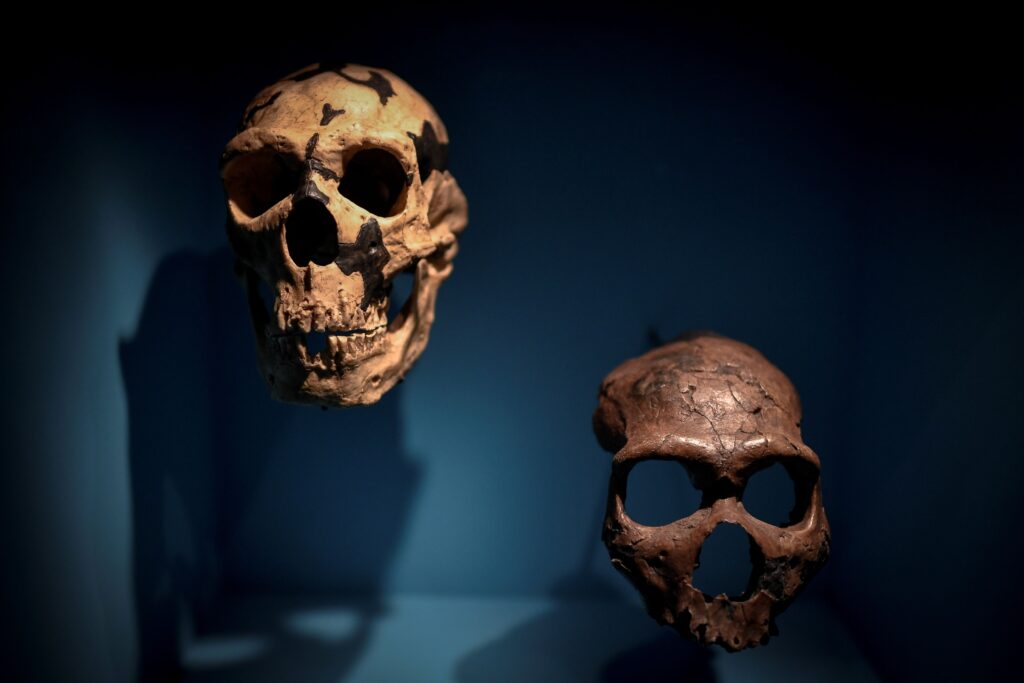
When Neanderthals and our species had babies together, the prehistoric pairings tended to follow a distinct pattern: Neanderthal dads and moms who were Homo sapiens — the same as modern humans.
Since 2010, scientists have known that Neanderthals and our ancestors had offspring together, and those hybrid babies passed down their genes to many present-day people. But the idea of “archaic introgression,” episodes when ancient species of humans interbred and exchanged genes, remained somewhat distant and abstract.
A new study published Thursday in the journal Science begins to give clues about how two closely related human species behaved when they interacted. Scientists at the University of Pennsylvania examined Neanderthal DNA and modern human DNA to find evidence that couplings between these species followed the same parental pattern over interbreeding events separated by 200,000 years.
“What I thought was really cool was that we might be able to infer something about social behavior in these ancient populations,” said Sarah Tishkoff, an evolutionary geneticist at Penn who led the work.
DNA can’t spell out the context of how or why Neanderthal males had children with modern-human females. The researchers put forward “mate preference” as a plausible reason for the genetic patterns, a scientific term that could encompass a wide range of scenarios, from sexual coercion or violence to peaceful voluntary couplings. Their genetic model also allows for the possibility that male Neanderthals relocated into human populations to account for the genetic patterns.
“A big question is … what was happening when these species came into contact with each other — and what was happening at an individual and community level?” said Sohini Ramachandran, a human population geneticist at Brown University who called the new study clever.
The understudied X chromosome
Since scientists reconstructed the Neanderthal genome from ancient DNA samples in 2010, it has been known that people with non-African ancestry can trace a fraction of their genome to Neanderthal ancestors. That’s because a population of Homo sapiens left Africa and lived alongside Neanderthals in Eurasia, interbreeding for an extended period between 45,000 and 49,000 years ago.
But there are also “Neanderthal deserts” in the human genome — areas that have less-than-expected amounts of Neanderthal DNA. One particularly well-known Neanderthal desert is on the X chromosome, one of the sex chromosomes, which determine people’s biological sex. Females have two X chromosomes, and males have an X and Y chromosome.
“We knew there was something special about the X chromosome, that modern humans had lost or did not have much at all Neanderthal ancestry in their X chromosome … but we were unable to resolve why that is,” said Alexander Platt, an evolutionary geneticist at Penn and part of the research team.
One possibility is that the paucity of Neanderthal DNA on the human X chromosome reflected an imbalance in couplings between the two species — with a dominant pairing of Neanderthal males and Homo sapiens females. Another was that over time, evolution favored X chromosomes without Neanderthal DNA, and over the years the Neanderthal genetic contribution was simply lost.
The scientists did analyses to predict how each scenario would play out. They analyzed Neanderthal genomes, to see how much human ancestry they had on their X chromosomes, and human genomes from modern populations in sub-Saharan Africa, including hunter-gatherers, to test their models.
They were able to rule out that evolution led to the lack of Neanderthal DNA on the X chromosome, and instead found evidence to support the idea of a strong sex bias in mating. The same pattern — Neanderthal males mating with human females — was apparent in the Neanderthal genome, too.
“Scientists have speculated for over a decade on what causes this difference” on the X chromosome, said Joshua Akey, a professor at Princeton University’s Lewis-Sigler Institute for Integrative Genomics who was not involved in the work. “This is a fascinating and provocative hypothesis. I find it extraordinary that we can use genome sequences to infer social dynamics that occurred tens to hundreds of thousands of years ago.”
Neanderthal-human hybrids
Much remains mysterious about how Neanderthals and modern humans interacted. But the genetic evidence has built the case that interbreeding events were not a single episode or a short period of contact, but occurred over thousands of years.
Last summer, a team of researchers published a study in the journal L’Anthropologie, reanalyzing the 140,000-year-old skull of a child thought to have died somewhere between ages 3 and 5 years old at Skhul Cave in Israel. After CT-scanning the skull, the research team argued that the child had features of both Neanderthals and Homo sapiens, and proposed that it was a hybrid.
Israel Hershkovitz, a professor in the department of anatomy and anthropology at Tel Aviv University and one of the leaders of that work, said that the new study adds to a body of already substantial evidence that supports the idea that there was a sex bias in these ancient interbreeding events between Neanderthals and modern humans.
Ramachandran noted that sex biases in mating can occur for social or cultural reasons, when members of one sex tend to relocate into their mate’s group — such as females moving to live with a male’s group, or vice versa. But in more recent history, the X chromosome can reflect sex biases in mating that occur because of power disparities or colonialism. For example, there are studies showing the X chromosome has an imbalance of genetic material that reflects that European males tended to have children with enslaved or Indigenous people. That raises the question of how male Neanderthal DNA came to be incorporated into the human population, given that their species went extinct.
Hershkovitz’s research posits that Neanderthals were living in the Levant, a region along the eastern Mediterranean, when modern humans began arriving around 250,000 years ago. Neanderthal males, he proposes, then captured modern-human females, starting the flow of their genes into the Neanderthal population.
As more modern humans arrived and their population began to outnumber the Neanderthals, the gene flow reversed, helping to explain why the male Neanderthal genes ended up in the human population.
The new paper will add to a growing but limited body of evidence shedding light on this period of ancient hominin history, but it also raises more questions.
“The importance of studies like this one is to help us reconstructing how different Homo populations interacted (not just that they interbreed),” Hershkovitz said in an email.
correctionAn early version of this story incorrectly said modern humans began arriving in the Levant around 200,000 years ago. It was 250,000 years ago.
The post Neanderthal males and human females had babies together, ancient DNA reveals appeared first on Washington Post.