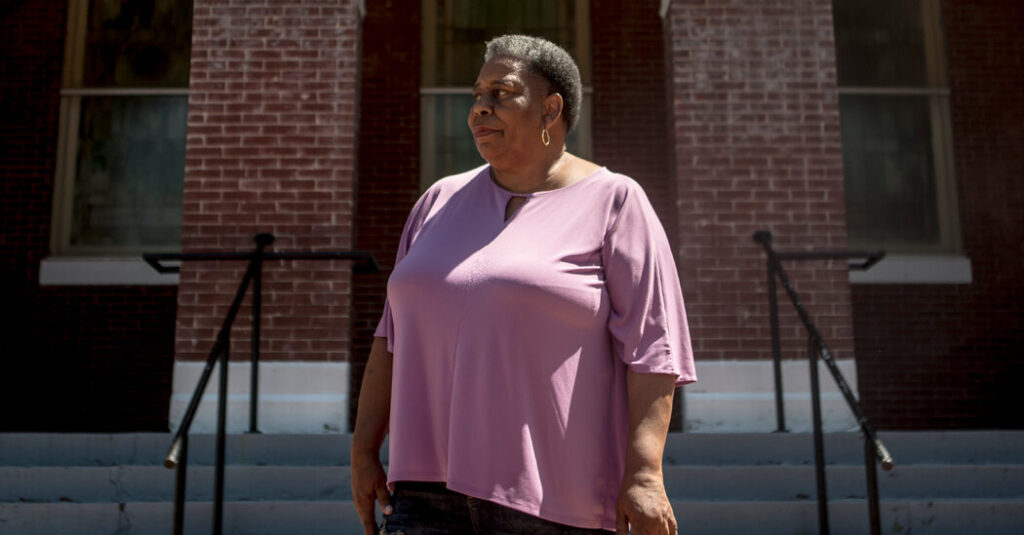
Jo Ann Bland, who participated in the 1965 “Bloody Sunday” protest for voting rights in Selma, Ala., at the age of 11, making her one of the youngest foot soldiers in the civil rights movement, died on Feb. 19 at her home in Selma. She was 72.
The cause of death was lung cancer, her granddaughter Jasmyn Bowie said. Ms. Bland’s sister Lynda Blackmon Lowery, who was also at the 1965 protest, at age 14, died in December at 75.
Both sisters could claim a role in one of the pivotal moments for civil rights, which unfolded in their hometown on March 7, 1965.
That Sunday, key lieutenants of the Rev. Dr. Martin Luther King Jr. began a peaceful march from Selma to the state capital in Montgomery to demand an end to racist literacy tests and other hurdles to meant to slow the process of registering Black voters.
Ms. Bland and her sister said they were among the roughly 600 protesters who attempted to cross the Edmund Pettus Bridge in Selma, only to be met by state troopers armed with tear gas and billy clubs. John Lewis, a leader of the march and future congressman from Georgia, was seriously wounded.
“It’s the screams I remember the most — people just screaming and screaming and screaming,” Ms. Bland said later.
“The last thing I remember seeing on the bridge that day is this lady and this horse,” she added. “I don’t know if the horse ran over her, or if the officer on the horse hit her with the billy club, but I remember the sound of her head hitting that pavement — I’ll never forget it. It was too much for me. I fainted.”
Once she came to, Ms. Bland told NPR in 2022, she and her sister bolted.
“We ran past our house, thinking we didn’t have time to unlock the door because those same men were chasing the marchers back,” she said. “We were terrified. And we kept running, and we ran up those steps and went inside the church, thinking we were safe. We were not. They came into the church and started beating people all over again.”
The violence committed by Alabama state troopers against peaceful marchers was captured on national television and helped spur the passage of the Voting Rights Act of 1965, which prohibited racial discrimination in balloting. President Lyndon B. Johnson signed the act into law that August.
As an adult, Ms. Bland became an educator and historian of the Selma march.
She helped found the National Voting Rights Museum and Institute in Selma in 1993; helped establish Foot Soldiers Park in the city; and organized tours, called Journeys of the Soul, to “remind people where we’ve been as a nation,” she said, “and that what happened in Selma is not Black history. It’s American history.”
Charles Mauldin, a fellow protester who was 17 when he joined the march with her in 1965, called Ms. Bland “the most iconic young person who became part of the movement and who continued the march forward since then.”
Jo Ann Blackmon was born on July 29, 1953, in Selma, one of four children of Alfred C. Blackmon Sr., a cabdriver, and Ludie (Wright) Blackmon.
Her mother died in childbirth in 1957 in the hallway of a Selma hospital where Black patients and staff were segregated from whites. Doctors, she said, had delayed a vital transfusion until blood could be obtained from a Black donor nearly 90 miles away in Birmingham.
Jo Ann was raised in large part by her grandmother, who had returned to the South after decades in Detroit.
“Standing with her grandmother outside of Carter Drug Company one day, Bland wanted to go in and order at the lunch counter,” Karlyn Forner wrote in “Why the Vote Wasn’t Enough for Selma” (2017). “Her grandmother explained that colored children were not allowed to do that. Then, leaning over, she told Bland that when they got their freedom, she could do that too.”
“I became a freedom fighter that day,” Ms. Bland was quoted as saying.
She joined the Student Nonviolent Coordinating Committee when she was 8, she said, and had been arrested 13 times for acts of civil disobedience by the time of the voting rights march.
After graduating from high school, she served in the U.S. Army as a legal clerk; lived with her husband, John Bland, in Florida before they divorced; and adopted a son, Antonio Bowie, Jasmyn’s father.
A complete list of survivors was not immediately available.
When Ms. Bland returned to Selma in 1989, she committed herself to keeping its history alive.
“When my students come” to the National Voting Rights Museum, she told the website Medium in 2016, “I kick it plain.”
Referring to the martyrs of the civil rights movement, she added, “I don’t use language like ‘They gave their lives’ — they didn’t give anything, they were murdered.”
She continued: “The more stories these children hear about the past from people who were there, it becomes real and not remote, and they start to think about how they fit in the puzzle of social change.”
Sam Roberts is an obituaries reporter for The Times, writing mini-biographies about the lives of remarkable people.
The post Jo Ann Bland, Child Activist in Civil Rights Struggle, Dies at 72 appeared first on New York Times.