As a man who loves men, as a man in love with a man, I was surprised by how little I wanted to watch a man fall in love with a man on TV. I’ve been perplexed about why. You can probably imagine where this is going. So forgive me, because yes: the hockey show. For weeks, it — “Heated Rivalry” — took over a wing of the country.
You have to watch this thing, people told me. It’s beautiful, life-giving, hot. Yet something about all the drooling got on my nerves. It was embarrassing, like ’round-the-block-lines-for-$20-bread embarrassing. Grown women were ripping their own bodices over what I had been led to believe was porn. They were filming their boyfriends and husbands ugly-crying. (More than once, “fetish” crossed my mind.) Whatever this show was going to turn out to be, I was pretty sure I already had an app for it.
But then, mid-pandemonium, I watched it and understood. For my heart, too, soared. And then, just like that, it sort of sank: Why wouldn’t I have wanted this? Here was a six-episode show that’s exemplary as romance, as physical intimacy, as banter, as athlete psychology, as conversation, confession and comedy, as just good television that involves a few of my favorite things: sex, sports, men, training montages, the spiky post-punk of Wet Leg. So why? Let’s start with wariness.
So much of being a gay man in this country has entailed resistance — to neglect, to exploitation, to death. Yet how many times have I settled for stories about men wanting men that use tragedy as their primary romantic enterprise, pulley systems of shame and sadism and secrecy? If we didn’t suffer, we didn’t exist, not completely. “Heated Rivalry” banishes that kind of existential suffering.
Before, a man could enjoy even the arguably phobic depictions because at least they’re depictions at all. Whatever hate you could lob at, say, “Cruising,” which people loathed during its 1980 run, that movie remains a kaleidoscopic index of gay sex clubs in the Meatpacking District, when that neighborhood was considered an outer ring of hell. The men in that movie like it hot. And nothing in the camera’s observation fears the heat. It’s got hungry eyes, too. But there’s this political hitch. A homicidal maniac is on the loose, and he’s killing “homosexuals.” He might, alas, be gay himself, and the heterosexual detective (Al Pacino) trying to catch him worries he might not be as straight as he thought.
I’ve always appreciated this movie as a psychic, archival and hormonal journey. But loving it has meant tolerating another alignment of “queer” with “psycho.” Ditto for “The Talented Mr. Ripley” (1999) and Matt Damon’s obsession with Jude Law, which also produces a body count.
Let’s not enumerate every single lusty, tear-jerking, demented box-office bummer. But let’s also never fail to remember that for a long time “Brokeback Mountain (2005) sufficed as a dictionary definition of “gay love story.” I mean, Jack Twist gets beaten to death and, in the final shot, Ennis Del Mar stands in a trailer all by his lonesome, his shirt wearing Jack’s. In a closet. His ambiguous declaration of devotion (“Jack, I swear …”) is uttered too late. But not too late to reach for my hankie.
Is movie grief our cathartic kink? Maybe what I’d grown accustomed to was art that knew my pain. Had I ever seen heartbreak rendered as ragefully as Chiron’s smashing that chair over his bully’s head the way “Moonlight” lets him? Maybe I was accustomed to art that would enrage me.
A BOY CAN DEVELOP a taste for depictions of deviance. I grew up during the AIDS crisis. My fluency was in camp and subtext, winking and doom. I merged with scenes and people famed for innovative responses to rejection: disco, house, leather and drag; Robert Mapplethorpe, Edmund White, John Waters, Gregg Araki, RuPaul. A regime of dehumanization spawned a knowing counterculture of subversion that revealed and exposed, satirized and warped, protested and castigated all kinds of norms, people and ideas. But man does the rejection linger. It seeps into your worth, what you think you’re worthy of. It exhausts you. Being allowed to marry some man always seemed beside the point. Am I going to be allowed to live?
This tension has always felt like the anxious root of these proliferating Ryan Murphy extravaganzas — “American Horror Story” or “Feud,” or “Pose” or “The Politician” or “The Beauty.” I, at least, watch them and wonder whether a decade’s worth of legalized same-sex marriage has done a number on the gay psyche. The shows that hail from Murphy’s company have often struck me as worried protests of the defanging side effects of so-called normalization.
“Heated Rivalry” is actually a tidy, giddy period piece with an ingenious structure that lets it skate from 2008 to 2018. Hockey takes the show’s lovers, Ilya and Shane (a Russian and a Canadian), across the U.S., where a kind of normie gay culture would be erupting around them. Soapboxes aren’t the show’s thing. Yet everything that seemed possible in real life then feels poised to happen here. “Heated Rivalry” itself has landed amid the anxieties of the early and mid-2020s. Forget worrying about what marriage would mean for a gay man’s idea of himself. Now, we’re freaked out all over again about what a man even is. And last summer, Mark Harris used the occasion of a Pee-wee Herman documentary to explore, in T Magazine, whether the closet, culturally, was back. To that end, somehow none of our major men’s sports leagues includes an openly gay player.
During all of these years of queeny ensemble comedies and weepy ghost stories, of high school comings-of-age and great-man biographies, the gay romance shelf has been barren. Before the hockey show, the closest I’d seen is that perfect hour that Nick Offerman spent “sharing his home” with Murray Bartlett in a single episode of HBO’s end-of-the-world zombie show, “The Last of Us.” It chronicles years of domestic comfort that begins with a Linda Ronstadt song: meals, gardening, bedtimes. But even there, death intrudes.
One of the marvels of “Heated Rivalry” is its de-emphasis of tragedy. It hails from the world of the romance novel, where gay plots aren’t novel at all. (Rachel Reid, its author, has written a slew of these books.) As a screen event, however, one that dares to exponentially deepen the worlds Reid dreamed up, the show constitutes a revelation that I forgot I needed, a revelation that maybe I had assumed I was too good or maybe too cool for: a work of utter ardor.
No one’s too cool to say anything on “Heated Rivalry.” There’s no subtext in play. Ilya and Shane (Connor Storrie and Hudson Williams) meet during their rookie years and spend years trying not to fall in love. When they fail, the question becomes how to tell everybody that their relationship has been going on for as long as it has. The last shot of the final episode puts the camera in the back seat of a car as these two drive out of the closet. It was like watching Danny and Sandy achieve liftoff at the end of “Grease.”
Jacob Tierney adapted Reid’s book and directed the show’s six episodes. His show rebukes that history of demise, abuse and exploitation, those blues. The show seems truly exasperated by the surge of winking, prurient gamesmanship that’s taken hold in the realm of men wanting men, in movies like “Saltburn” and the recent work of Luca Guadagnino, a director who’s never more pleased with himself than when he can luxuriate in sexual obliqueness.
This show demands directness, sparing us the is-he-or-not orientation detective work that some of us are so fond of doing, on screens and sidewalks. The sex is an extension of moods — nervousness, bliss, anger, confusion. I liked its delicacy, the occasional bloom of modesty.
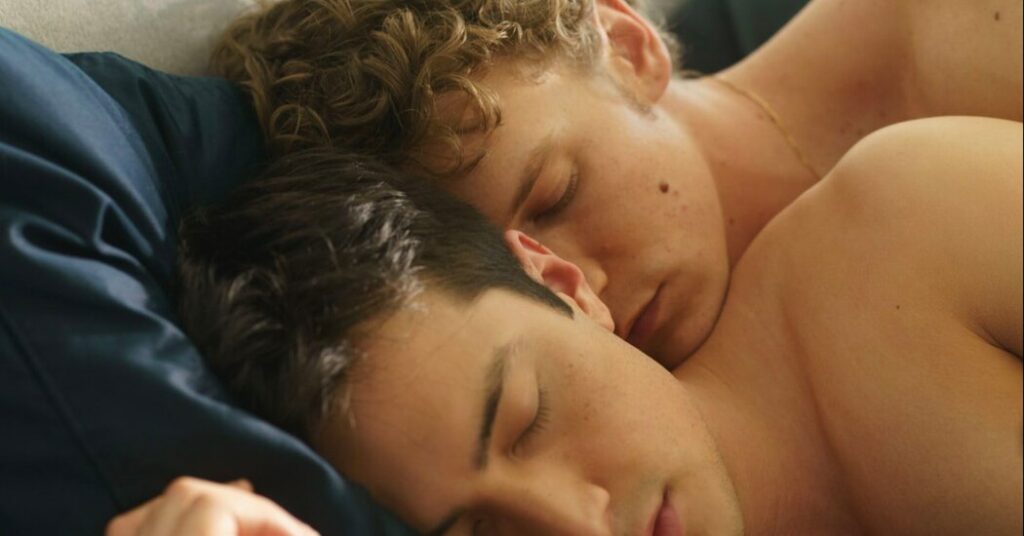
This is a bodily show, full of freckled backs and noses, shaved chests, and at least one posterior easily mistaken for a pair of blue-ribbon gourds. Ilya and Shane enjoy each other’s bodies in a way I haven’t experienced in something visually gay since the runners in Robert Towne’s “Personal Best,” from 1982. That movie must have a half-dozen moments of Mariel Hemingway and Patrice Donnelly really basking in each other’s physicality, what they know their bodies can achieve on a track, what they discover their bodies can do together. The hockey on “Heated Rivalry” justifies all the muscles and the single-digit body mass index. The rampant shirtlessness indicates dedication and strength, obviously. It also draws an alluring contrast with the show’s heroic belief in emotional nudity. There’s your porn.
I AM DEFINITELY going through something here. For years, I had been operating with the delusion that depicting gay men as regular, closet-free people living drama-less lives would be the ideal alternative to dying for love, dying of love, to gayness as a surer cause of death than any disease. Put friendship and jobs and downtime on a screen — HBO’s “Looking,” basically — and I’ll see me. Gay culture has lavished us with great expenditures of frolic and frippery and fluidity; of rage and risk and unruliness; of mystery and embattlement and the occasional titanic, polemic masterwork; of the “homosexual liberation” laid out in John Murphy’s 1971 manifesto, to tag just one. Rarely, though, are we invited to experience the comfort and safety of romance.
I think the culture’s going through something, too. The work is in progress. The work is progress. You can sense that in a newish movie called “Pillion,” about a young, meek British parking lot attendant who submits to an older motorcyclist’s commands — to cook his meals, to sleep at the foot of his bed, to anticipate his disrespect. It’s a beautiful movie that gets at the dynamic I’m trying to lay out: Abuse is the parking attendant’s true kink; he seeks it. But what the relationship helps him develop is self-respect. When he wants their vividly rough sex sessions to cease, he must say “I give,” meaning “give up,” “give over,” “give in.” What he learns is what I’ve come to accept, that we deserve to receive affection, too.
If my hunch is correct and “Heated Rivalry” is even loosely aware of itself as an antidote for a kind of cultural self-loathing, what should we make of its taking place in two sets of closets? At the show’s halfway point, we’re introduced to a surprise hidden relationship between a different hockey star, Scott, and the doting art history student he’s fallen for, Kip. The secrecy feels less like the prison it tends to be everywhere else and more like a source of incubation. The men who occupy it are devising and negotiating their way out of it; they’re looking for solutions for themselves, for emotional reinforcement. They have ideas, ideas that come from talking in this private laboratory that otherwise would be called the closet.
The talking is the strength of the show. On the one hand, big deal. Men have never been doing more talking. They’re talking so much that we now refer to that talking as the manosphere, meaning that the chat has achieved a degree of gaseousness that only earth science can name. What are they talking about? Sports, sure, gambling, dream money. Pizza, politics, the politics of pizza. But when men talk on “Heated Rivalry,” something is being risked. They dare to say what they desire. The pipeline from the heart to the mouth knows no traffic.
And the path to self-acceptance is the men’s business. But it’s the women in their lives who urge them to be true. Ilya and Kip have old female friends (Ilya still has sex with his). Shane tries dating a charming, famous actress. And after a few weeks together, her “uh-oh” sensors start blinking. But rather than berate Shane for wasting her time, she sits with him at a restaurant and all but treats him like a patient on her couch, insisting that they remain friends.
Women are facilitators of these men — love doulas, a friend called them. Stories of men secretly loving men typically proceed at the expense of a wife or a girlfriend. It’s a shock that no women are hurt in the making of all this love. In fact, each of them is vivacious, charismatic, interesting.
It is not a woman’s show. And yet they’re along for the ride; they want the riding done safely and with respect. The talking the men do here, and the smiling, dancing, hugging, spooning and thrusting, is speaking to women who perhaps need proof that tenderness still means something to a man. Every time I look into the face of some “Heated Rivalry” enthusiast, women mostly, what’s staring back at me isn’t a lot of ah-ooo-gah. (Although, the drool has been exhaustively inspected.) It’s not even amour. It’s an emotion infrequently billed as a reason to watch a show. What’s been staring back at me is a life response, a thank-God-I’m-in-here-instead-of-out-there-in-that-world response. It’s relief.
In here, compassion exists. Women matter. Men heed them. Men heed and check on and care for one another. The sex isn’t simply positive. It’s love’s gateway. Culturally, that felt new. I had been single for most of my adult life. I liked that, and liking it felt kind of political. Was the point of all this sex really a husband? No, dummy. And so what if it was?
Gay men, I have to remind myself occasionally, are also … men. My initial resistance to “Heated Rivalry” owed to something institutional that convinced me I don’t need to see all this love. Or, scarier, maybe I don’t deserve to see it. That’s not entirely right. Once more: I’m in love right now. With a man. So after my lifetime of watching men on screens do just about everything, I can see now that somebody missed a spot. I, at least, can’t recall being asked to watch a portrait of men falling in love with each other and staying there, staying alive in love, the way I actually am. It figures that I needed a woman — women — to lead me to the spot.
Wesley Morris is a Times critic who writes about art and popular culture.
The post I’m So Used to Gay Tragedies That I Almost Missed Romance appeared first on New York Times.