Paula J. Dobriansky is vice chair of the Atlantic Council’s Scowcroft Center for Strategy and Security and a former under secretary of state. Paul J. Saunders is president of the Center for the National Interest and publisher of the National Interest.
At January’s World Economic Forum in Davos, Switzerland, Canadian Prime Minister Mark Carney announced the collapse of the rules-based order. German Chancellor Friedrich Merz likewise declared at February’s Munich Security Conference that the rules-based “order, imperfect as it was even at the best of times, no longer exists.” Meanwhile, Secretary of State Marco Rubio, who led the American delegation in Munich, was more forward-looking, announcing a “new era in geopolitics” ahead of the trip and outlining a vision for a NATO that retains what works while adapting to new realities.
The United States is already moving to redefine the alliance on more sustainable terms, particularly on burden sharing and strengthening the defense industrial base. The outlines for a path forward are there, and many European leaders privately acknowledge as much. But convergence will come only if European allies focus less on the old order and engage seriously with the new one.
It’s worth understanding how NATO got here, because today’s tensions long predate the current administration. Two long-term drivers have brought the alliance to this point.
The first is China’s rise. China’s booming economy, soaring military spending, expanding nuclear arsenal, and rising self-confidence and assertiveness have been obvious since shortly after many in the West supported China joining the World Trade Organization in 2001 and opened their markets to Chinese exports. China used that market access to build an export-driven industrial machine that undercut Western manufacturers, gobbling up critical supply chains and converting the profits into military power. Regrettably, U.S. and Western policy largely failed to respond, leaving the United States and its allies economically dependent, disadvantaged and vulnerable.
The second driver is America’s frustration with the evident costs and less evident benefits of international leadership.
The United States and its allies created NATO to advance their shared security interests in facing the Soviet Union. However, America now sees China as its principal threat — and as not only a security threat, but also an economic threat. Yet U.S., European and Canadian economic interests do not overlap in the same ways, or to the same extent as their security interests have, now or in the past. Responses to China’s economic threat — such as efforts to rebuild domestic manufacturing — can quickly provoke disputes among security allies that are simultaneously economic competitors.
In Munich, Under Secretary of Defense Elbridge Colby aptly described NATO’s challenges and suggested a new basis for a revitalized alliance, which he called NATO 3.0. “Europe must assume primary responsibility for its own conventional defense,” he said.
It’s not just rhetoric. President Donald Trump’s Feb. 6 executive order “Establishing an America First Arms Transfer Strategy” fleshes out this approach. The order aims to ensure that U.S. arms sales support both America’s strategic interests and efforts to rebuild domestic arms manufacturing. It pursues these goals in part by giving priority to arms deliveries to countries that are investing in their own self-defense, are geographically critical or contribute to U.S. economic security. Countries like Poland, the Baltic states, Norway and Denmark — all spending above 3 percent of gross domestic product on defense as of June 2025 — stand to benefit, as do Finland, Sweden and Britain, which are spending significantly on new capabilities. The policy could also help Ukraine indirectly by accelerating deliveries to NATO countries that plan to transfer American weapons onward.
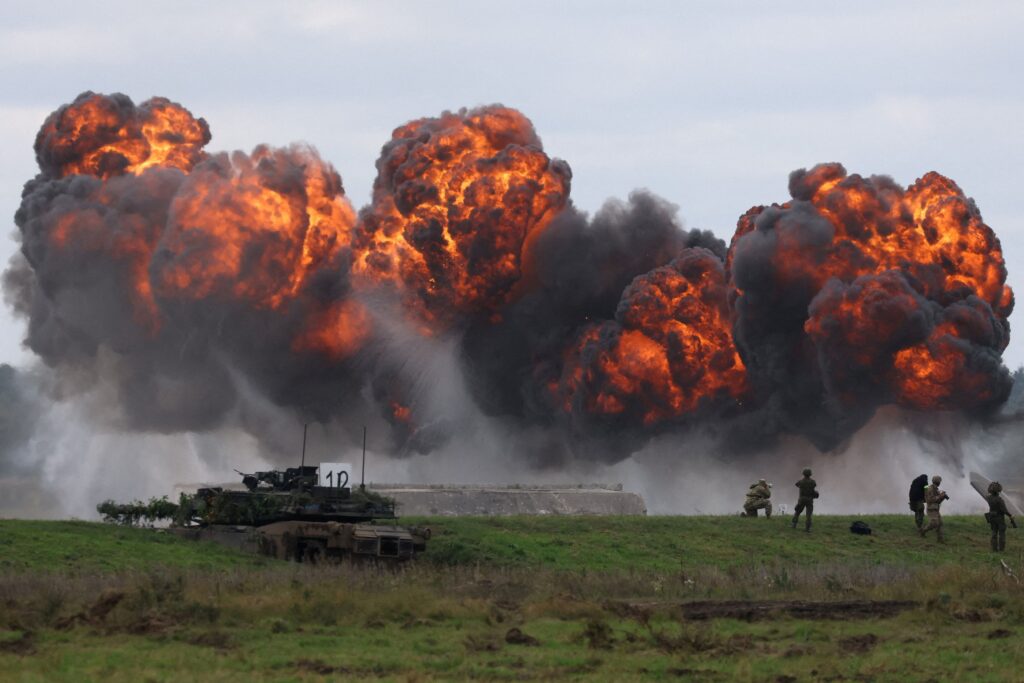
While its intent is to encourage allied investment in U.S. domestic defense manufacturing — an important goal — the Trump administration could also consider how allies could enhance U.S. economic security through co-production in their countries. Expanding U.S. defense firms’ operations in allied countries can serve American interests by generating additional revenue for U.S. manufacturers, driving down unit costs through greater scale and binding allies’ economic interests more tightly to America’s. An existing Abrams tank maintenance facility in Poznań, Poland, offers a ready-made opportunity to expand collaboration.
For far too long, NATO focused more on its size than on its purpose and capabilities. Trump has launched a series of necessary disruptions that, if successful, could sustain the alliance well beyond its 100th anniversary in 2049. It looks messy, but the outcomes could be profound. Getting there will take disciplined U.S. effort toward this new strategic vision — and European allies willing to match American ambition with their own.
The post How to make NATO great again appeared first on Washington Post.