India, the world’s fastest-growing large economy for four years in a row, released data on Friday showing that it expanded at a rate of 7.5 percent last year, driven in part by strength in manufacturing.
Many economists, and India’s government, had expected India to become the world’s fourth-largest economy in 2025, overtaking Japan in size. Instead, with the Indian rupee weak against the dollar and Japan’s yen relatively strong, India’s economy stayed a step behind when measured in dollar terms.
But in terms of growth, India far outperformed Japan, which grew only 1.1 percent in 2025. The three largest economies — the United States, China and Germany — all grew more slowly than India last year.
India became the world’s fifth-largest economy four years ago, pushing aside Britain, its former colonial ruler. The International Monetary Fund has projected that India will nudge past Japan in 2026.
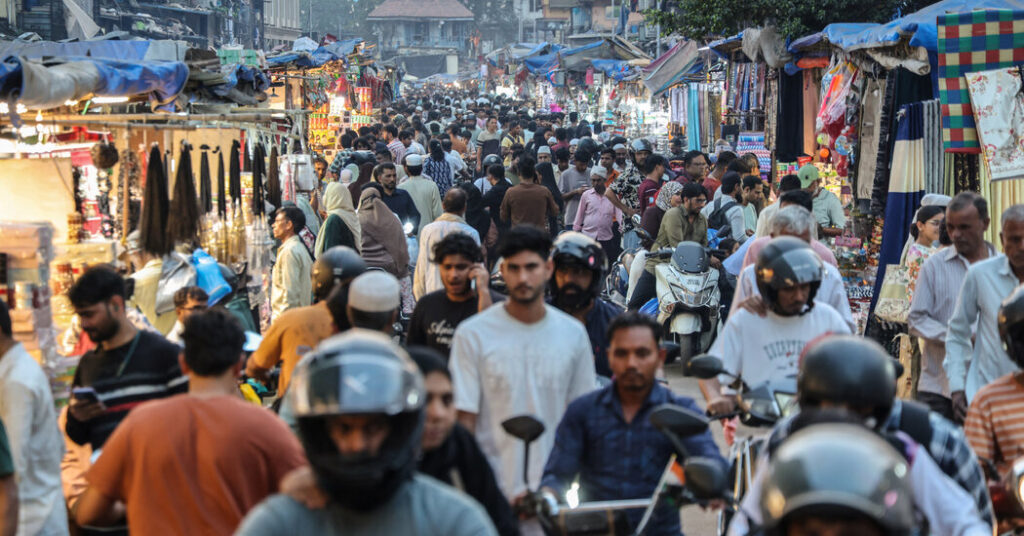
The strong growth last year underscores India’s place as one of the world’s most consequential centers of economic gravity, despite breaking every rule about how countries are supposed to modernize. Its rise up the league table of economies has given it geopolitical clout and drawn interest from investors. Yet, the shape of its progress is unique. With India’s economic power growing even faster than its population — now more than 1.4 billion people, larger than any other country’s — India is on a course all its own.
The country’s thousands of small businesses hire most of its workers, but an increasing share of growth has come from its biggest companies. Dynastic family firms play an outsize role at every scale, from conglomerates like Mukesh Ambani’s Reliance Group to industry-specific companies.
Sanjiv Bajaj, a scion of a 100-year-old family business with roots in the automotive sector, has had a ringside view of India’s growth. Mr. Bajaj, 56, split off the Bajaj group’s financial services operation from Bajaj Auto in 2007. Bajaj Finserv started with $550 million under management and now controls $53 billion. Its own market value has grown 377 times over.
Much of the company’s success can be traced to India’s policies to modernize technology. In the past decade, the government has pushed biometric IDs and digital payments, pulling a majority of India’s adults into the banking system. India’s own digital payments system now processes 20 billion transactions a month. Most amounts are tiny, Mr. Bajaj said, but the sheer size of the country’s population means that even small shifts in behavior turn into tremendous moneymaking opportunities.
All of that data, Mr. Bajaj said, “allows us to look at every small shop owner and see his inflows and outflows every day.” His company can now make lending decisions at an enormous scale, bringing millions of Indians into the formal credit system, he said.
Among the world’s economies, the United States and China are way ahead in terms of size, ahead of Germany, Japan and India, all in a tight cluster, by about four to six times.
India has been holding tight to its position as the fastest-growing large economy since 2021. With annual growth of more than 6 or 7 percent, it doubles in size every decade, while Germany, Japan and most other rich countries struggle to hit yearly growth of 2 percent.
Germany and Japan have over decades become manufacturing powerhouses that have lifted their populations out of post-World War II poverty.
India is still poor. The average Japanese income is 12 times the Indian average. The average German’s is 21 times greater. Indians on average have incomes of only about $2,900 a year, and the country’s top-heavy economy means most of its citizens make far less.
The contrasts can be shocking. In India, billions of dollars are being invested to build data centers, and airports are sprouting everywhere, even as about 800 million people depend on the government for free sacks of grain.
India’s inequality leaves most of a billion people in a state of subsistence, and it also hobbles the country as a whole. Social divisions deepen, it becomes harder to fund public health and education — and it gets much tougher for consumer-facing companies to turn a profit.
But for businesses like Bajaj Finserv, Mr. Bajaj estimated, the better-off 400 million Indians are a great opportunity in their own right. No other country except China has so large a group of consumers, he said.
Narendra Modi, India’s prime minister since 2014, said he intended to transform India into a fully developed country by 2047, the 100th anniversary of its independence. That won’t happen unless the country’s growth speeds up to the kind of pace China achieved earlier this century.
Since the Industrial Revolution, no other place has shot up the top-tier rankings except through the power of its factories. China, factory to the world, devotes 25 percent of its economy to manufacturing. When Mr. Modi announced a Make in India campaign in 2015, manufacturing accounted for 16 percent of the economy. Since then, it has fallen to 13 percent.
That is barely more than in the United States, which is called a postindustrial economy. As is the case in America, India’s economy is driven by its services, led by high-value work like chip design, computer engineering and office work for multinational companies, and powered by transportation and trade in goods.
The evolution of the Bajaj family business illustrates the point.
Bajaj Auto was much bigger than Bajaj Finserv when the companies split ways, but now the banking company is 50 percent larger. Finance, not factories, has been the hotter sector in India, as is in the United States.
But Bajaj Auto has also grown, in keeping with the industrial part of India’s economy. It produces 4.5 million motorcycles and auto rickshaws a year, nearly half for export to countries like Indonesia, Egypt and Mexico.
The mixed quality of India’s economy has helped it weather storms like the financial crisis of 2008, but it also made the country vulnerable during trade negotiations with President Trump. Focused mainly on serving its own immense population, India found itself without any bargaining chips in global supply chains.
The three cities in the world with the most skyscrapers under construction in 2025 were all in India. The tallest of those buildings however, the 56-story Palais Royale in Mumbai, is stalled, under construction since 2008. India is in a mode of making tall promises, and delivering on them sporadically.
“Directionally, India is in a very exciting place. It’s screwed up, sure, but we’re in a very interesting position for the next 10 to 15 years,” Mr. Bajaj said. Its young people, perhaps especially those from disadvantaged backgrounds, he continued, are “bright, and hungry,” and before long they will become part of the world’s third-largest economy.
River Akira Davis contributed reporting from Tokyo.
Alex Travelli is a correspondent based in New Delhi, writing about business and economic developments in India and the rest of South Asia.
The post How India Became One of the World’s Biggest Economies appeared first on New York Times.