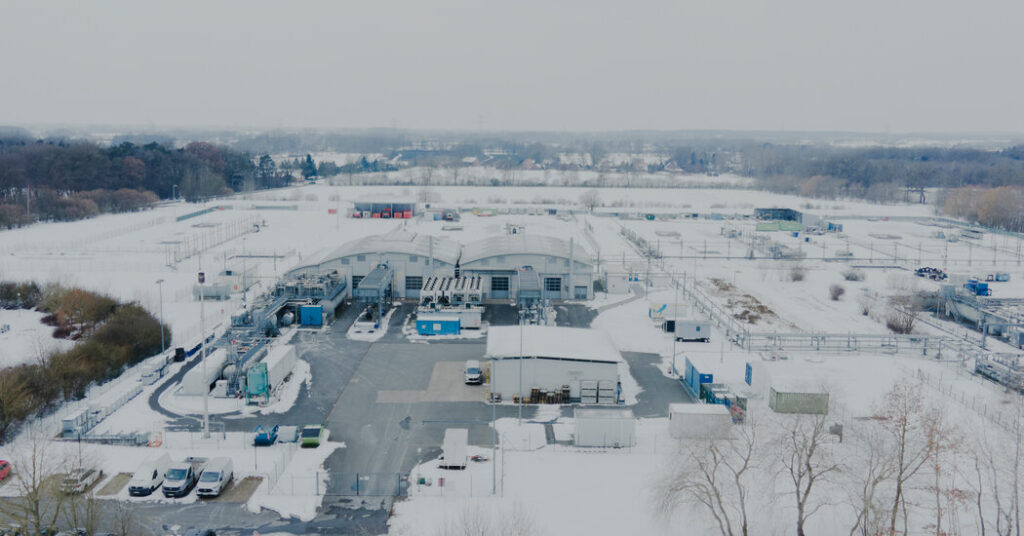
When technicians opened the valve on a deep and powerful new natural gas well on a recent snowy February day in Germany, it was a cause for celebration.
The well, in Georgsdorf, a village near Germany’s border with the Netherlands, completed the 230-million-euro Adorf natural gas field, a critical source of energy that will supply an estimated 300,000 households.
“Our job is to produce oil and gas, and this helps,” said Thomas Jürriens, an operations manager for Neptune Energy, one of Germany’s largest oil and natural gas producers and the developer of the site.
Germany is hungry for gas, which remains vital for heating, electric power generation and other industry. Domestic production like Neptune’s, though, can supply only a small fraction of these needs.
The country’s domestic oil and natural gas output is fading. Since 2000, natural gas production in Germany has fallen about 80 percent and now makes up only about 5 percent of demand.
Germany is among the countries in Europe most eager to phase out emissions-causing fossil fuels, but the petroleum industry has long been prominent in western Lower Saxony, the region that is home to the Adorf field. From the roads in the region, oil pumps can be seen bobbing like mechanical dinosaurs, sometimes even in the midst of houses.
Work on the wells is often parceled out to companies in the area, said Claus Griese, Neptune’s chief engineer, because they often offer lower prices and can react quickly when demand rises. That work has provided jobs for generations of residents like Mr. Jürriens, who started as a well controller in 1981.
Germany lost its main source of the fuel after Russia invaded Ukraine in 2022. Since then, Berlin has scrambled to replace those flows with natural gas piped in from Norway and liquefied natural gas, much of it from the United States.
The new era, though, has brought higher costs. Natural gas prices in Europe are trading almost 70 percent higher than before the pandemic, squeezing consumers and energy-intensive manufacturer, like steel mills and chemical plants, which are “really suffering,” said Tom Marzec-Manser, a gas analyst at Wood Mackenzie, a consulting firm.
Adding to the pressure, storage levels of the fuel in Germany, which influence the market, have fallen to just 21 percent, compared with about 40 percent a year ago.
Since the war in Ukraine, Germany has raced to bolster supplies including adding several terminals to import liquefied natural gas. So far, though, little effort has been made to increase domestic output, industry executives say. They blame aging fields for most of the decline, but societal antipathy to oil and natural gas and an accompanying tough regulatory environment also contribute.
Ludwig Möhring, chief executive of the BVEG, a mining industry group, said Germany and Europe had become more open to activities like producing rare earths. “When it comes to fossil fuels, that debate is different,” he said. “German policymakers are still hesitant to really push.”
For instance, some industry figures say shale gas drilling, which has greatly increased output in the United States, could be successful in Germany, but the fracking that is necessary to unlock oil and gas from the rocks has been banned for about a decade.
While Chancellor Friedrich Merz’s government, which took power in May, is “supportive of gas production, I wouldn’t say that we saw a huge difference to before,” said Claudia Kromberg, managing director of the German unit of Harbour Energy, an international oil and natural gas company based in London.
Bolstering domestic output would help ease what some Europeans say is becoming an overreliance on the United States for liquefied natural gas.
For now, German drillers seem to be content to keep a low profile. Ms. Kromberg said the role of the German branch of Harbour was “really to stay in our hubs and focus on those.”
Managing a declining resource is the theme at Harbour’s natural gas center off a country lane in Langwedel‑Holtebüttel, a village about a half-hour’s drive from Bremen.
Wells that feed the plant were drilled decades ago and have lost most of their pressure, said Daniel Richardson, Harbour’s production manager for the area. “Our job is to arrest the decline as much as possible,” he said, adding that the flows in some wells have become so weak that technicians have to shut them down “for the pressure to build back up again.”
Mr. Richardson and his team recently increased output by drilling a successful well at nearby Weissenmoor. He is skeptical, though, about investing in further exploration activity, saying that obtaining permits from the regulatory authorities takes years and that it is becoming increasingly difficult to secure petroleum services like drilling.
“Oil and gas production is to end by 2045 at the latest in the interests of climate protection,” Carsten Mühlenmeier, president of the state authority for mining, energy and geology, wrote in an email. “That’s not much time for a new oil and gas project.”
Despite obstacles, oil and gas activities in Germany can be profitable. In first half of 2025, for instance, Harbour’s German unit earned €39 million. And Neptune, using an industry metric, reported a profit of €230 million in 2024.
Andreas Scheck, Neptune’s chief executive, said that over his 30-year career, he had seen operating conditions in Germany become more difficult with regard to environmental protection and carbon dioxide emissions.
Neptune is owned by an investor group, which includes China Investment Corporation and Carlyle.
With growth in oil and natural gas looking unlikely, Mr. Scheck said the company was considering new energy activities.
For instance, the company is scoping out what it estimates could be a significant deposit of lithium, a chemical that is often used in batteries, in an existing gas field in eastern Germany. Mr. Scheck is also considering putting the company’s skills to work in tapping into the earth’s core for heat and energy.
What he calls “new energies” is what “we want to grow in the future,” he said.
Stanley Reed reports on energy, the environment and the Middle East for The Times from London. He has been a journalist for more than four decades.
The post Germany’s Oil and Gas Output Is Dwindling as Prices Rise appeared first on New York Times.