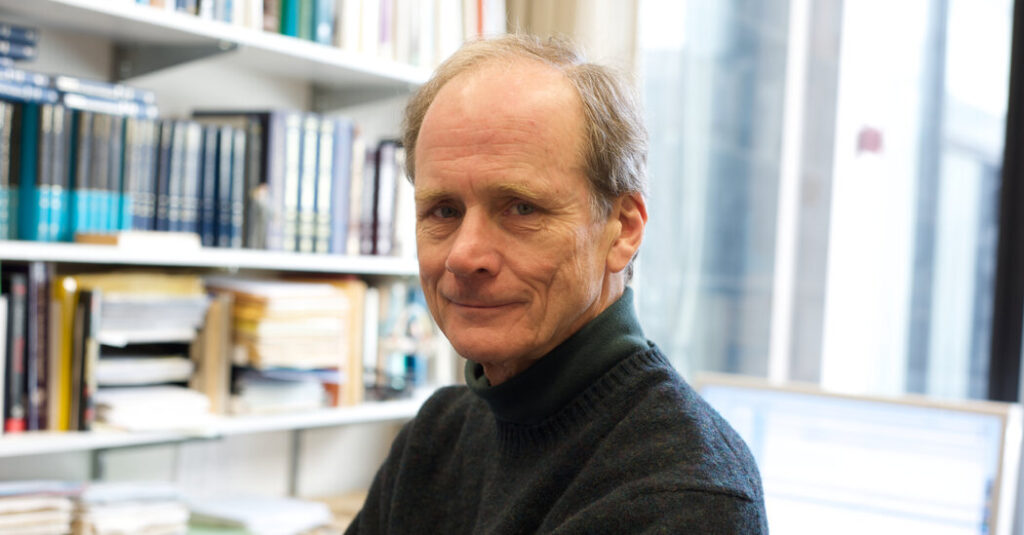
Edward L. Deci, a psychologist at the University of Rochester whose groundbreaking insights, with his colleague Richard M. Ryan, into what motivates people to do what they do — or not — helped revolutionize fields as disparate as the workplace, education, sports and marketing, died on Feb. 14 at his home in Rochester, N.Y. He was 83.
His nephew Brett Jensen said the cause was complications of dementia.
Working together in the late 1970s, Dr. Deci (pronounced DEE-cee) and Dr. Ryan came up with what they called self-determination theory, a cluster of ideas about motivation and agency based on the view that people are naturally curious and eager to grow, and that they flourish in situations in which they feel autonomous, connected and competent.
This may seem obvious today. But at the time, psychology was in the grips of behaviorism, an approach centered on quantifying human behavior, with an emphasis on measured inputs and outputs and a rejection of human agency and subjective concepts like well-being.
“Most psychologists don’t think about people as living entities,” Dr. Deci said in a 2011 video. “They think about them as machines.”
Motivation was seen then as a single force, a set of largely external carrots and sticks. But he and Dr. Ryan had a different perspective: They believed that there are various types of motivation, and that the particular type is the most important factor.
Dr. Deci demonstrated this point early on, in a set of experiments in 1971 that predated his work with Dr. Ryan.
In each experiment, a group of students was asked to perform a task that the members found inherently interesting: solving a three-dimensional puzzle, for example, or editing a newspaper.
They were then asked to do it again, this time for payment. In a third session, they performed the task once more, but now they were told that there would be no payment.
Dr. Deci found that the students in the third phase of the experiment were significantly less motivated to complete the task than those in a control group who had never received money.
He concluded that the introduction of external motivation had the effect of diminishing the students’ internal motivation, a finding that became a core element of self-determination theory.
“When we began to reward people for things they found interesting, they stopped finding it interesting anymore,” he said in the video. “This activity, which they used to find interesting and enjoyable, now they find it a route to getting the reward.”
In 1981, Dr. Deci and Dr. Ryan started the Human Motivation Program at the University of Rochester, where they applied their research to areas like education, health care and the workplace. They also looked at how to improve coaching in sports and how to better reach customers through marketing.
In 1985, they published “Intrinsic Motivation and Self-Determination in Human Behavior,” a book that introduced their work to researchers worldwide.
The two psychologists continued to develop their theory, arguing that there are three core human needs: autonomy, competence and relatedness to others. Only when those requirements are met, they said, can people feel a true sense of autonomous motivation. It was a message that would become foundational to modern industrial relations, teacher training and the self-help movement.
Yet another critical insight, in research led by Dr. Ryan, came with the notion of internalization. Not all autonomous motivation originates from within; it can be transmitted in the form of values, norms and an imbued sense of responsibility.
So, for example, they argued against bribing children to do the dishes or finish their homework. Instead, they advised parents to offer praise and explain why something should be done, so that children would feel empowered to make their own decisions. But don’t push too hard, Dr. Deci warned.
“Legitimize your child’s feeling about the activity, whatever that feeling might be,” he told The New York Times in 1990, for a column called Parent & Child. “If you try to convince children that something is interesting when it isn’t, you’re saying that their feelings don’t count.”
Edward Lenris Deci was born on Oct. 14, 1942, in Palmyra, N.Y., a small town east of Rochester. His parents, Charles and Janice (Upchurch) Deci, were managers for a company that made industrial seals.
He graduated with a history degree from Hamilton College, also in upstate New York, in 1964 and earned a master’s in business administration from the Wharton School in 1967. He received his doctorate in psychology from Carnegie Mellon University in 1970, the same year he began teaching at the University of Rochester.
Dr. Deci spent his entire career at Rochester, retiring in 2017.
Along with his nephew Brett, he is survived by a brother, Charles Deci Jr.; a sister, Shirley Jensen; and three other nephews, David Jensen and Freddie and Louis Deci.
In the summer of 1973, Dr. Deci took a vacation on Monhegan Island, a square-mile patch 10 miles off the coast of Maine, which was popular with artists like Edward Hopper, Andrew Wyeth and Rockwell Kent.
He fell in love with the place and returned every year for decades. But he was more than a summer visitor: He served as president and director of the Monhegan Museum of Art & History, expanding its collection to include work by many of the island’s best-known visitors.
“One of the things I understood,” he said in a 2019 interview for the museum, “is that if you are going to be a part of a community, you have to accept responsibility for doing something for that community to help it survive and thrive.”
Clay Risen is a Times reporter on the Obituaries desk.
The post Edward L. Deci, 83, Dies; Found Self-Determination as a Key to Happiness appeared first on New York Times.