Former President Bill Clinton said he “saw nothing” and did nothing wrong when he associated with Jeffrey Epstein decades ago, as he sat for hours of closed-door questioning on Friday by the House Oversight Committee.
Mr. Clinton’s sworn deposition made him the first president in history to be forced to testify before Congress against his will. His appearance reflected how Republicans in Congress have shifted the focus of their investigation into Mr. Epstein, the disgraced financier and convicted sex offender, away from President Trump and prominent Republicans who associated with him and toward Democrats.
The former president was by far the most prominent figure in American politics so far to be questioned in the House inquiry, which began last year when Democrats and a small group of Republicans effectively forced the G.O.P. to look into a matter that Mr. Trump had made clear he would rather move past.
But as he settled in for questioning at the Center for Performing Arts in Chappaqua, N.Y., near his home, Mr. Clinton struck a far more compliant tone than his wife, Hillary Clinton, had a day earlier, when she was defiant about being compelled to testify about a man she said repeatedly she had never met.
In an opening statement that he posted on social media, Mr. Clinton acknowledged that he had a relationship with Mr. Epstein and that he was willing to answer questions about it. But he insisted that he never knew about Mr. Epstein’s crimes and cut off his association with him long before his first guilty plea on sex crimes charges.
“I saw nothing, and I did nothing wrong,” he said. “Even with 20/20 hindsight, I saw nothing that ever gave me pause. We are only here because he hid it from everyone so well for so long.”
The one note of pique in Mr. Clinton’s comments related to how the committee had treated his wife.
“You made Hillary come in,” he said. “She had nothing to do with Jeffrey Epstein. Nothing.”
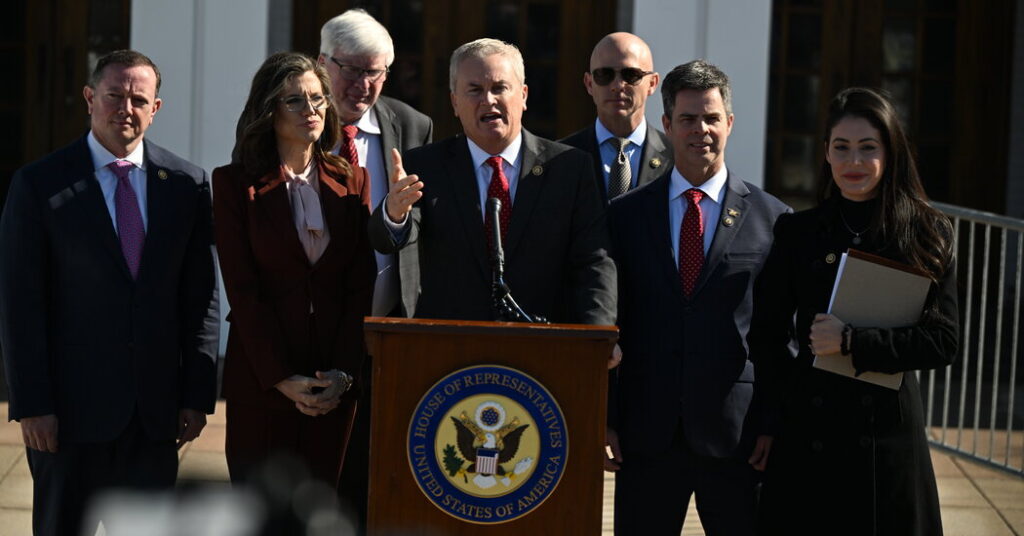
Representative James R. Comer of Kentucky, the committee’s chairman, began the day by crowing about having finally wrestled the Clintons into cooperation after months of resistance.
He said that his panel was bringing “some of the most powerful people in the world” to testify in the Epstein investigation. He also said that he intended to grill the former president about visits that Mr. Epstein made to the White House while Mr. Clinton was president, as well as photographs of the two men together that were released by the Justice Department.
“There are a lot of photos,” Mr. Comer said.
At the White House, Mr. Trump — who also had a yearslong relationship with Mr. Epstein and appears in many photographs with him — was less than enthused to see Mr. Clinton hauled in.
“I don’t like seeing him deposed,” he told reporters. “I like him, and I don’t like seeing him deposed.”
House Democrats who participated in the deposition said that when the transcript and video of the session were released, their tough questions would prove to the public that they were treating the investigation in a nonpartisan fashion. But many of them said they felt they were questioning the wrong president, and sought to use Mr. Clinton’s appearance to ratchet up pressure on Mr. Trump to testify.
Representative James Walkinshaw, a Virginia Democrat, told reporters that the investigation would not be complete until the current president appeared before the committee, too.
“A new precedent has been set in America today,” said Representative Ro Khanna, Democrat of California. “Now we have the ‘Clinton Rule,’ which is that presidents and their families have to testify when Congress issues a subpoena.”
During a break after about three hours of questioning, Mr. Comer emerged to push back on those calls. He told reporters that Mr. Clinton had demurred when Democrats asked if he believed that the current president should testify.
“That’s for you to decide,” Mr. Clinton replied, according to Mr. Comer, who added that the former president said he had never seen anything to make him think Mr. Trump was involved with Mr. Epstein. House Democrats disputed that account and reiterated their call to release a full transcript to clear up any confusion.
Some Republicans commended Democrats for their tough lines of questioning.
Representative Nancy Mace, Republican of South Carolina, wrote on social media that a Democratic colleague with whom she often clashes, Representative Melanie Stansbury of New Mexico, “showed courage and bravery today in her questioning of President Clinton.”
The Clintons fought for months to block subpoenas they called invalid, unenforceable and politically motivated. They ultimately capitulated to Mr. Comer’s demands that they testify after some Democrats on the Oversight Committee voted with Republicans to hold them in contempt of Congress if they failed to do so.
But any resistance by Mr. Clinton appeared to have been shelved by Friday during the deposition. Democrats and Republicans alike said he delivered long, deliberate answers to their questions. That stood in contrast to their experience with Mrs. Clinton, who remained vexed at having to participate throughout a session where Republicans appeared to run out of things to ask her.
“I don’t know how many times I had to say I did not know Jeffrey Epstein,” she told reporters after the session ended. “It’s on the record numerous times.”
Mr. Clinton, by contrast, did have a relationship with Mr. Epstein.
Mr. Epstein was a Clinton donor who visited the White House several times from 1993 to 1995, the year his main contact point, an aide named Mark Middleton, left the administration. Files recently released by the Department of Justice revealed that the first known complaint to the F.B.I. about Mr. Epstein’s conduct related to girls came in 1996, but it would take another decade before investigators began scrutinizing his predatory behavior.
Asked whether Mr. Clinton was aware of that complaint, Angel Ureña, a Clinton spokesman, said that “it would not have risen” to the level of the president. “Before this White House started telling the F.B.I. what to do,” there “was a firewall between law enforcement and the president,” he added.
In the early 2000s, after he left office, Mr. Clinton grew closer to Mr. Epstein and Ghislaine Maxwell, Mr. Epstein’s companion at the time, as he was courting donors for his post-presidential ventures. Ms. Maxwell played a substantial role in supporting the creation of the Clinton Global Initiative, a signature post-White House endeavor. Mr. Clinton has said he stopped speaking with Mr. Epstein sometime before his 2006 indictment.
Danny Hakim contributed reporting.
Annie Karni is a congressional correspondent for The Times.
The post Bill Clinton Testifies He ‘Saw Nothing’ of Epstein’s Misdeeds appeared first on New York Times.