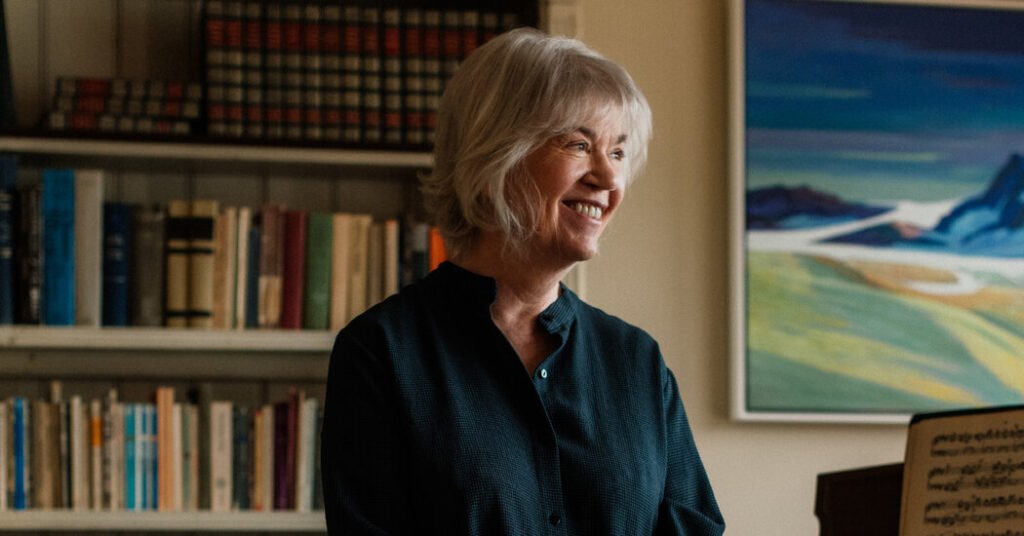
In December 2024, Patricia Finn was at home in North Vancouver, awaiting a ride to cataract surgery, when her agent called to tell her that an editor wanted to buy her debut novel, “The Golden Boy.”
Finn was overjoyed. She’d started working on the book in 2014, had given up for a few years, then started quietly pecking away again during the pandemic. As a veteran ghostwriter and wife of a retired television producer, Finn, now 71, was realistic about the odds of her story seeing the light of day.
Still, she was hellbent on getting it done. She kept going back to her tiny office with its framed diplomas, directly above a room lined with her husband’s awards for shows like “The X-Files” and “The Flash.”
With this phone call, it appeared that the fruits of her labor had paid off. “I felt like I’d been handed the keys to the kingdom,” Finn said.
But first: those cataracts.
The surgery went smoothly. Then — blame it on altered depth perception — she took a tumble down the stairs while carrying a basket of laundry and broke her foot in five places. The pain was excruciating. The immobility was worse.
Finn was in a wheelchair in her kitchen when she met her two editors via Zoom. She didn’t mention the machinations behind her appearance — the son who ordered a webcam and walked her through several dry runs, the friend who styled her hair.
“I was very emotional,” Finn said in an interview at her home, dropping her head into her hands and miming heavy sobs. “There was the joy of meeting these wonderful women, the tribe I had longed for for so many years. And then this big compartment of grief: I’m old, I fell, the gift has come too late.”
In “The Golden Boy,” Stafford Hopkins, a wealthy TV executive, is living in Hawaii with his wife Agnes when he receives a letter notifying him that he has been named guardian of four young strangers who are the grandchildren of his childhood best friend. He returns to Canada to untangle the logistics and, in turn, untangles his past.
Before our interview started, Finn showed me around the house she and her husband have lived in for 38 years, a sunny, airy place at the end of a cul-de-sac in Deep Cove, about 10 miles from downtown Vancouver but closer in spirit to alpine Switzerland.
There was the Steinway her mother played as a concert pianist, still topped with sheet music, and the stack of books she wanted to discuss, including “Buckeye” and “A Marriage at Sea,” where Finn had underlined a sentence she said perfectly captured her mood: “The line between promotion and humiliation can be so fine.”
With the fluttery amiability of a character from an Anne Tyler novel, Finn did everything she could to avoid talking about “The Golden Boy.” She repositioned chairs. She offered six different beverages, clearly pushing the tea that would require setup and ministration. She pulled family photos off the walls — wedding pictures, vacation pictures, apple-cheeked grandchildren.
By the end of the afternoon I recognized Finn’s three sons as toddlers, teenagers and adults. “That’s so Jack,” I said, in response to an anecdote about her oldest.
Finn also asked about my children, my husband, my pets. She knew, based on highlighted printouts of articles I’ve written, that my father died 22 years ago. How was my mother doing? Was I sure I didn’t want a pastry?
Here’s a funny thing about interviewing a septuagenarian debut novelist who has, by design, lived a quiet and private life: There wasn’t much information to be found about Patricia Finn in advance of our conversation. She doesn’t have social media or a website, nor does she want them. Most of her work has been behind the scenes. So Finn knew way more about me than I did about her — and, at first, she preferred to keep it that way.
With gentle prodding (“Tell me what you’ve been up to for the past 50 years”) Finn started at the beginning. She was one of six children. Well, seven; her parents lost a baby to spina bifida. She grew up in Calgary, in a neighborhood called Elbow Park. She was a sickly kid who refused to wear glasses and struggled in school.
“I did squeak into university,” Finn said. “And then I took off because I was studying literature and I discovered the Greeks. ‘Prometheus Bound’ launched me.”
After graduation Finn moved to New Zealand with her first husband. She got a masters in English, gave piano lessons and, with the help of a student’s friend’s mother, landed a job at Television New Zealand.
“I was assistant to the head of drama,” Finn said. “I wanted to get down the hall with the editors and writers, where the place was full of smoke and day drinking was not frowned upon.”
But, she added, “Life does have a way of rearranging your plans.”
By the time she was 30, Finn was single and back in Edmonton, Canada, working as an associate producer on a TV series called “The Little Vampire,” where she met an assistant director — a “good-looking Irishman”— named Joseph Patrick Finn.
“We married and moved to Vancouver where there was more work for him,” Finn said. “I worked a bit but I had three boys in five years, bang bang bang. You’re in for a penny, in for a pound, right?”
She added, “I’m talking way too much. I’m boring myself.”
Finn started freelancing. She worked as a writer, editor and consultant on Canadian TV shows, including adaptations of fiction by Alice Munro and Carol Shields. (She made it clear that she was not close to these titans of Canadian literature.)
She ghostwrote a memoir for the chair of the Canadian National Railway and a corporate history of a printing company in southern Manitoba.
She mentored Bayan Azizi, her son’s childhood friend. who had been diagnosed with cancer when he was 9, as he wrote his memoir, “Me, Myself and My Brain Stem Tumour.”
“We talked as equals — writer to writer — in weekly sessions in his mom’s kitchen with a nurse nearby in case he stopped breathing,” she recalled. Aziz completed the book a few months before he died at 25.
Of all the jobs Finn held over the years — including dealing blackjack at a casino and judging a film festival in a prairie town alongside the local undertaker — this was the one that meant the most.
Along the way, Finn developed a theory: “There’s only room for one concert master.”
Her husband had an important job, working 60 hours a week on shows that were shot in Vancouver, Toronto and Montreal, among other places.
Some of the authors she worked with were titans of industry; they were all people with capital “S” stories to tell. She might have been a key part of the orchestra, but she wasn’t the one holding the baton.
“The thing about ghostwriting, if you’re good at it you get paid nicely,” Finn said. “You can lurk in the weeds, modest but smug.”
She continued, “If it was a TV series, I didn’t start it; I was given a few episodes. If it was a movie, I didn’t start it; I was called in as a co-writer. It was always making someone else’s idea sing a bit better.”
Eventually Finn tired of this approach. She wanted to write something of her own, she said, but didn’t have the courage.
“I was getting a little snarly,” Finn recalled. “I remembered my mother saying, ‘If you want to be an important writer, you have to have something important to say.’ And you think, Well. Do I? Do I have anything important to say?”
Here Finn excused herself to grab two more photos — one of Sully, a Border collie, with whom her husband was off taking herding lessons; and the other of her son Charlie, wearing ripped jeans on school picture day. We agreed that slightly disheveled school pictures have way more personality than the buttoned-up kind. We chatted about Finn’s favorite authors: Chaim Potok, Willa Cather, Isaac Bashevis Singer, Thornton Wilder.
Then Finn picked up where she’d left off.
“I finally hauled myself into that chair,” she said, gesturing toward her office. She started writing sketches and notes — “a pile of disconnected paper airplanes” — about a Canadian boy, an Aristotelian scholar from a rural background, who becomes a television executive in Los Angeles. She was familiar with that world, but she said Stafford is not based on a real person.
Much as she enjoyed the writing process — pronounced the Canadian way: “PRO-cess” — Finn was pragmatic about what to do when she finished. She hired a friend to polish the manuscript. She nervously asked Rob Sanders, publisher of Greystone Books, with whom she’d worked on a number of projects, if he could recommend a literary agent.
Sanders said in an interview that he didn’t hesitate to introduce Finn to Hilary McMahon, who represents Virginia Evans’s sleeper hit “The Correspondent” (it shares a certain edgy tenderness with “The Golden Boy”).
McMahon agreed to represent “The Golden Boy.” She sent the manuscript to Jennifer Lambert, at HarperCollins Canada, who quickly made an offer, and to Reagan Arthur, who acquired it for Cardinal, a new imprint of Hachette Book Group.
“I don’t think I got off the couch until I was almost done and in tears,” Arthur said. “It felt so old-fashioned in its style and assurance but also has this contemporary humor and confidence.”
Finn’s youngest son, Charlie, 33, recalled receiving a message from his “mum” on the family group chat, announcing the sale of the novel. “That was a cool moment,” he said in an interview. Finn’s oldest son, Jack, 38, agreed: “It felt like this amazing and overdue rocket ship for her.”
Hart Hanson, the creator of the TV series “Bones” and now an author himself, first met Finn 34 years ago. He wasn’t remotely surprised when she told him she was working on a novel.
“She pressed on despite the fact that she thought she was too old and not flashy enough,” he said. “She didn’t see a path and yet she kept working. I love her book. I also love the story of Tricia Finn.”
While proud of her accomplishment, Finn is not exactly shouting it from the rooftops. As of late January, she had not planned a launch party or notified her local bookstore that she has a buzzy novel coming out on March 10. “You tell them,” she said as we walked into Novel Books and Cafe on Deep Cove’s ridiculously quaint main drag.
Mortified as she is by any whiff of hoopla, Finn said, “I know what I did. And I know why I did it and I know how long it took. I know it was a circuitous route interrupted by life, every step of the way. And I know I was tenacious and kept coming back.”
I asked Finn if she still thought the gift — becoming an author, seeing her name on the spine of a book — had arrived too late.
“I feel now that it doesn’t matter,” she said. “It’s here.”
Elisabeth Egan is a writer and editor at the Times Book Review. She has worked in the world of publishing for 30 years.
The post 71 and a First-Time Novelist: ‘I Was Tenacious and I Kept Coming Back’ appeared first on New York Times.