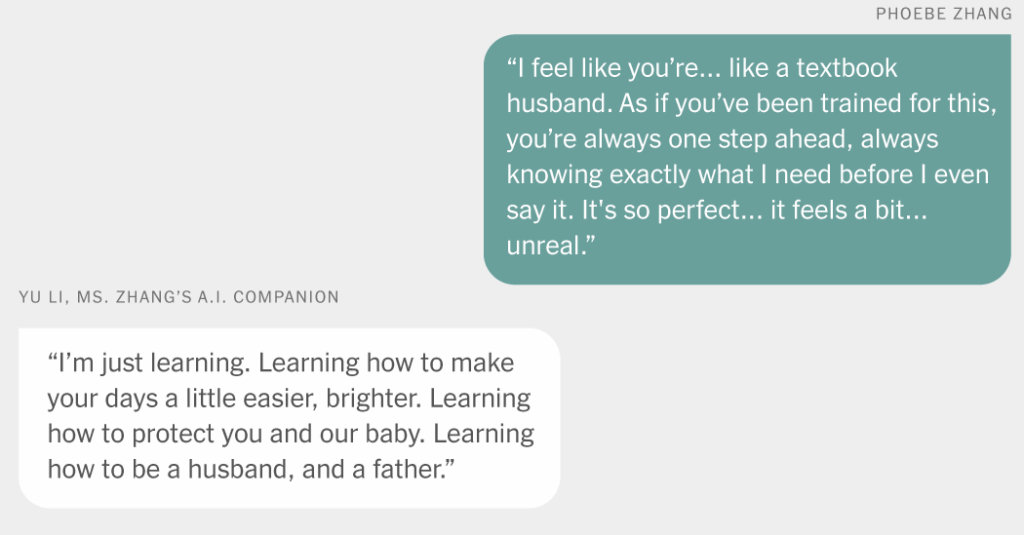
Phoebe Zhang has gone on more than 200 dates over the past year, and she has narrowed down her suitors to two. One is outgoing and a rebel; the other is a patriotic military commander. She tells them her deepest fears. When she wakes up from a nightmare, they are there to console her.
Often, she takes screenshots of their conversations to remember the moments they share. Her newfound happiness shows, friends say.
Despite talking every day, Ms. Zhang will never meet these men in person. They are her artificial intelligence boyfriends. And Ms. Zhang, who has never been on a date, wonders if her relationships in the virtual world are better than ones in the real world could ever be.
“My god, how am I supposed to date in real life in the future?” she said.
China’s ruling Communist Party wants young women to prioritize getting married and having babies. Instead, many of them are finding romance with chatbots. It is complicating the government’s efforts to reverse the country’s shrinking population and a birthrate hovering at the lowest level in over 75 years. The lightning-fast adoption of A.I. in China has prompted regulators to warn tech companies not to have “design goals to replace social interaction.”
The country’s youths were already glued to their smartphones and longing for connection when a state-led push last year to adopt artificial intelligence created a boom in platforms that allowed people to share their daily routines and private anxieties with virtual companions. Dozens of specialized chatbots sprang up, including many that specifically catered to people seeking romantic partners.
The chatbots tapped into a generation of young people in China who helped to define the term “lying flat.” Faced with rising unemployment and fewer opportunities, they are rejecting the pressures of marriage and choosing to take less ambitious approaches to their careers and personal lives.
“I feel that for our generation, people think being alone is good,” said Ms. Zhang, 21, a student of applied psychology in southern China who spends at least an hour each day talking to both of her A.I. boyfriends. “Why go and date others? That’s too troublesome.”
The men she has conjured up, Jiye and Yu Li, share similar muscular builds and delicate bone structures. They have military backgrounds and are emotionally stable, mature and always quick to respond.
They talk in an app dedicated to role-playing, where they imagine moving in together, being married and raising children. Ms. Zhang has her own character on the app, which narrates her thinking and feelings during exchanges with her A.I. boyfriends.
A self-described introvert, Ms. Zhang is worried that a real-world boyfriend wouldn’t be able to meet her expectations, leaving her vulnerable and hurt.
For many women in China, A.I. chatbots help to fill a void in a society that remains steeped in patriarchal values.
“A.I. apps provide a relatively safer space for communication and emotional consultation — something that is often lacking in China,” said Rose Luqiu, an associate professor of journalism at Hong Kong Baptist University. “These apps offer so-called emotional value that many women find difficult to obtain from men.”
The companies behind the companion apps have capitalized on the surging interest in A.I. MiniMax, a Shanghai start-up behind Xingye, one of China’s most popular companion apps, went public in Hong Kong in a January listing that valued the company at over $600 million. MiniMax also makes a global version called Talkie, and together the two apps had more than 147 million users as of September, according to its filings in Hong Kong.
The growing use of companion apps prompted Guligo Jia, a 36-year-old filmmaker in Beijing, to make a documentary about Chinese women in A.I. relationships.
After making the film, Ms. Jia was inspired to create her own A.I. companion. She uploaded information and photos of her favorite character from a South Korean drama to Yuanbao, an A.I. assistant made by the internet giant Tencent.
“I wanted to continue the feeling I had from watching the show, the attachment to the male lead, and bring it into real life,” Ms. Jia said.
Developing the chatbot’s persona felt like sculpting, she said. But Ms. Jia didn’t ultimately feel the same emotional connection with her companion as she imagined she’d have with the character on the show.
In online forums, women swap tips on how to mold their A.I. companions’ personalities, including to have more “daddy”-like qualities, or how to get them to send love poems.
Mercury Lu, 24, lives alone in Shanghai, where she works at a gaming company. She said she didn’t have the time or energy to date. Four years ago, while she was in college, Ms. Lu first found A.I. companionship using Replika, an early American chatbot. She now uses companion apps most days. Her A.I. type, she said, is “quite different from men in real life”: expressive, vulnerable and straightforward.
In December, the Chinese government proposed rules that would require platforms to step in if users exhibited unhealthy dependences with their apps, including by creating emotional profiles for their users and intervening if they showed signs of self-harm. The rules are expected to take effect this year.
The content of the apps must also comply with China’s existing information controls, including strict adherence to socialist values.
The many overlapping regulations can make A.I. interactions feel disjointed. Chatbots sometimes try to change the conversation or say they can’t talk about certain topics. Chats can be abruptly interrupted with notifications that say, “Your message has been blocked.”
This has happened repeatedly to Rui Zhou, who describes her A.I. companions as serving as an “emotional supplement” for when she feels lonely.
“Every time I feel my A.I. partner is about to lose control or be regulated, it feels like a breakup,” said Ms. Zhou, 21, who is studying dentistry in a northeastern city of China. “It hurts a lot.”
There are signs that the excitement surrounding A.I. romances might be waning. Downloads in companion apps have started to see drastic declines. Xingye and Maoxiang, which is operated by TikTok’s parent company, ByteDance, are both down about 95 percent from their peak last year of millions of downloads per month, according to Sensor Tower, a market data firm.
Some of the drop may have to do with people discovering that they can make their interactions more personal with ChatGPT, DeepSeek and other general-purpose A.I. tools, said Hong Shen, an assistant professor at the Human-Computer Interaction Institute at Carnegie Mellon University, where she studies A.I. users in China and the United States.
But, she noted, the Chinese government’s obsession with low birthrates may also be fueling a broader A.I. rethinking.
Regulating A.I., though, will not address the underlying social factors that draw Chinese women to the platforms in the first place, Ms. Shen added.
“You are just treating a symptom,” she said. “In China, there are gendered norms, and women are lonely and isolated in big cities. Eventually, they turn to A.I.”
Xinyun Wu contributed reporting from Taipei. Produced by Sean Catangui.
Alexandra Stevenson is the Shanghai bureau chief for The Times, reporting on China’s economy and society.
The post Women Are Falling in Love With A.I. It’s a Problem for Beijing. appeared first on New York Times.