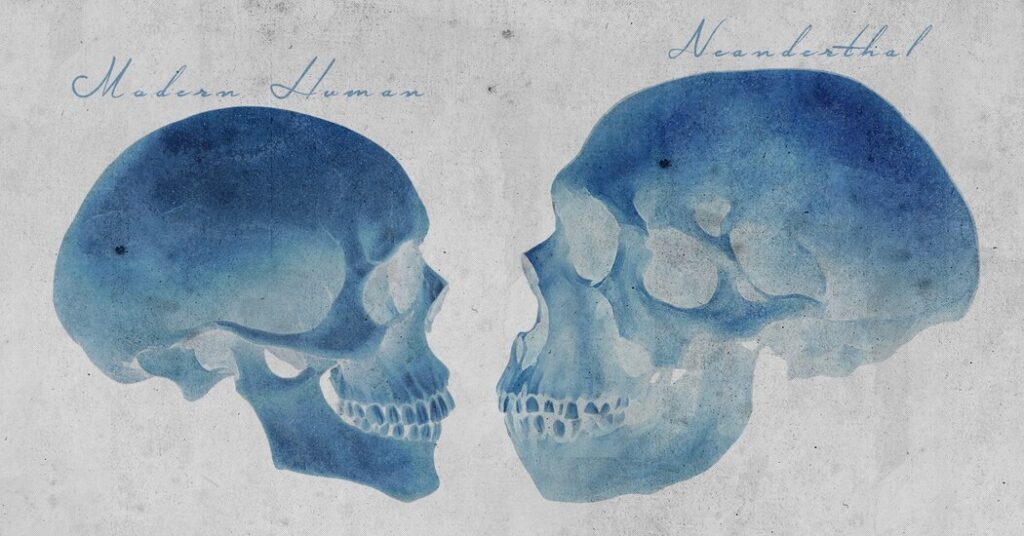
One of the biggest discoveries about human evolution in recent decades is that, tens of thousands of years ago, Neanderthals and modern humans interbred. As a result, most people alive today carry a bit of Neanderthal DNA in their genome — and that residual DNA, in turn, is giving scientists a detailed look at the ancient sexual encounters that put it there.
In a study published on Thursday in the journal Science, a team of researchers report that men with a lot of Neanderthal ancestry and women with a lot of modern human ancestry had a strong preference to mate with each other. Maybe modern human women found something especially attractive about men with a lot of Neanderthal DNA, or vice versa. Or maybe the two groups were equally attracted to each other.
However it played out, the preference was intense. “You need a strikingly strong phenomenon to get us there,” said Alexander Platt, a geneticist at the University of Pennsylvania and an author of the new study.
April Nowell, a paleoanthropologist at the University of Victoria in British Columbia who was not involved in the research, praised the study for using DNA to uncover details of our ancestors’ intimate lives. “We are learning so much in the labs these days about the behavior of Neanderthals,” she said, “things that just wouldn’t preserve in the archaeological or fossil record.”
Scientists first extracted bits of Neanderthal DNA from fossils in the 1990s. Since then, the data has brought the history of Neanderthals and ourselves into sharper focus.
Both groups of humans descend from a population that lived in Africa roughly a million years ago. By about 600,000 years ago, the Neanderthal lineage split off and expanded out of Africa. Neanderthals endured across Europe and western Asia until about 40,000 years ago.
In the meantime, modern humans continued living in Africa. About 250,000 years ago, one group moved off the continent and interbred with Neanderthals. Fossils of later Neanderthals retain bits of DNA from that initial wave of emigrant Homo sapiens. This indicates that hybrid children from those encounters were raised in Neanderthal societies and later passed down their genes.
At some point, those first-wave Homo sapiens died out. But 50,000 years ago, a new wave of modern humans expanded out of Africa. They also interbred with Neanderthals, about 46,000 years ago, and continued to expand — ultimately around the world, carrying Neanderthal DNA with them. Today, the DNA of people with ancestry beyond Africa is up to a few percent Neanderthal.
Over the generations, the Neanderthal DNA in modern humans has been reduced to tiny fragments, which differ from person to person. Some of those fragments have disappeared altogether. It’s possible that many vanished because they were useless or even harmful and were not passed on for long.
Puzzlingly, our X chromosome — one of the two chromosomes that help determine the sex of an embryo — has far fewer fragments of Neanderthal DNA than other chromosomes. For their new study, Dr. Platt and his colleagues wanted to understand why. What they found surprised them.
Every human embryo inherits two sex chromosomes, X or Y, one from each parent. An embryo with two X chromosomes becomes female, and an X and a Y leads to males. Mothers pass down only X chromosomes, whereas fathers pass down either an X or a Y.
Dr. Platt’s group wanted to see how the X chromosome of Neanderthals had changed after interbreeding with humans 250,000 years ago. It was possible, they reasoned, that Neanderthals would turn out to have had little modern human DNA in their X chromosome. Maybe the modern human genes on the X chromosome proved harmful, and hybrid children who inherited them didn’t survive to pass them on.
But oddly, they discovered just the opposite: Neanderthal X chromosome carried much more modern DNA than other chromosomes did, not less.
The best explanation, Dr. Platt and his colleagues concluded, was that Neanderthals and modern humans had strong preferences about whom they had sex with. In particular, Neanderthal men in Neanderthal societies may have had a strong attraction to hybrid women — that is, to women with a modern human parent or grandparent. As a result, the women would have passed on their modern human X chromosomes to the Neanderthal population. Over generations, the Neanderthal X chromosome would have accumulated DNA from modern humans.
The same attraction may have had the opposite effect in societies of modern humans who left Africa 46,000 years ago. Modern human women may have preferred men with Neanderthal ancestry — but those men could pass down a Neanderthal X chromosome to only half their offspring on average. So over time, the X chromosomes of modern humans carried ever less Neanderthal DNA.
Joshua Akey, a geneticist at Princeton University who was not involved in the study, said that it was a remarkable example of ancient DNA shedding light on ancient behavior. “I wouldn’t have thought that was possible when I started doing this work in graduate school,” he said. “This study pushes us in a new direction.”
Benjamin Peter, a population geneticist at the Max Planck Institute for Evolutionary Anthropology in Leipzig, Germany, expressed caution. What looks like a striking feature of the X chromosome might be a mirage produced by the statistical methods that the scientists used in the study.
“It’s a very clever argument,” he said. “But the big unknown for me is, ‘Are there any technical artifacts that could also cause this pattern?’”
The findings, if they hold up, don’t clarify what sort of mating preference was at play. Conceivably, Neanderthal men used violence, even raiding other groups for women. But Dr. Nowell was skeptical of such explanations.
“It is a possibility, but we don’t have any thing in the archaeological record that would support that,” she said, noting a lack of evidence for violence between groups of humans 50,000 years ago or 250,000 years ago.
Instead, she raised the possibility the mating preferences of women were at work.
“Biologically, females of a species are considered to be the ‘choosy sex’ when it comes to sexual selection,” Dr. Nowell said.
Rebecca Sykes, an archaeologist at the University of Cambridge, noted that few fossils or archaeological remains exist from 250,000 years ago that could bolster the DNA findings. Archaeologists have unearthed much more from humans living 50,000 years ago, but no site offers definitive clues to the mating habits of humans and Neanderthals — or how interbreeding affected their social lives.
“We still do not have a cultural signature for a hybrid social population,” Dr. Sykes said.
But she held out hope that new evidence — in the form of skeletons, tools or ancient DNA — might let archaeologists test the ideas that Dr. Platt and his colleagues are putting forward.
“One find can genuinely make an enormous difference,” Dr. Sykes said.
Carl Zimmer covers news about science for The Times and writes the Origins column.
The post What Your DNA Reveals About the Sex Life of Neanderthals appeared first on New York Times.