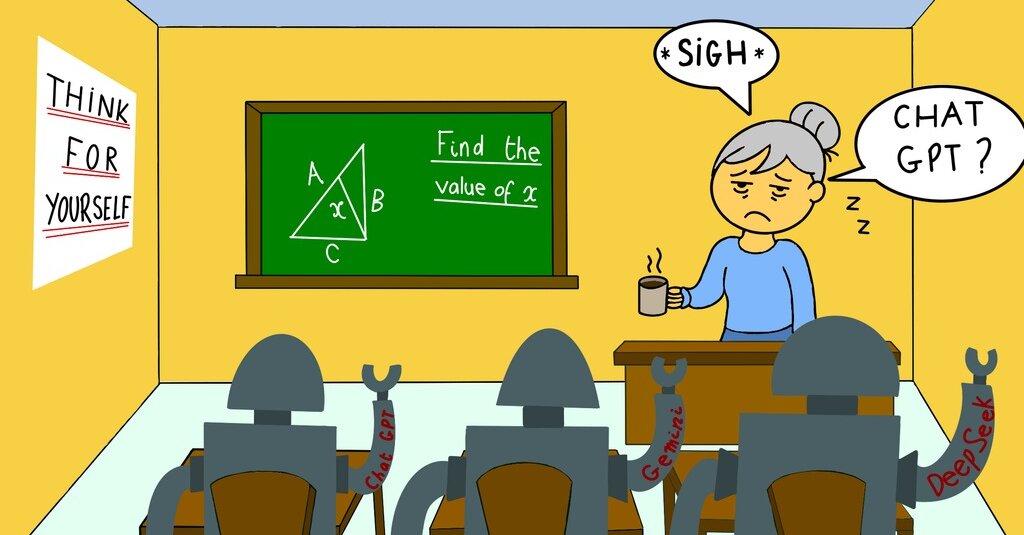
Every fall we invite teenagers to address a big question facing their generation, and we allow them to do it in whatever medium they like, whether words, images, audio or video.
This time around, our focus felt obvious, and, because we hoped teachers and students would explore it together, we invited educators to submit too. “What’s it like to think, create, teach and learn at a time when artificial intelligence is transforming our world?” we asked, and over 2,500 people answered — in poetry, paintings, essays, sculptures, rap songs, charts, cartoons, podcasts, videos and at least one satirical Terms of Service agreement.
Below, our 35 favorite student pieces, which both address our question and pose important questions of their own. You can find the winning teacher work here, and we hope you’ll read the two collections together. We also hope you’ll leave comments for these creators telling them what you noticed, what you learned and what will stay with you after you close the page.
One note: Though participants were allowed to use A.I. to create for this contest, few did. The three winners below who used the technology have explained how, either in the piece itself or in their artists’ statements, an excerpt from which accompanies every visual piece we’ve published.
You can find the full list of student winners, plus the 63 runners-up and honorable mentions, in this PDF. Congratulations to all of our finalists, and thank you to everyone who participated!
Thinking and Creating in an A.I. World
“What happens when the last human to remember the taste of a word is replaced by a server humming in Arizona?” — Anwita D. Pillai, 15
In Progress
By Ailey Takashima, 15; Grace Kozak, 16; Sophia Kim, 15; and Wanya Zafar, 15
St. John’s School, Houston
All of the creators of this video have felt fear and hopelessness as we hear about generative A.I. What will our future schools be like? What will happen to our beloved teachers? Will writing for fun be seen as a waste of time? Will we ever be able to get a job in the humanities?
But we believe human creativity will always endure, and we will keep writing anyway.
Wistful Glitches of a Pixelated Heart
By Anwita D. Pillai, 15
Kendriya Vidyalaya Ernakulam, Kerala, India
This is an excerpt from a longer piece. Read it in full here.
Behold, the Clown
By Eleni Pollard, 15
Brooklyn Technical High School, Brooklyn, N.Y.
I believe that A.I. is having a more drastic effect on this generation than many might realize.
The Tailbone of Thought
By Chaebeom Lim, 17
Darlington School, Rome, Ga.
This is an excerpt from a longer piece. Read it in full here.
Mirror, Mirror, Ctrl-Z
By Nikita Vijay, 15
Cypress Ranch High School, Cypress, Texas
Sometimes I feel proud when chatbots offer encouraging words. However, over time all that positive reinforcement starts to feel meaningless because A.I.’s answers are almost always affirming. At first “you nailed it” feels great, but eventually it creates a kind of shared delusion.
As we plan for college and talk about careers, A.I. sits at the center. The mirror panels warn that if we only seek flattering reflections, we risk losing originality for convenience.
Astray Icarus (A.I.)
By Gianne Andrei Rosales Cabrera, 17
Granada Hills Charter, Granada Hills, Calif.
The more I used A.I., the more greedy and lazy I got. A.I. thought for me, so I stopped thinking.
Just as Icarus’s wings melted as he flew closer and closer to the sun, the more I used A.I., the more my identity began to get lost in a sea of binary code.
The Voice
By Adeen Ahmed, 16, and Zara Ahmed, 18
Bravian International School and College, Lahore, Pakistan
We all know that nowadays, most high schoolers get help from ChatGPT. We all also know that it’s detrimental to their creative muscle. What nobody actually asks is, why do they do it?
For me and other young creatives, it doesn’t come from laziness, exactly, but insecurity and low self-esteem — from feeling as if you and your work will never be good enough.
Based on True Events
By Maximilian Kane, 17
Marblehead High School, Marblehead, Mass.
As someone who wants to write and make movies for a living, it seems as though real creativity is harder and harder to come by. I wanted to show people my age that creativity isn’t dead yet, and we can all strive to resist the urge to write a prompt in ChatGPT.
A.I. in Everyday Teen Life
“For me and my generation, it already feels normal.” — Yuna Kim, 14
Chatification
By Zoya Salam, 17
Westlake High School, Austin, Texas
After looking over old texts, I noticed how often “Chat,” short for “ChatGPT,” appeared. I realized that generative A.I. for our generation has become more than a tool but an instinct, shaping the way we learn, communicate and even joke.
should I ask a bot?
By Karen Zhao, 15
Collingwood School — Wentworth Campus, West Vancouver, British Columbia
Not the Apocalypse, Just a Random Tuesday
By Yuna Kim, 14
Tyee Middle School, Bellevue, Wash.
This is an excerpt from a longer piece. Read it in full here.
I Don’t Exist: Growing Up With A.I.
By Jayden Kim, 17
Bergen County Technical Schools, Teterboro, N.J.
My film serves both to spread awareness and as a call to action to my generation. I fervently believe that it is our responsibility to advocate for restrictions to generative A.I. before its impacts are irreversible.
Note: The video above was partly generated by A.I., as the artist explains.
Diary of a Sleepless Assistant
By Ethan Chen, 14
Shanghai American School, Shanghai
This is an excerpt from a longer piece. Read it in full here. The writer used A.I. only for the final line in the piece beginning with “but to augment.” This is so that readers can hear from the A.I. itself on its role in working with humans.
perhaps mercy
By Qianxi Chelsea Hu, 17
The Athenian School, Danville, Calif.
This is an excerpt from a longer piece. Read it in full here.
A.I. at School
“Let me guess. This essay was filtered through an A.I. check before human eyes ever saw it.” — Gyuree Ane, 15
Replaced by Our Own Creations
By Jiyan Turan, 15
Lycée Français Saint-Louis, Stockholm
Teenagers have always tried to claim independence from their parents, school and rules, but now this generation has become dependent on something else: A.I.
Sometimes I feel that students should stop clicking the generate button and start generating ideas on their own.
The A.I.-Generated Reality of Humans
By Gyuree Ane, 15
Stuyvesant High School, New York City
This is an excerpt from a longer piece. Read it in full here.
History of My Backpack
By Eunsoo Han, 13
Eastside Preparatory School, Kirkland, Wash.
A.I. has been replacing the weight of books with the weight of data; my backpack is now a symbol of that transformation. Everything is just simple, one click away.
Sometimes I miss my books, with dog-eared pages that represent my long nights studying. They mean something to me, the meaning of being human. Having a little chaos wherever we go.
The Algorithm
By Cecilia Garcia, 16
Riverdale Country School, Bronx, N.Y.
This is an excerpt from a longer piece. Read it in full here.
Artificial Negligence
By Jonathan Craig, 14, and Bjorn Walsh, 14
Archie Williams High School, San Anselmo, Calif.
Generative A.I. is a soulless hodgepodge of stolen creations. We created this to show how students using generative A.I. for school assignments can negatively affect those who don’t.
Is It Too Good?
By Nawmi Manaam, 18
Mymensingh Govt College, Mymensingh, Bangladesh
Before the rise of A.I., there was always a doubt when creating something: “Is it good enough?” But now another question lurks in the back of my mind: “Is it too good?”
As A.I. gets more advanced and more unrecognizable from human work, the anxiety creeping in my mind only grows stronger.
Prompt and Answer
By Myiesha Jain, 15
The American School in Japan, Tokyo
This is an excerpt from a longer piece. Read it in full here.
Temptation
By Rhayane Koblinger, 17
Livingston High School, Livingston, N.J.
As the work being assigned piles up for our eight classes, our minds go down the drain, falling into a never-ending cycle of late nights studying or working on homework. While our minds spiral out of control, desperately trying to get the mountains of work done and submitted by the 11:59 p.m. deadlines, the devil on our computer screens calls our names.
The Quiet Teacher
By Vivian Foutz, 16
Western Albemarle High School, Crozet, Va.
This is an excerpt from a longer piece. Read it in full here.
The Algorithmic Kitchen
By Isabelle Chapman, 16
Taipei Fuhsing Private School, Taipei, Taiwan
My generation is growing up inside systems shaped by artificial intelligence. To the people who argue A.I. just assists our learning to make us better, I argue back that, along the way, it also quietly defines what we see, write and believe. Is our creativity still our own when every idea passes through an algorithm?
The Gray Zone of School A.I.
By Hanhua (Edward) Hu, 16
Ridley College, St. Catharines, Ontario
In my school, the A.I. issue has shifted from if to how. In group chats, students trade humanizer websites the way years ago we traded past essays.
I interviewed 19 classmates across GPA ranges and three teachers from different subjects. I used A.I. to turn the recordings into word scripts and summarize them. Across the interviews, all used A.I.; 65 percent tried to mask its fingerprints.
“I always use A.I.,” said a student with a 96.3 GPA. “Then, I always run it through a humanizer and rearrange the wordings. I don’t think teachers can tell.” The student added that using a paid humanizer makes the work sound natural. “Free ones are easy to spot.”
The fairness gap that once came from private tutors or editing services has simply moved online, disguised as access to better A.I. and humanizing tools. The system rewards those who hide best, not those who learn most, which is a familiar inequality in a new disguise.
My Locker Has a Search Bar
By Keon Etminan, 17
The Awty International School, Houston
This is an excerpt from a longer piece. Read it in full here.
Artificial Information
By Ali Aydemir, 19
Gap year, Istanbul
Perhaps it is because I am the son of two teachers, but I understand one concrete truth about the way to find success in one’s efforts: through valid criticism. I am concerned by the fact that artificial intelligence tends to hold back from criticism when it is needed the most.
This generation is growing up around uncertain events, a global pandemic, economic instability, and unheard-of levels of college competition. Now it has A.I. chatbots willing to root for them. For that reason, not everyone is ready to close the screen. That frightens me.
Creativity Against the Machine
By Yunseo Jang, 17
Korea International School — Jeju Campus, Seogwipo, South Korea
This is an excerpt from a longer piece. Read it in full here.
A.I. and the Future
“Prolonged despair may result in targeted advertisements for happiness.” — Melis Helen Serbest, 16
Lost in Touch
By Evie Pyeun, 15
Mercer Island High School, Mercer Island, Wash.
The girl is smiling to herself, content with the “likes” she receives. These “likes” symbolize the interconnection between A.I. and social media, the digital world current youth become lost in.
But a tornado approaches in the background, running rampant and slowly disrupting the beautiful landscape. She is unaware of the disaster, much like our society, which faces the issue of losing our perception of reality as it becomes increasingly, and frighteningly, difficult to differentiate between what’s real and what’s artificial.
Terms and Conditions of Being Human
By Melis Helen Serbest, 16
ENKA Schools, Istanbul
This is an excerpt from a longer piece. Read it in full here.
E-waste
By Eva Chen, 16
Eastside Preparatory School, Kirkland, Wash.
We all sit through the Acceptable Uses of A.I. lectures, but the smirks from the back of the classroom tell me they do little.
My piece illustrates our growing reliance on this technology, as wires and circuits consume my face and the nature behind me.
Is This Really ‘New’?
By Yena (Emily) Choi, 17
Korea International School — Pangyo Campus, Seongnam, South Korea
This is an excerpt from a longer piece. Read it in full here.
The Water’s Artifice
By Joey Szpilczak, 16
Germantown Friends School, Philadelphia
In class this year, as I read Stanley Lambardo’s translation of Ovid’s “Echo and Narcissus,” I thought of how absurd it seemed for Narcissus to be so enraptured by his own reflection that he died from being unable to look away. However, when I read the line, “What you see is a shadow, / A reflected image, and has nothing of its own,” I realized I had heard this story before.
From what I perceive, the power of artificial intelligence over us is founded on the idea of perfection. Just as Narcissus looks into the water and is captured by a flawless image, we look to A.I. to fill in the blanks we see in ourselves. However, unlike Narcissus, we do not see only ourselves looking back, but rather a synthesized version of other creatives’ work that is stripped of their nuance and context, an echo chamber that limits our understanding of our own capacity and hinders our need as humans to continue shaping our narratives.
chat, is this real?
By Suvina Sethi, 14
Langley High School, McLean, Va.
This is an excerpt from a longer piece. Read it in full here.
Zugzwang
By Alison Koop, 16
Malvern Collegiate Institute, Toronto
In chess, zugzwang is the term for the situation in which, by their obligation to move, one player is put at a disadvantage. I sculpted and painted these pieces to embody the impossibility of the situation we are in. If this rapidly evolving technology is developed unethically or carelessly, it will be extremely dangerous.
But as any devoted player knows, despite being typically thought of as weak and disposable, pawns actually make up the heart of the position in every game. Here, the pawns represent the people and their power to think, solve, and feel in ways that A.I. never will.
There may never be a perfect option, but the world keeps spinning and choices will have to be made.
Thank you to our contest judges.
Annissa Hambouz, Elisa Zonana, Erica Ayisi, Jeremy Engle, Jeremy Hyler, Katherine Schulten, Kathy Curto, Kim Pallozzi, Kimberly Wiedmeyer, Michael Gonchar, Natalie Proulx, Shannon Doyne, Shira Katz, Sue Mermelstein, Susan Josephs and Willow Lawson
The post What It’s Like to Grow Up With A.I.: The Winners of Our Multimedia Challenge appeared first on New York Times.