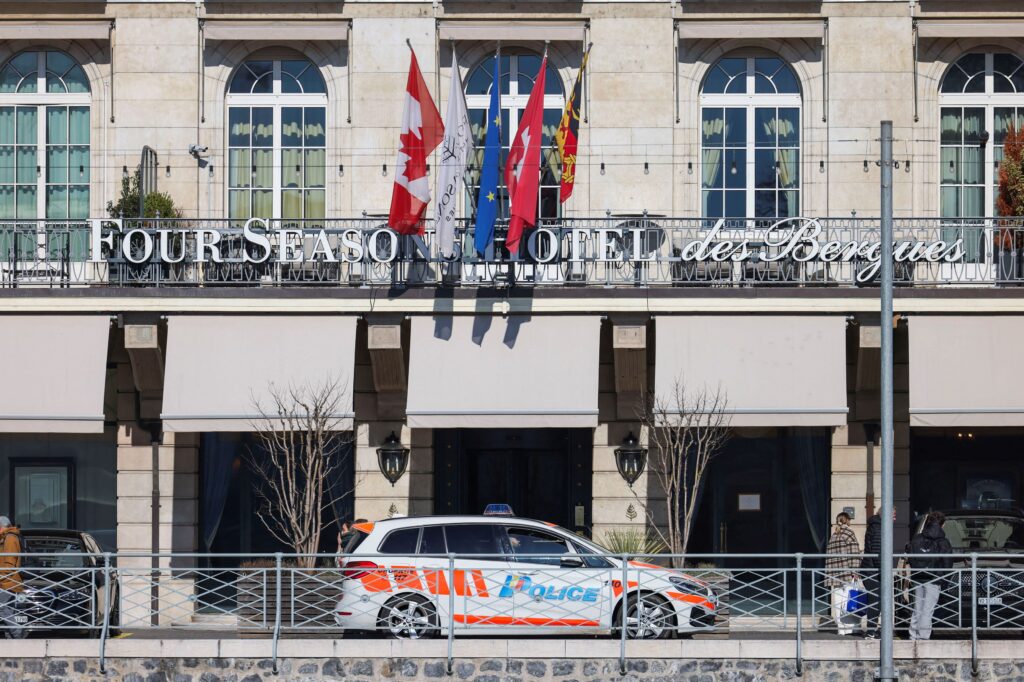
U.S. and Iranian officials completed a round of nuclear negotiations Thursday in Geneva in the shadow of a large-scale U.S. military buildup around Iran. The sides made “significant progress” and an agreement to meet next week to discuss technical details in Vienna, said Oman’s foreign minister, the mediator of the talks.
The apparent plan to continue negotiations, after three rounds in recent weeks, could indicate that President Donald Trump remains open to diplomacy, at least for now. A senior Iranian official, speaking on the condition of anonymity to share details from the closed-door talks, said the meetings were “serious,” but that the negotiations “still have miles to go” to resolve differences. The Trump administration has yet to weigh in on how the talks went or what is next and did not respond to a request for comment.
To avert conflict, negotiators will have to find an off-ramp that Iran might accept while also giving the Trump administration the chance to claim a win.
In statements reported midway through talks by Iran’s state-backed media, Iranian Foreign Ministry spokesman Esmaeil Baqaei expressed hope that by the afternoon, following a pause for each side to consult with capitals, they would focus on what Iran considers the two main issues — restraints on its nuclear program and the lifting of U.S. sanctions.
The talks may have been “the most serious round of negotiations with the Trump administration ever,” said Ali Vaez, an Iran expert with the International Crisis Group, a Brussels-based think tank. He said he had spoken with the negotiating teams on both sides Thursday.
“They are the most decisive, because everybody understands what’s at stake and what the price of failure would be,” and if continued over days, “I think one could be hopeful that maybe they could reach an understanding,” Vaez said.
The U.S. military has shifted scores of aircraft to bases in Europe and the Middle East since a round of talks ended last week without a breakthrough, amid an intermittent drumbeat of threats from Trump that began in response to Tehran’s violent crackdown on protesters last month. The U.S. military presence, assembled under a president who campaigned on stopping wars and criticized the era of U.S. military intervention in the Middle East, is among the largest in the region in more than two decades, since the U.S. invasion of Iraq in 2003.
Governments in the region and some of Washington’s closest allies have expressed concerns over what could result. At the same time, U.S. military officials have warned that any direct conflict with Iran would be lengthy and could dangerously deplete already-low U.S. weapons stocks.
White House envoy Steve Witkoff and Trump’s son-in-law Jared Kushner arrived early Thursday in Geneva, where they were also scheduled to meet with representatives from Ukraine and Russia in hopes of reviving apparently stalled negotiations over an end to that war.
Iran has said that its focus is on statements by Trump that it can never have a nuclear weapon and must take verifiable steps to that end, in exchange for the rollback of sanctions that have hobbled its economy.
U.S. officials, including Secretary of State Marco Rubio, have voiced a range of demands — many of them backed by Israel — including an end to Iran’s support for armed groups in the region and curtailment of its ballistic missile program.
Rubio, Witkoff and others on the U.S. side have pushed for Iran, which international inspectors say has amassed hundreds of pounds of near-weapons-grade, highly enriched uranium, to surrender that material and accept a ban on future enrichment.
Iranian negotiators have insisted on their right to enrichment under the Nuclear Non-Proliferation Treaty. “There is no doubt that the United States is interested in addressing nonnuclear issues as well,” Vaez said. “I think the [U.S.] president believes that if he is to sell a deal it also has to address missiles and Iran’s regional activities.”
“But it is also clear that on those issues a substantive solution might not necessarily be available,” he said. Vaez suggested that a deal on nonnuclear issues might be struck that is “more symbolic than substantive. But it would definitely not amount to the kind of capitulation that the U.S. was hoping it would be able to achieve with heightened pressure on Iran.”
Iranian Foreign Minister Abbas Araghchi, who headed the Iranian delegation, delivered via his Omani counterpart, Badr Albusaidi, a new proposal that included “token” nuclear enrichment for medical purposes and other research, according to two people familiar with the proposal, who spoke on the condition of anonymity about closed-door diplomacy.
The Iranian offer includes a pause on most enrichment for three to five years, during which time Iran would be allowed to maintain 1.5 percent enrichment for medical purposes at a Tehran research reactor, said one of the people with knowledge of the offer, speaking on the condition of anonymity to share sensitive details. After the pause, a “normal” level of enrichment would be handled by a regional consortium.
But Iran might be open to locking, under supervision of international inspectors, the sites of vast underground centrifuges and storage sites for enriched uranium that Trump has said were “obliterated” by U.S. and Israeli bombing last summer, the person with knowledge of the offer said.
The senior Iranian official said after the talks that dismantling Iran’s nuclear sites remained a red line for Tehran and that Iran would not agree to ship enriched uranium out of the country.
Rafael Mariano Grossi — the director general of the International Atomic Energy Agency that has inspected Iran’s program on the ground since the 2015 nuclear deal signed under the Obama administration, from which Trump withdrew during his first term — also attended the Thursday’s talks.
Iran has amassed an amount of highly enriched uranium beyond levels needed for most nonmilitary use, although it has said repeatedly it has no intention of producing a nuclear weapon. Grossi said this month there is no evidence of an active plan to build a bomb.
In the annual State of the Union address, Trump said on Tuesday that he preferred a diplomatic solution, while adding he would “never allow” Iran to have a nuclear weapon: “Can’t let that happen.”
Ali Shamkhani, an adviser to Iran’s supreme leader, saidThursday that an agreement was “within reach” if the talks stick to Iran’s pledge not to build a nuclear weapon. He said Iran’s foreign minister has “sufficient support and authority” to come to a deal in the negotiations.
Francis reported from Brussels and DeYoung and George reported from Washington. Mohamad El Chamaa in Beirut and Anthony Faiola in Rome contributed to this report.
The post U.S., Iran wrap round of talks as Trump weighs diplomacy against strikes appeared first on Washington Post.