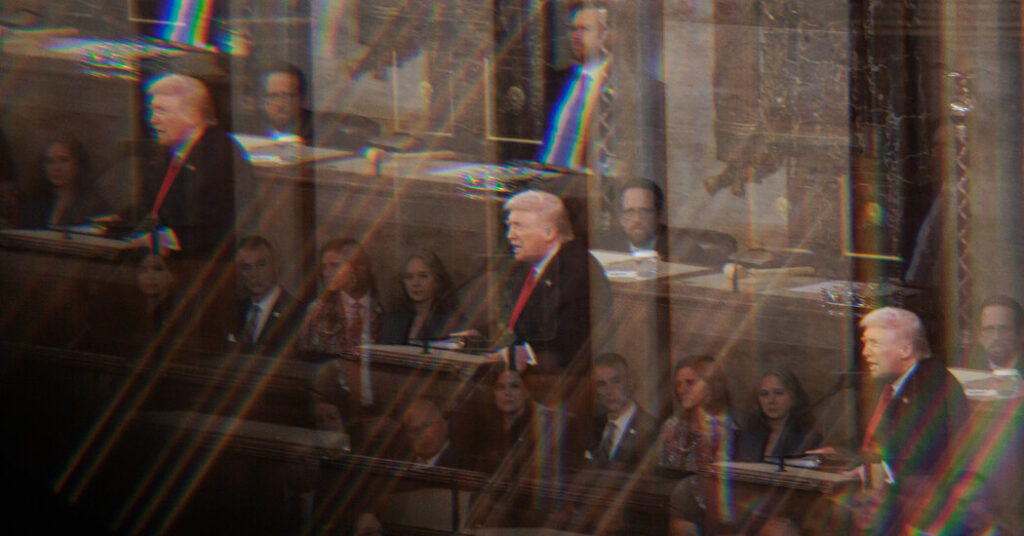
Bret Stephens: Frank, your thoughts about President Trump’s interminable speech?
Frank Bruni: It was the Trumpiest Trump I’d ever beheld — preposterously self-satisfied, preternaturally nasty and profoundly delusional. Most of what he boasted about was hallucinatory. I haven’t been that fully immersed in fantasy since the first “Avatar” movie. I kept thinking I should have worn 3-D glasses.
Bret: Just for the sake of being argumentative, let me lay out what I think many Americans might have liked about the speech — at least those who made it through the whole hour and 47 minutes. They would have liked Trump calling out Democrats for refusing to stand in agreement when he said, “The first duty of the American government is to protect American citizens, not illegal aliens.”
They would also have liked the celebration of American heroism: the Coast Guard swimmer Scott Ruskan, who saved 165 people during the Texas flood; the Army helicopter pilot Chief Warrant Officer Eric Slover, who took four bullets in the leg during the operation to capture Nicolás Maduro; and of course, the U.S. men’s Olympic hockey team.
And they will have liked his Reaganesque attacks on federal regulations and his suggestion that income taxes will be replaced by tariffs.
Frank: I don’t believe for a second that more than a small fraction of the small fraction of Americans who actually heard (or will hear) the bulk of Trump’s remarks believe that his big, beautiful tariffs will replace income taxes. Over the past year, Americans have correctly experienced his capriciously administered and whimsically amended levies as some self-infatuated power trip. Claiming they’ll replace income taxes is, like almost everything else about Tuesday night, an example of Trump taking things much, much too far.
Bret: OK, so … you’re right. The basic problem with the speech is that in many respects, it felt out of touch with reality. Trump trumpeted a supposedly booming economy, yet the job market looks particularly brutal for young college graduates. He talked up lower gas and food prices, but gas prices are, on average, only a few cents lower than they were a year ago, and food prices in urban areas have kept rising. Yes, the homicide rate is at a record low, but crime was already coming down in the last year or two of the Biden administration. And by the way, there’s no such thing as a “Congressional Medal of Honor,” as Trump kept calling it. It’s just the Medal of Honor. The fact that the commander in chief doesn’t know this was embarrassing. And telling.
All of which means that Trump is becoming the very thing that destroyed the Democrats in the last term: a reality-denial machine. I don’t know who coined the expression “Don’t pee on my leg and tell me it’s raining,” but it fits the overall tone of the speech.
Frank: “Don’t pee on my leg,” period, is an admonition I can really get on board with. Also? I love fact-checker Bret. He may be my favorite Bret yet.
Bret: My kids will attest that I have a gift for obscure words and recondite information.
Frank: While we’re on the subject of illusion versus reality, everyone should look at The Times’s sprawling, panting, verging-on-frantic fact-check of the speech. It necessitated a cast of thousands, and reading their attempts to correct and qualify Trump’s ludicrous assertions is like watching a team of workers in hazmat suits and mops trying to contain the spread of a toxic spill. They’re heroic and doomed. And their vocabulary! “Misleading,” “needs context,’ “exaggerated,” “false.” Those are genteel synonyms for “hooey,” “whopper,” “Are you kidding me?” and “Do you really think I’m that stupid?”
Bret: A dirty job that someone has to do. But since we’re in a postfact world, do you think the speech helped Trump or the Republicans in any way?
Frank: That’s the question, isn’t it? And I don’t feel at all confident in my ability to answer it, because I’m so distraught about — and terrified of — how Trump and his co-conspirators are governing that I tilt wishfully toward “no.” How about you give your answer, and then, true to cantankerous form, I’ll quibble with it?
Bret: I’m always leery about writing Trump’s political obituary — I’m the moron who wrote the column “Donald Trump Is Finally Finished” after the 2022 midterms — so it would be foolish of me to underestimate him now. But there’s no question Trump has dug himself into a deep political hole. The grotesque heavy-handedness of ICE in Minnesota was a major part of it. The idle, menacing, crazy-seeming threats to seize the territory of our allies were another. And I don’t think Americans are sold on the idea of tariffs as anything other than a tax on business and consumer prices.
Frank: Agreed, agreed and agreed, except I’d replace “grotesque” with “homicidal.” So what can Trump do? Well, what he has always done best — and what we saw in such garish form on Tuesday night: try to cast the Democratic Party as an alternative so much worse than him and his Republican lickspittles that he gets a pass on his broken promises, his corruption and his cruelty. As much as anything else, that’s the key to his political survival.
Earlier, Bret, you mentioned his denigrating Democrats in the House chamber for not standing up against “illegal aliens.” That was neither the beginning nor the end of his cheap, cynical mockery and vilification of them. “Crazy,” he called them — more than once. “Sick,” he added, for good measure. The next day, he picked up where he left off with a social media post that ranted that two Democratic House members, Ilhan Omar and Rashida Tlaib, had the “bulging, bloodshot eyes of crazy people, LUNATICS, mentally deranged and sick who, frankly, look like they should be institutionalized.”
Frankly, the “institutionalized” part may be the best example to date of Trump’s tendency to project, as the psychiatrists say.
Bret: Right now, mission No. 1 for Democrats is to shed their reputation as the party of sick and crazy. Which is what some enlightened Democrats, like Mark Kelly, a senator from Arizona, and Jake Auchincloss, a congressman from Massachusetts, want to do.
Frank: They’ve got ample company, including Ruben Gallego, the other senator from Arizona; Elissa Slotkin, a senator from Michigan; and Abigail Spanberger, the Virginia governor, who delivered the rebuttal to Trump’s remarks. The list isn’t short.
Bret: But that requires Democratic leaders to take some stands that won’t be popular with parts of the base. Like distancing themselves from public-sector unions that are a big reason that blue states like New York and Illinois are so misgoverned. Or apologizing for the border chaos that characterized most of the Biden years. Or rethinking some of their more extreme cultural stances, especially on subjects like gender transitions for minors. Or, yes, acknowledging all the stealing from the public trough that occurred in places like Minnesota, even if it means risking spurious accusations of racism.
By the way, I have to admit that I didn’t stay awake for Spanberger’s response, but I gather you did. How did she do?
Frank: Very well. She seemed a tad nervous and was too amped up at times, and the weird choice of an arranged studio audience who clapped on cue was distracting. But she rightly stressed the cost of living and the fact that Trump’s attention lies elsewhere, on limitless self-aggrandizement. Most important, Bret? She spoke in crisp, plain, common-sense language. No voguish acronyms. No partisan cant.
Bret: But did she mention her SAT scores?
Frank: And now we’re back to your favorite gelled White House aspirant, Gavin Newsom, whose smoothness is overrated and whose book tour is getting a little bumpy. For readers who missed this, he recently cited his humble performance on the college boards to connect with a predominantly Black crowd in Atlanta. “I’m like you,” he said. “I’m no better than you. I’m a 960 SAT guy.”
Bret: So this may surprise you, given my political distaste for Newsom, but give the governor a break. He made an off-the-cuff remark that was intended to illustrate his ordinariness and humility, and it just landed really, really badly. It’s certainly happened to me. The fact that Newsom mastered his dyslexia through intense personal discipline — among other things, he’s in the habit of memorizing his speeches — is very much to his credit. So is his willingness to engage with his ideological opponents. It’s his record in California that demands scrutiny.
Frank: In general, I’m with you on our need to allow for the fact that when you’re speaking in public all the time — as politicians and political candidates are — you’re destined for oratorical pratfalls. The brain-mouth connection is an imperfect one. And I, too, admire Newsom’s work ethic. I just worry sometimes that his hunger — to woo listeners, to win people over — outpaces his judgment, because his hunger is so very intense.
But let’s look south of California. I’d love your thoughts on the mayhem in Mexico because you know that country so well, having grown up there.
Bret: The mayhem has been a long time coming. For years, the Mexican government and the drug cartels have observed an implicit truce: The cartels would not disturb the peace in tourist destinations like Puerto Vallarta, and the government would more or less allow the cartels to operate throughout much of the country. But Trump’s demands on the government of Claudia Sheinbaum — to crack down on the cartels — made that demand all but impossible to sustain. Now the Mexican government is going to have to go back to the strategy of confronting the cartels rather than coddling them, and the price is going to be extremely high and extremely bloody. I’d suggest readers skip that planned trip to Tulum and check out Belize or Costa Rica instead.
Anyway, that’s depressing. Anything more uplifting for our readers?
Frank: You’ll roll your eyes at me because here I am traveling back to the Winter Olympics, but withhold judgment for a second! I’m not going to gush about the athleticism. I’m going to praise the journalism. Big events often yield bold writing, and I savored Jodi Walker’s dispatches in The Ringer.
She wrote that the Winter Olympics were “seemingly invented by enterprising knee surgeons who wanted to buy boats” and that the Games mostly appeal “to competitors from the two wildest subcultures: rich and mountain.” She referred to the luge as “the elite sport of a guy flying down an ice tube on a greased-up cafeteria tray — only to have another guy come up and say, ‘OK, but what if we did it like bunk beds?’”
Fun, no?
Bret: Agree. And even though I’m not a sports guy, I was moved by David Margolick’s magnificent obituary for Bill Mazeroski, the Pittsburgh Pirates second basemen who, in the bottom of the ninth in the seventh game of the 1960 World Series against the Yankees, hit a winning home run off a fastball from Ralph Terry and then more or less danced his way around the bases. The entire obit is great, but it’s Margolick’s kicker that really got me by the throat:
A 14-year-old schoolboy named Andy Jerpe, who had left the game early to help his mother prepare dinner but had lingered outside the fence, retrieved Mazeroski’s home run ball. When he presented it to Mazeroski in the dressing room, the Pirates second baseman signed it, then gave it back.
“You keep it, son,” he told him. “The memory is good enough for me.”
One sunny day the following spring, the boy lost the ball in the weeds during a pickup game. Estimates are it would have fetched up to $1 million today.
For all any of us know, that ball is still in the weeds. Someone should go find it.
The Times is committed to publishing a diversity of letters to the editor. We’d like to hear what you think about this or any of our articles. Here are some tips. And here’s our email: [email protected].
Follow the New York Times Opinion section on Facebook, Instagram, TikTok, Bluesky, WhatsApp and Threads.
The post Trump Has Lost Touch With Reality appeared first on New York Times.