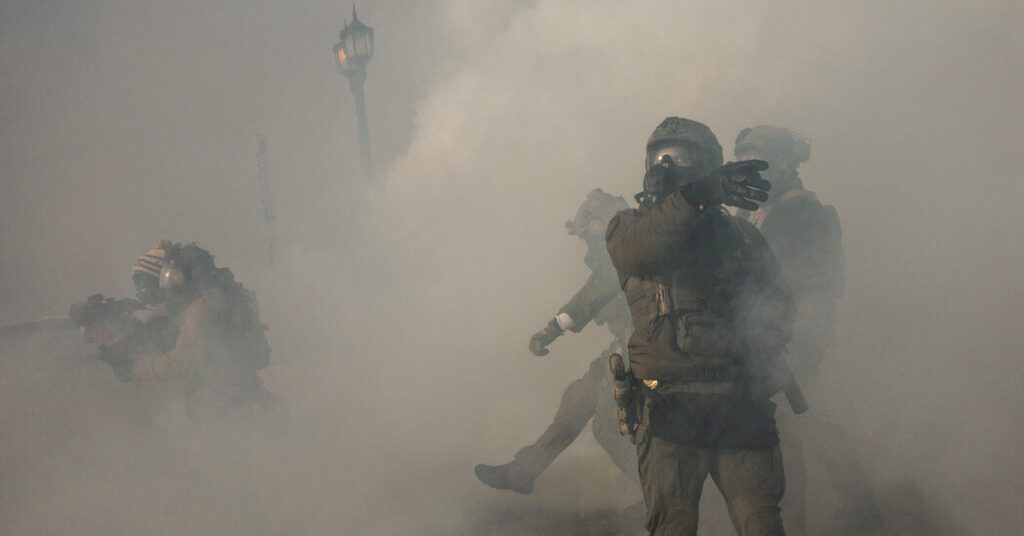
When the Trump administration announced it was scaling down its surge of federal agents to Minneapolis earlier this month, the White House was quick to take a victory lap.
President Trump’s adviser on the border, Tom Homan, said the administration decided to pull back many of the roughly 3,000 agents after it had secured “an unprecedented level of coordination with law enforcement officials” on immigration enforcement. The White House claimed that nearly every county in Minnesota had established new agreements to help transfer undocumented immigrants in their jails to federal custody.
“The Twin Cities of Minnesota in general are and will continue to be much safer for the communities here because of what we have accomplished under President Trump’s leadership,” said Mr. Homan, who wound down a contentious two-month operation that led to thousands of arrests and the deaths of two U.S. citizens at the hands of immigration agents.
But sheriffs and public officials across the state say little, if anything, has changed about their immigration enforcement policies. In fact, many of them said they were already cooperating and that the operation in Minneapolis had nothing to do with it.
The office of Gov. Tim Walz of Minnesota, a Democrat, said it was unaware of a single policy change on immigration cooperation at the state, city or county level. The sheriff’s office in Hennepin County, which includes Minneapolis and is the only county in the state to explicitly ban coordinating with federal authorities on civil immigration enforcement, said its policies remained unchanged. Sheriff’s offices in three of the other six largest counties in Minnesota said they had not signed any new agreements with the administration. The two others did not respond to multiple requests for comment.
The differing accounts from the Trump administration and local officials suggest a disconnect about what, exactly, federal agents accomplished in Minnesota and why. Critics say the administration was under fire over a heavy-handed operation that had become politically toxic and was looking for a way out.
“They are drawing down and will continue to draw down because of the political damage they are suffering,” Mr. Walz said during the first day of the legislative session last week. “There is no upside at all to keep ICE agents in Minnesota, and they are trying to save face now.”
And while the administration insists it demanded new cooperation, the show of force in a Democratic-led state also could be seen as a potent warning to other states at a moment when Mr. Trump is trying to reclaim the narrative on immigration, which has been a traditional political strength for Republicans.
‘Unprecedented Levels of Cooperation’
Mr. Homan was clear early this month about why he was winding down the operation.
Because of “unprecedented levels of coordination that we’ve obtained from state officials and local law enforcement, I have proposed and President Trump has concurred that this operation conclude,” he said. “This community is safer.”
White House officials have provided various responses when asked to provide details about the new agreements they said they struck with counties. Speaking on the condition of anonymity to detail the reasoning for winding down the operation in Minnesota, White House officials claimed that 80 counties that previously declined to cooperate with ICE had now agreed to notify the agency when they released undocumented immigrants from their jails.
When asked for the names of those counties, the White House said it was sensitive law enforcement information. When asked about various counties that said they were already cooperating with ICE or had not changed their policies, Mr. Trump’s aides argued that some counties have increased their cooperation without necessarily changing their written policies.
“These agreements, paired with pledges from local police to respond to our officers’ calls for help, take down roadblocks and respond to agitator unrest, represents unprecedented levels of cooperation that did not exist before,” said Abigail Jackson, a White House spokeswoman.
But sheriffs across Minnesota said that is nothing new.
“I don’t know what the gauge is for unprecedented,” said Joe Leko, a sheriff in Dakota County, Minnesota, who added that his department had been notifying ICE when it released people without legal status from its jails. When the administration made its claims of new cooperative agreements, Mr. Leko said he “kind of looked over my shoulders and, like, what? Who committed to what here? Am I missing something else that we should be doing?”
Throughout the deployment, called “Operation Metro Surge,” the administration repeatedly complained that Minnesota jails and prisons released people without legal status with little or no effort to transfer them into federal custody. State facilities, however, said they were already transferring people to ICE once they finished their sentences.
‘Our Policies Remain Unchanged’
About 30 percent of the people ICE detained in Minnesota last year were turned over by local jails and prisons, a New York Times analysis of federal data shows, but that number is a lower share than in 39 other states. No one, for example, was transferred from Hennepin County, which has the state’s largest jail.
The sheriff’s office there said in a statement that it “has not entered into any new agreement and our policies remain unchanged.”
Local jails in Minnesota have declined or ignored hundreds of the more than 2,000 detainers — requests to hold someone longer in detention until ICE could take custody of them — filed since Mr. Trump took office.
Sheriffs in the state said their hands were also tied by local laws and some have lost lawsuits in recent years filed by immigrants who said they were unlawfully detained at the request of immigration officials.
Minnesota’s attorney general, Keith Ellison, a Democrat, has said sheriffs cannot hold people wanted by ICE longer than they would otherwise be jailed. The agency has historically asked jails to keep people for up to 48 hours beyond their projected release time so they can take them into custody.
Mr. Ellison late last year issued a legal opinion saying that sheriffs could not unilaterally enter into cooperative agreements with ICE unless they had the blessing of county commissioners, who are elected officials.
At least seven counties had signed those deals before the crackdown in Minneapolis.
James Stuart, the executive director of the Minnesota Sheriffs’ Association, said he was not aware of any counties that had signed new deals with the Trump administration. But Mr. Stuart, who is also Mr. Trump’s nominee to be the U.S. marshal in Minnesota, did say that the “mutual communication and cooperation” between the local authorities and administration had improved.
One reason for that could be a change in tactics by federal authorities, rather than the approach by local officials, said Mr. Leko. He said he had noticed the administration had positioned immigration agents closer to the jails, making it easier to detain people when they were released by local authorities.
The lone change Mr. Leko’s department has made is allowing ICE agents to enter their garage to pick up people released from their custody, rather than doing so in their parking lot or outside their building. But he has not signed on to any new agreements.
Sheriff’s departments in Anoka and St. Louis Counties also said they had not reached any new deals with the Trump administration. Brian Evans, a spokesman for Mr. Ellison, said the office was “not aware of any policy changes that have been made, regardless of their level of precedent.”
‘What Is the Reason for Why You Were Here?’
Mr. Leko and state officials suspected that the administration might be looking for something to show after a nearly two-month deployment that resulted in bipartisan backlash against the White House.
“What might be coming from D.C. now is, well, we got to show that there’s unprecedented changes,” Mr. Leko said of the claims of new cooperation with ICE. “We were doing it all along. So now what is the reason for why you were here?”
Mr. Homan was deployed to Minneapolis to negotiate with state officials after the fatal shootings of two American citizens caused even some of Mr. Trump’s allies to call him and tell him that the images in Minneapolis were distracting from his immigration agenda.
After the shootings, polling showed that a small, but growing, share of Republicans said the administration’s enforcement tactics had gone too far. And independent voters, who helped swing the 2024 election to Mr. Trump, also said the crackdown had gotten out of hand.
“Television matters, and the images got to be, you know, more than the market would bear,” said Senator Lindsey Graham, Republican of South Carolina who was one of the allies to call Mr. Trump with concerns. “So Trump adjusted. That doesn’t mean we’ve abandoned mass deportation.”
In the span of just a few weeks in January, federal agents had killed Alex Pretti, a 37-year-old nurse who was pinned face down and shot multiple times in the back; and Renee Good, a 37-year-old mother who was shot inside her S.U.V. on a Minneapolis street.
Mr. Leko said he was concerned that the aggressive tactics harmed trust between residents and law enforcement, something that was already fractured after the murder of George Floyd in 2020 by a Minneapolis police officer. He said one of his own deputies of Hispanic descent was pulled over recently by ICE agents when she was off-duty.
“You’re up here for the worst of the worst, the rapists and the murderers, but you’re stopping law enforcement off-duty because of their race,” Mr. Leko said. “So what are you doing? How are you going to explain that?”
“It was like a tornado coming through here, and we’re trying to pick up the pieces right now,” he added. “And unfortunately, a lot of this stuff, I think, could have been alleviated on the front end.”
Zolan Kanno-Youngs is a White House correspondent for The Times, covering President Trump and his administration.
The post Trump Declared Victory in Minneapolis. But What Did He Accomplish? appeared first on New York Times.