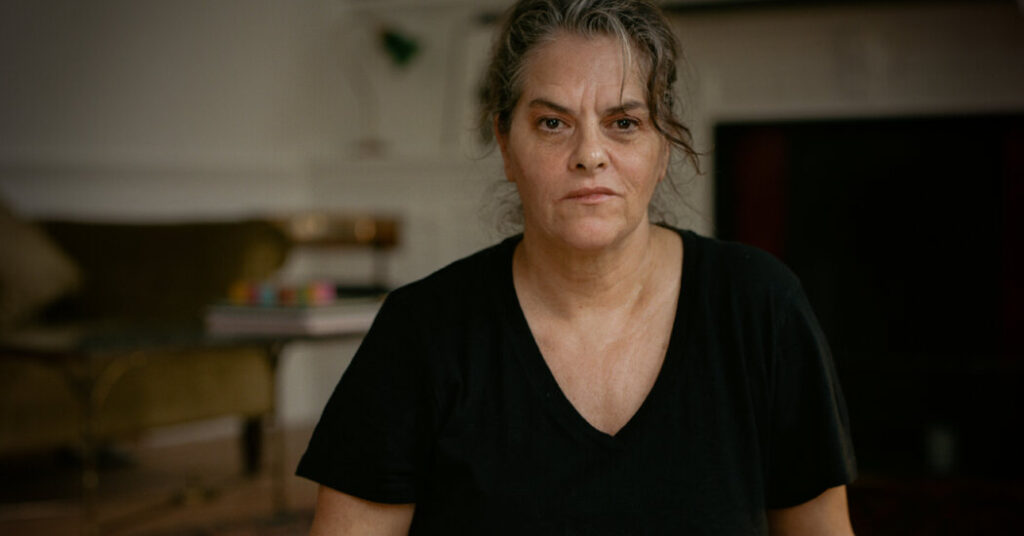
Tracey Emin’s new kitchen is immaculate.
On a rainy January afternoon in Margate, the English town where the artist also grew up, the wind whipped off the sea and howled down the street outside the bright white room. Inside, a fire crackled in the grate as gentle piano music played from discreet speakers. Two gray cats padded across the painted floorboards.
It was a strikingly different domestic scene from the one many people still associate with Emin: the groundbreaking 1998 conceptual work “My Bed,” which transported the debris of a four-day breakdown from the artist’s bedroom to a gallery, catapulting Emin into the public’s consciousness — and British tabloid headlines.
In the last six years, since a bladder cancer diagnosis and extensive surgery, Emin’s life had become “unrecognizable,” said the artist, now 62, nursing a pot of herbal tea at her kitchen table. “I’m much happier than I used to be, and enjoying life much more.”
She has also been very productive: “I’ve done more in the last five years than I have done in my lifetime,” she said, including overseeing a program that offers free and subsidized studios for artists in Margate.
Emin calls this recent period her “second life,” which is also the title of a major new retrospective of her work — including “My Bed” — at Tate Modern in London, opening on Feb. 27 and running through Aug. 31.
“Tracey Emin’s name is so well known, we think we know the work,” said Maria Balshaw, whose final project as the director of the Tate museum group is curating the retrospective. “But she has not had a whole-career show in the U.K. for 15 years, meaning younger generations haven’t yet had the chance to see all that Tracey is.”
“A Second Life” aims to provide that opportunity by tracing Emin’s defiantly autobiographical, multidisciplinary practice over four decades. The retrospective’s more than 90 works showcase her determination to have her trauma and experiences — of violence, the British class system, sexual and physical health, love and loss — seen and felt by her audience.
Several works in the show address abortion — which “I don’t think there is enough discussion about,” Emin said — including her embroidered quilt “The Last of the Gold” (2002) and the searing 1996 video work “How It Feels,” in which Emin reflects on her own experience of the procedure.
“Her work reminds us that issues around women’s rights, around their bodies and even their sexual and physical expressions, are still in great need of protection,” Balshaw said.
“A Second Life” will travel to several international museums after Tate Modern, but none of them are in the United States. “Now is obviously not the right time for me to show in America,” Emin said. A U.S. show would be “controversial,” she added, her voice soft and lilting, “and that isn’t what I want. I want people to go and look at my work and enjoy it and think about it.”
There was a discussion, Emin said, about the Guggenheim Museum in New York hosting “A Second Life,” but the small space the institution offered would have meant removing many works from the show. “Wonder what those works would be? I just don’t know,” Emin said archly.
In a wide-ranging conversation (occasionally interrupted by her cats), Emin discussed her self-destructive past, becoming a dame — a British honor equivalent to a knighthood — and how getting cancer changed everything. The conversation has been edited for length and clarity.
Many of the newer works in the show focus on your body after your illness, including close-up photos of your stoma, the hole in your abdomen that allows you to use a plastic pouch as a bladder. What do you want people to take from that?
I want people to see what it looks like. And most people don’t understand that it’s a live, visual thing. It’s blood, it’s skin, it’s membrane.
Living without a bladder is really hard. Having a stoma is hard. I’ve had sepsis twice now, and I get infections all the time. I take antibiotics for about eight months of the year. Nothing can be improvised. Everything has to be planned around where the loos are, who you’re sitting with.
When I found out I wasn’t going to die after the surgery, I was a bit disappointed. I really thought it was going to happen, and it was like being jilted at the altar. There I was going to meet death, with open arms, and then death cheated me. So now I’ve got to live.
How else is your life different now?
The “why” is different, the “where am I going” is different, and everything has a different emphasis behind it and a reason. Whereas, before, my reason was lost. I was like a little lost soul.
All my nihilism from when I was young, and my craziness and everything, really makes sense as well. If I wasn’t going to starve myself to death, I was going to drink myself to death, I was going smoke myself to death — one of these things.
If I look back on my life, there are moments that I’m mortally ashamed of, because there’s a callousness about that behavior, and really I care about lots of things — so how come I appeared that I didn’t? Why was I living in this sort of brash way? It was another set of self-destruction.
I stopped drinking five and a half years ago, because you can’t drink when you have bladder cancer. So every day the drinking got less. And then after the surgery, I did say that if I could fall deeply in love, I’d stop drinking. And I did fall deeply in love.
Are you in love now?
Yeah, I’m still in love. Look, whether or not it will ever work, or could work, it makes no difference. Just being in love is good.
There was a time when you got a lot of attention for being out and about in London, as well as for your art.
When you’re single and you’re younger, you have another reason to go out. Like a she-wolf, hunting.
I was always in the press. But some of that was my fault and some of it wasn’t. If you’re followed around everywhere, that’s not your fault. There were a lot of things that now I don’t think the press would be able to get away with. My phone was tapped. I would come out of somewhere tipsy, and they would try and trip me over. All the people who would lay on the floor when I was getting into cars, it was really disgusting.
Does it make you angry, to think now about how you were treated?
No, I’m not angry. If I was going to be angry, I could be angry that I don’t have a bladder and that I chain smoked since the age of 13. Stupid girl, why did you do that?
But I think the way I was treated has a lot to do with the class system. If I didn’t speak the way I do, if I didn’t have the brash attitude that I did, hadn’t left school at 13 … One of the reasons it’s really good that I’m a dame is to show that you can be respected by the establishment. And the establishment has caught up. People can’t be as mean and as they used to be.
Another establishment distinction you hold is being a trustee of the British Museum. You joined the board in 2023.
It’s quite a big job. The British Museum is going through massive changes at the moment. I wish people would stop picking on it, because Rome wasn’t built in a day, and the British Museum, to catch up with the ethics and morality of the 21st century, it has to move fast. And it can’t move that fast. It’s been run by men, completely, for hundreds of years. Things take a long time. It’s slow, but it’s happening.
People say to me that the British Museum is colonial, it’s this, it’s that. And I say, “Yeah, that’s exactly why I’m there: because I want it to change.”
In your Tate show, one significant piece that won’t be there is your breakout work “Everyone I Have Ever Slept With 1963-1995.” It’s a tent embroidered with the names of people you had sex with — but also the people you’d slept alongside — and which was destroyed in a warehouse fire in 2004. How do you feel about it not being there?
It’s a shame, isn’t it? It’s quite weird with the tent. If I’d known really how I was going to feel, and how it would affect people’s perspective of my work, I might have made more of a fuss of the fire. But at the time I was philosophical.
Now, morally, I probably would never have ever made that work, because I think it was too subjective and it really freaked a lot of people out. That’s also why I was celibate for 10 years — no one had the courage to go there.
What’s it like seeing a work as intimate as “My Bed,” which is in the show, installed in a museum?
That whole bed is like a time capsule. At the time, there was so much fuss about it. It was kind of quite shocking for people. But now it’s old, and it has this sort of grace and beauty.
Every time it’s shown it’s different. When it was shown here in Margate Turner Contemporary, it was with the Turner paintings, his seascapes. The bed looked tousled and sort of alive, whereas in other places it could look really forlorn and desperate.
You made your name with these very personal, conceptual pieces. Now, you mostly paint.
I just love painting so much. All the other work is like the mountain, like me climbing up. And then my painting is the flag on the top of the mountain.
When I was younger, painting was a struggle for me. It’s a battle every time you go to that canvas. It’s like sucking something out of you. When I take on a painting, I have no idea what I’m going to paint until it’s done.
I only paint when I feel like it. Sometimes I really want to paint, and I’m in the wrong place, and I feel it in my insides. I’m agitated and I get moody. My painting is not about whether it’s a good or bad painting. It’s about why it exists, why it had to come out of me.
What else would you like people to take away from the show?
Two things. One is that life isn’t easy, and the other one is that if it isn’t, just keep going, don’t stop. Because you prove people wrong, and you prove yourself right. I think that’s self-evident in the show. Yeah, it’s good. Yeah, I’m nervous about it.
Have you gotten less nervous about opening your shows over the decades?
No, it’s got harder. For an opening, someone has to come and prize me out of the house. Because of my immunity, just going to the opening now is kind of risky. People are always trying to hug, and cuddle, and stroke me. Do they try to hug and cuddle Jeff Koons, I wonder?
Tracey Emin: A Second Life Feb. 27 through Aug. 31 at Tate Modern in London; tate.org.uk.
The post Tracey Emin on Love, Loss and Getting Out of ‘My Bed’ appeared first on New York Times.