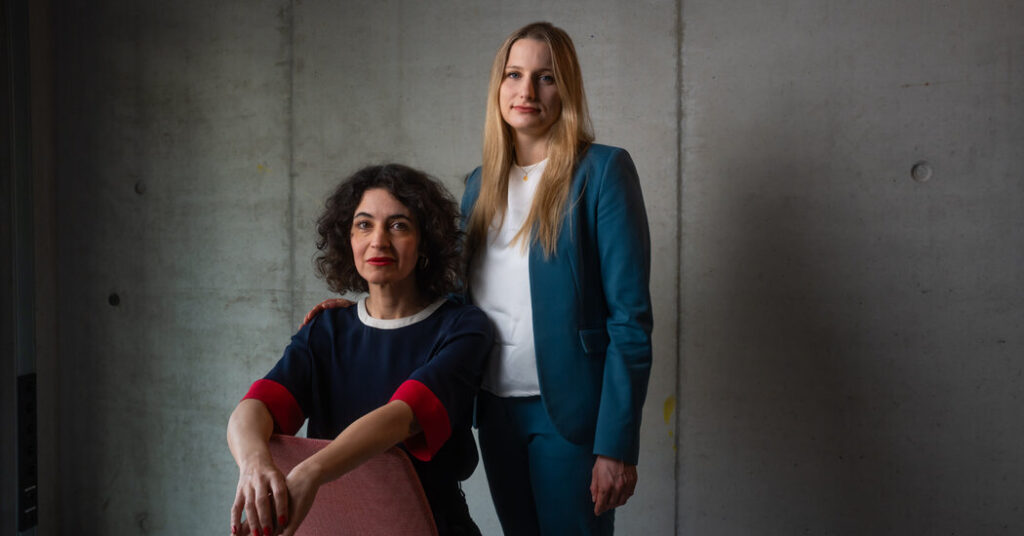
Josephine Ballon was on her couch in Berlin two nights before Christmas when she received an email saying that her visa for traveling to the United States had been revoked.
She was stunned, but not entirely surprised. In the preceding months, Ms. Ballon had worried that the organization she co-leads, HateAid, was under scrutiny from the Trump administration and its allies for supporting Germany’s tough social media rules. Last year, Vice President JD Vance had called those policies “lunacy” and “Orwellian.”
Ms. Ballon’s suspicions about why her U.S. visa had been revoked were soon confirmed. Secretary of State Marco Rubio announced that Ms. Ballon and her colleague Anna-Lena von Hodenberg were indefinitely barred from traveling to the United States, accusing them of being part of a “global censorship-industrial complex.” If they entered the country, it could have “serious adverse foreign policy consequences for the United States,” Mr. Rubio said.
“We have felt like they are watching us,” said Ms. Ballon, 36, who had a U.S. visa from a previous trip but no immediate travel plans.
Ms. Ballon and Ms. von Hodenberg, 43, had been caught in a trans-Atlantic battle over regulation of the internet and what constitutes protected speech. HateAid is one of Europe’s most influential proponents of social media regulation, which the organization says is critical to reducing online hate and vitriol. But American officials argue that safety rules undercut free speech globally and silence conservative voices, with the Trump administration using travel bans and other tactics to combat the policies.
In the United States, the people behind the most toxic online behavior are rarely punished. In Germany, the rules are different. Rooted in the history of the Holocaust, strict laws are in place to prosecute people for publicly insulting others or targeting people based on their race, religion, ethnicity or sexuality.
“In Europe, we have a different perception of freedom of speech, and this has to do with our history,” said Ms. von Hodenberg, who founded HateAid in 2018. “We have seen what freedom of speech, where you can say everything, where this can lead.”
The social media debate is part of a wider U.S.-European rift over trade, the war in Ukraine and control of Greenland. Apart from Ms. Ballon and Ms. von Hodenberg, three other Europeans were barred from traveling to the United States in December. They include two leaders of organizations that fight online disinformation and hate speech, and Thierry Breton, a former European commissioner who helped write a landmark European Union online safety law called the Digital Services Act.
From offices in a co-working space in south Berlin, HateAid provides legal support, privacy advice and emotional counseling to politicians, journalists, activists and others who, the nonprofit argues, are being driven from public life by online abuse.
HateAid has worked with thousands of victims since it was founded, helping some get content removed from the internet and win financial damages — usually a few hundred euros each — from those who threatened or insulted them online. The German government, which provides funding to HateAid, tapped the group to advise it on carrying out the Digital Services Act and to flag illicit content for social media platforms, which then decide whether to take it down. Special prosecutor units have been established around the country to investigate online abuse partly because of HateAid’s work.
President Trump’s free speech arguments, Ms. Ballon and Ms. von Hodenberg said, are hypocritical considering that his administration has cracked down on protesters, universities, talk show hosts and others.
The State Department declined to comment. It pointed to past statements by Sarah B. Rogers, the under secretary of state for public diplomacy, about HateAid’s work related to the Digital Services Act.
“If you spend your career fomenting censorship of American speech, you’re unwelcome on American soil,” Ms. Rogers said in December.
Ms. von Hodenberg, a former journalist, started HateAid after being alarmed by the rise of online extremism in Germany and how far-right groups were coordinating on social media to target critics. In 2019, she hired Ms. Ballon, a lawyer who had defended tenants against predatory landlords, to lead the group’s legal work.
Trump Administration: Live Updates
Updated
- The C.D.C.’s new acting director draws unexpected praise from agency staff members.
- FedEx says it could return tariff refunds to its customers.
- The Trump administration asks the Supreme Court to end protections against deportation for Syrians in the U.S.
They rejected the view that abuse and sexualized attacks were just part of life on the modern internet. They began helping people who experienced sexist attacks, revenge porn and doxxing, which is when someone’s phone number or address is published online with malicious intent.
“People arrived for a consultation and said: ‘The internet is a lawless place. Why should I care about filing a complaint? Nothing will happen,’” Ms. Ballon said. “When you win, they are over the moon and they feel empowered.”
Clients poured in. HateAid paid for lawyers to help victims file criminal and civil complaints against perpetrators of online attacks, leading to arrests and fines. Ms. Ballon and Ms. von Hodenberg were unapologetically aggressive and sometimes publicized the perpetrators’ names after convictions, with the goal of deterring others from posting harassing messages.
“It’s about getting those guys to face every possible charge they could possibly face, getting all the money we can possibly get,” said Luisa Neubauer, 29, a prominent climate activist in Germany who has filed dozens of complaints with HateAid’s assistance over the past five years, donating the proceeds back to HateAid. In 2021, one perpetrator was fined 6,000 euros, about $7,000, for posting sexual insults against Ms. Neubauer on Facebook.
Theresia Crone, 23, an environmental activist, said online abuse was often aimed at scaring women from being politically active. HateAid helped her get sexualized deepfake images of herself removed from an online forum and file a complaint that led to a €3,000 fine against the perpetrator.
“Sadly my story isn’t unique at all,” Ms. Crone said.
Ms. von Hodenberg and Ms. Ballon have also targeted big social media companies. In a landmark 2021 case, HateAid helped Renate Künast, a German politician, sue Facebook to take down copies of a meme with a quote that was falsely attributed to her. The case, which could set a precedent requiring social media companies to proactively remove content, is now winding its way through the European court system.
HateAid, which has about 55 employees, has lost in court, including a 2023 suit against X for the spread of antisemitic content on its platform.
There is a debate in Germany and other European countries over what online content is illegal versus legitimate expression.
Critics argue that Germany’s efforts to combat online abuse have gone too far, and that definitions of illicit speech are overly broad and subjective. A German retiree was recently investigated after calling Friedrich Merz, the chancellor of Germany, “Pinocchio” on social media, a case that was dropped.
“Speech should not be restricted in any way unless it is actively asking people to be violent,” said Marie-Thérèse Kaiser, a politician with the far-right Alternative for Germany party. She accused HateAid of liberal bias and not helping combat sexist abuse she faced online in 2019, which HateAid disputes. In 2023, Ms. Kaiser was convicted of incitement of hatred for a social media post about Afghan immigrants.
Angelika Nussberger, a German legal scholar who generally supports HateAid, said, “Not all cases are clear-cut.” When she was a member of the European Court of Human Rights, the region’s top civil rights court, judges often struggled to decide cases involving free expression.
“Where to draw the red line is always the problem,” she said.
Over the past year, Ms. Ballon and Ms. von Hodenberg have come under scrutiny. Last February, Ms. Ballon was interviewed on a “60 Minutes” segment on CBS about Germany’s laws, leading to the criticism from Mr. Vance.
In May, Representative Jim Jordan, a Republican of Ohio and the chairman of the House Judiciary Committee, mentioned HateAid’s work in a report criticizing European social media rules. Later that month, Mr. Rubio threatened visa restrictions against unspecified “foreign nationals who are responsible for censorship.”
Since the U.S. travel ban, Ms. Ballon’s mother has expressed worry about her daughter’s safety and Ms. von Hodenberg had to explain to her family why they cannot visit friends and relatives in the United States. The two women also faced rape and death threats online. They raced to move money and change online services in case more sanctions are issued that bar their access to U.S. financial networks and tech services.
On a rainy evening in Berlin this month, about 150 people turned out to support HateAid at a museum exhibit the group had created about online abuse. A photo booth demonstrated how easy it was to make deepfakes. People posed for pictures with cardboard cutouts of Elon Musk and Mark Zuckerberg.
“It’s very important that people see that we won’t back down,” Ms. von Hodenberg said.
Adam Satariano is a technology correspondent for The Times, based in London.
The post They Helped Women Fight Online Abuse. They Were Barred From the U.S. appeared first on New York Times.