We’re going back to the moon. Well, at least that’s the hope.
God willing, and without any additional delays, NASA plans to launch its Artemis II rocket sometime this spring, sending astronauts around the moon and back for the first time in 50 years. After that, the hope is to actually land again and establish a base for scientific research. And once we have a lunar base, well, maybe it will help us develop the technology to get to Mars and even beyond.
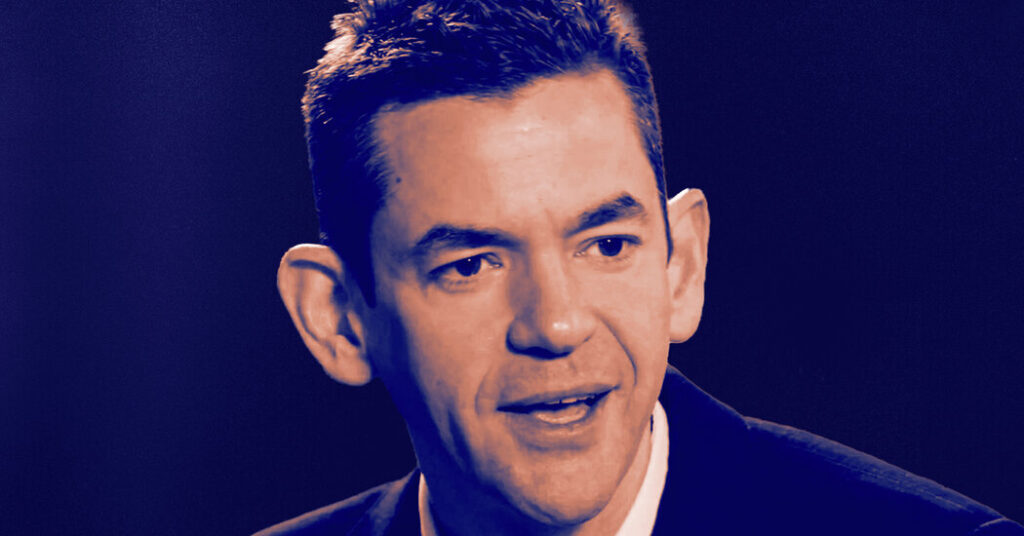
These are the goals of the new NASA administrator, Jared Isaacman. A billionaire entrepreneur and pilot turned SpaceX astronaut. As that description suggests, his goals overlap with figures like Elon Musk and Jeff Bezos, who are trying to make private space exploration work.
I want it all to work. I also have my doubts. An enduring human presence beyond Earth requires more than just ambition. It requires big technological breakthroughs. It requires stronger commercial incentives, maybe mining rare minerals, maybe building orbital data centers, and it wouldn’t hurt to have the evidence of extraterrestrial life that Donald Trump keeps teasing.
I sat down with Jared Isaacman at the Goddard Space Flight Center in Maryland to talk about all of this and more, and to let him make the case that we really can explore the final frontier.
This interview was recorded before NASA announced the delay of Artemis II’s launch.
Below is an edited transcript of an episode of “Interesting Times.” We recommend listening to it in its original form for the full effect. You can do so using the player above or on the NYTimes app, Apple, Spotify, Amazon Music, YouTube, iHeartRadio or wherever you get your podcasts.
Ross Douthat: Jared Isaacman, welcome to “Interesting Times.”
Jared Isaacman: Great to be here. Thank you.
Douthat: No, it’s great to be here.
Isaacman: Yes.
Douthat: So we asked for a secret test facility buried under the Rockies. We’re not there, but —
Isaacman: We got close.
Douthat: We got close. We’re in the woods of Maryland behind several gates marked: “Don’t pass — Ongoing testing.”
And we’re under this. What is this?
Isaacman: So we’re in this spacecraft magnetic test facility. This is where we calibrate spacecraft, satellites before they go up into orbit, where we need to take extremely precise measurements. Space weather would be a good example of it.
So yes, it is rather incredible. And even though this facility has been around for some time, it still kind of points you toward the future in some ways, doesn’t it?
Douthat: But if this starts up, we both get catapulted into a parallel dimension at some point in the podcast, right?
Isaacman: I was just about to make a joke on that, but I’ll refrain and just say we’ll probably be safely exited out of the room before that happens. [Chuckles.]
Douthat: All right. That’s the safer answer. We’ll see how it goes.
Isaacman: Keep the humor to a minimum these days on the subject.
Douthat: [Chuckles.] Well, we’ll get to some of those questions at the end.
Goddard is also home to NASA’s newest telescope, which has not yet been launched.
Isaacman: Correct.
Douthat: Tell me about that.
Isaacman: Sure. So the Nancy Grace Roman Space Telescope is in the clean room here.
Now, this is a really exciting mission because, if everybody knows Hubble, and everybody knows the James Webb Space Telescope as well, then people are about to know the Nancy Grace Roman Telescope. The reason is that it has at least 100 times the field of view of Hubble and 1,000 times the scan rate. So that’s pretty exciting when you think about how much science that instrument is going to be able to do, compared to the assets we already have up there.
Douthat: OK. Well, that’s something to look forward to.
Let’s talk about you for a minute, before we go back to NASA. You’re a billionaire, an entrepreneur — sorry, you looked slightly pained when I said that, but you are. You ran a financial tech company, an aviation defense contractor, and you’re also an astronaut. I think you’re the first private citizen to do a spacewalk, is that right?
Isaacman: I’ve been to space twice, on a Falcon 9 Dragon spacecraft, the exact same way that NASA astronauts and our astronauts [get] to and from space. The first mission was in September of 2021, so I led the first all-civilian mission to orbit.
And then, also, in September of 2024, my crew and I went farther into space than anyone’s gone since the last time we walked on the moon and tested out a new form of communication using satellite laser links. We communicated over a beam of light between our spaceship and the Starlink constellations.
It’s all in the idea of trying to build toward an exciting future where lots of people are living and working in space, we’re going to the moon and Mars, and when you get there, you’re going to probably need to get outside the safety of your habitat and go explore and discover and repair and build things. And you’re going to need lots of spacesuits in order to do that.
So I’ve been very lucky.
Douthat: What is it like to be in space, in 500 words or less?
Isaacman: Well, everything initially feels different. Going into microgravity, there’s no roller coaster here on Earth, no chamber we can put you in to feel what it’s like.
There’s basically a fluid shift in your body without gravity. Fluid in your body kind of gravitates up toward your head. So at first, everybody has this chipmunk thing, where your cheeks all puff out.
But that does other things to you, too. It can impact cognitive abilities, vision, something called spaceflight-associated neuro-ocular syndrome. It’s a long way of saying everybody feels different.
And to give you the bookends, your best case scenario for your first call at three to five days in space is you feel like you’re hanging upside down in your bed endlessly. That’s just the best case scenario for your first three to five days.
The other end of the spectrum, which unfortunately impacts about 50 percent of people, is horrific motion sickness. And it has nothing to do with your susceptibility to motion sickness on Earth. You could be a hard-core test pilot, an air show pilot, used to being upside down doing flips and rolls, and you —
Douthat: You were a pilot on Earth, right?
Isaacman: Yes. Still a pilot. [Chuckles.]
Douthat: Still a pilot?
Isaacman: Yeah. I was in the lucky 50 percent that feels like you’re hanging upside down from your bed.
Douthat: That’s good.
Isaacman: But in both my missions, 50 percent of the crew did not feel well. And this has been the case since the beginning of our space program.
But you know what? It’s worth it. It’s worth it for one of the greatest views ever, to see our planet from that perspective and to get a sense of the solar system around us, let alone the galaxy and the universe. I mean, we are a speck of sand in the grandest, vastest desert imaginable. And it’s just such an exciting, extraordinary journey to think about, because we’ve really only just begun.
Douthat: Did it change your perspective on Earth to see it? People talk about that sense of coming back to Earth and feeling differently about the planet. Did you have that?
Isaacman: So what you’re referring to is the overview effect.
Douthat: The overview effect. Yeah.
Isaacman: And I’m sure maybe some of my astronaut colleagues won’t appreciate some of my comments on this, but I believe this was very, very real in the 1960s, ’70s, ’80s. I can only imagine when Yuri Gagarin went into space and what he saw had to have just shocked him because we really had no idea what it would look like. Same with the early Mercury and Gemini astronauts.
Look, we have high definition video coming off the International Space Station. I can tell you, sir, it looks just like what you imagine it looks like.
Douthat: OK.
Isaacman: Yeah. So does that mean you need to go to space to appreciate that we shouldn’t fight wars over lines that were drawn on a map a century ago, or not dump toxic waste in our oceans or something? You don’t need to go to space to know that.
To me, what I found most impactful was when I saw the moon unexpectedly rise from around Earth. And it was like, how have we not gone back in so long? We took the first small step on what I think is the greatest adventure in human history, and then we stopped?
Now, thankfully, we’re on the return. President Trump created the Artemis program during his first term. He just created an unbelievable national space policy that said: Go back and build the base and stay, and then press on to Mars.
So we’re getting in the right direction. But when I was up there both times, I was certainly in awe of what I saw, but discouraged in a way that we began this adventure and then stopped. But now, we’re back in motion again.
Douthat: OK. Let’s talk about that. I’m going to try and go from the close-by to the further-out, like the plan: The moon, then Mars, and then bigger questions.
So tell me about the Artemis mission. What is Artemis going to do if all goes well?
Isaacman: Yeah, I think the first thing to emphasize right now — and not to take away from the mission that’s coming up — is the president created the Artemis program, and the Artemis program will live on. It is more than any one mission or one vehicle architecture.
So you see on the pad at Launch Complex 39B, there is S.L.S. out there.
That’s our Space Launch System. And when you look at it, you’ll say: Does that kind of look like a space shuttle? It’s kind of, but not really?
Yes. Why? Because the solid rocket boosters have heritage from the space shuttle program. The center core draws influence from the external fuel tank from the shuttle. Heck, the engines that are on it are from the space shuttle.
So this is where we begin. And that vehicle for Artemis II, when it launches, it’s going to accelerate those four astronauts to near Earth escape velocities, 25,000 miles an hour past the moon, back around safely to Earth. And we’re going to test out our vehicle for subsequent missions that will eventually lead to a landing.
But I’ll tell you, because that program draws on such history — has contractors, hundreds of subcontractors, tens of thousands of people — it’s expensive. It’s not the vehicle that you are going to take to and from the moon a couple of times a year as you build out a moon base the way the president wants, the way the national space policy calls for it. But it’s the way you initially get back.
And we are going to do that on Artemis II. We’re going to do it on Artemis III and IV and V and maybe VI — who knows? We’re going to get our astronauts back to the surface, we’re going to learn, and we are going to gradually roll in some of what you’re seeing today from some of our commercial providers, where vehicles are coming back and landing on ships and landing on land, because that’s what makes it more affordable.
That’s how we take frequent repeatable missions to and from the lunar environment and build out the moon base and actually go there to stay.
Douthat: So what does the moon base do? What is it for?
Isaacman: We have been operating on the International Space Station now, a continuous human presence for more than a quarter of a century. What an accomplishment.
We are hoping our astronauts, many of them very trained scientists and engineers, will crack the code on the orbital economy at the International Space Station. Who knows? Cancer-fighting drugs, biotech technology, maybe we all 3-D print a spare liver or kidney and put it in the fridge someday. Who knows?
Douthat: I want to come back to the orbital economy.
Isaacman: But I want to point out that that is a very different environment in lower Earth orbit than what we may stand to learn on the moon.
So you have a lot of protection — approximately 420 kilometers is the orbital altitude of the International Space Station. You get a lot of protection there from radiation. You get a lot of protection there from micro meteors and orbital debris, because at that altitude, it starts to decay and burn up in the atmosphere quicker. Meaning that we have kept astronauts alive in the incredibly harsh environment of space, but literally in the safest place you could have put them.
The moon changes the game. You’re not an hour and a half away from being in the water if something goes wrong — you’re days away from coming back to being in the water if something goes wrong. There is essentially no atmosphere or magnetosphere there to protect the astronauts from solar events, like radiation that could be really horrific.
So the moon gives us an environment to build out habitation that can keep our astronauts alive in a far more demanding environment. It gives us the opportunity to work with resources away from Earth, for in-situ resource manufacturing and refining. We can make propellant out of ice — things that we’re going to need to do to get to Mars someday and bring our astronauts home from Mars. So it’s a next-level proving ground.
Douthat: Does it have to be underground? What does the moon base look like physically?
Isaacman: OK, so this is a good question, because people ask me this and sometimes we have a habit of jumping to the dream state. You know, this amazing dome, with all this vegetation being grown inside of it, right?
It’s going to look like a junkyard for a while. Just set expectations here. We are going to land lots of low-cost rovers and landers and set up common antennas. Those rovers are going to burn out after maybe a single lunar night. And that’s OK, because we have to learn and we have to learn in an inexpensive way to get the data to inform our future architecture.
So, yeah, you know what? For the first, maybe, I don’t know, 10 years, it’s going to look like a pretty cool futuristic junkyard with lots of landers and rovers around. But someday — someday — that will evolve as the cost to put mass on the lunar surface goes down, into some pretty cool infrastructure.
Douthat: So over those 10 years — just help me imagine it — it’s something where there would be a continuous human presence in that world, but it’s a few astronauts going back and forth constantly?
Isaacman: That will evolve. It will not start that way. And certainly not in the early Artemis missions, when we are using an architecture that is extremely expensive. But over time, yes, we will be able to undertake repeatable, affordable missions to the moon. That’s what the president envisioned with his enduring presence. So there will be some crossover point where I can almost guarantee you that there will be astronauts living and working in lunar environment continuously.
Douthat: So maybe five to seven years, hypothetically?
Isaacman: I would say, let’s see what happens over the next decade. A lot is going to depend on industry.
I mean, look, we haven’t been back to the moon in more than a half century. This is super hard. Sending astronauts to the International Space Station in low Earth orbit: 1.8 million pounds of thrust. Sending them to the moon: 8.8 million pounds of thrust.
That’s complicated and hard. We need industry to be able to do it for us inexpensively, routinely. And then, yes, we can have a continuous presence.
I don’t think we’re going to put them underground so much, as I wouldn’t be surprised if we use rovers to try and cover some of our infrastructure and lunar regolith.
Douthat: What is lunar regolith?
Isaacman: Basically, the materials on the surface of the moon.
Douthat: The grit on the surface of the moon?
Isaacman: Yes. Taking that and using it to cover some of our infrastructure would be a good way to provide debris protection and radiation protection.
Douthat: Does NASA have enough money to do this?
Isaacman: Yes.
Douthat: So, as with other areas of the federal budget, the Trump administration proposed cuts to NASA. Congress is not doing those cuts. Are you happy overall with the money that NASA has to spend?
Isaacman: First of all, yes, I’m very happy with the resources available to us. But I just want to clarify, because it’s not as simple as: Did the president want to take cuts to NASA, and did Congress work this out? The president created an incredible national space policy and his One Big Beautiful Bill — the Working Families Tax Cut Act — was one of the most significant financial plus-ups to NASA in decades. Billions of dollars to invest in our exploration programs and the infrastructure required for the moon, plus enhancing our terrestrial infrastructure across our centers.
So, to be clear, the president loves space, created the Space Force, created the Artemis program, returned human space flight to the United States after a hiatus when we had to send our astronauts to space through Russia after the shuttle was retired.
That said, do I have any fault that through the budgeting process, we were asked to take a closer look at how we spend things, get things more on track, on budget? I don’t fault that at all. That’s a good forcing function to take a closer look at how we operate.
And like all government agencies, we’re not good capital allocators. We could do better, and we are trying to do that right now. If we can, within our resources, within our budget — $25 billion a year — yeah, we can do some pretty extraordinary science and discovery.
Douthat: But it does seem like, in the optimal scenario where you are establishing a permanent presence on the moon, you’re going to need a larger budget. And is it something where you feel like each technical success, like the success of the Artemis mission, generates support for more spending? Is that how you envision it?
Isaacman: Well, I think that with every win, we earn more trust from all our stakeholders — our work force, the American public, Congress, O.M.B. [Office of Management and Budget], the president for sure.
Now, I will say, again, I visited every one of our centers. We’ve been running 18-hour days for the last two months since my confirmation, getting a handle on things. I don’t think we have a shortfall in resources. $25 billion is an awful lot of resources. It’s not —
Douthat: It’s not going to get us to Mars, though. Right?
Isaacman: Well —
Douthat: I’m not trying to push you into demanding more money. I’m just trying to calibrate —
Isaacman: Just to give you a sense, though: The Manhattan Project, adjusted for inflation, was $30 billion. And we really knew nothing about that at the time. We had to build factories across the country for enriching uranium, plutonium production reactors.
I’m just saying that people at times think that a billion is not a billion anymore. $25 billion, with some of Our One Big Beautiful Bill plus-ups — we can do an awful lot.
Douthat: That’s fair. One of my recent interviews was with the head of an A.I. company and the amount spent on data centers for A.I. is extraordinary. I have that in the back of my mind as perspective.
Is it safe for astronauts to go to the moon? I ask in part because you had some really critical words about NASA’s failures on a recent mission, the Starliner project. I’m just wondering, even in terms of public support for NASA, how essential is it that the safety of astronauts be paramount, versus how important is it for people to just live with the reality of risk and the possibility of death?
Isaacman: I do think that it’s impossible to undertake our mission and explore the worlds beyond ours without taking some risk. Now, I do think we have a responsibility to drive risk down, to the greatest extent possible. In order to do that, you need to fully understand it. What am I dealing with right now?
That’s why we have tests and qualification programs. OK, we found something, we don’t like it, we can’t make it go to zero. How do we mitigate it to the greatest extent? How do we get comfortable with it? That should be inherent in how we operate as a space agency. But I will say, at some point or another, you do have to go.
My comments reflect a culture that I’ve grown up in, between flying high performance aircraft and going to space twice, which is that you debrief your successes and your failures, your shortcomings, your mistakes. You understand it, and then you communicate by it. And by doing that, it instills confidence with every other person in the room and everyone else who depends on those missions to be successful, because you understand what you got wrong.
If you don’t do that, if you pretend mistakes never happened at all, then you invite them to happen again. And I don’t know how we can ever get comfortable with that.
So I did not use the press conference to bash Boeing about building a bad spacecraft or how we let these qualifications —
Look, this is hard. The Russians are still flying essentially the same spacecraft for more than a half century. Not a lot of countries have built a vehicle that can take humans to and from space successfully. It is hard.
We played a role in why that spacecraft was built the way it was. But worse in my mind — and that’s where I chose to concentrate my energy — is that we did not own our shortcomings. We didn’t declare a mishap a mishap when we should have done it. We didn’t have accountability when those bad decisions were made. And we didn’t have the right leadership that should have stepped in at the time, when it was clear that we were going off course, to correct that course trajectory. That’s what we called attention to.
So really I think it’s imperative that that story was told before we step into sending our astronauts around the moon, before we start landing astronauts on the moon and building a moon base.
Douthat: Do you think that the Challenger disaster, which was my primary childhood encounter with the space program, and then the Columbia disaster later — do you think those created a kind of overhang of skepticism around the space program that needs to be overcome by Artemis?
Isaacman: No. Look, I think the American public — the space-loving public from around the world — should understand that we cannot undertake missions like this without accepting some risk. There will be bad days, and that’s unfortunate. But it’s applicable to our people who undertake dangerous jobs every single day. Flying off aircraft carriers, diving under the sea, working in nuclear power plants — these things are not without risk.
And certainly, accelerating human beings on a controlled explosion into space, where there’s no atmosphere, no breathable air, and everything coming from the sun and the debris around you is trying to kill you — yes, it’s a dangerous environment.
There are scenarios, like the past catastrophic events, where people say that at times, that made NASA too risk averse — and maybe so, in some cases. Then there are situations, like I saw with Starliner, which was: What are we doing here? You are continuing to take risks that you don’t understand, and by failing to communicate it and acknowledging where we got things wrong, you are inviting it to happen again. You are sending a message to the work force that in this environment, failure is an option, and it’s not — and that needed to be fixed.
Douthat: All right, so let’s talk about the private side of space exploration — the role of private industry. You mentioned public–private partnerships and government contractors. You have a pre-existing relationship with Elon Musk. And in fact, your accession to this job was delayed for a little while when Musk and the president had a falling out.
Isaacman: I think people perceived that to be a closer relationship than reality.
Douthat: Maybe. “Perceived” — let’s say there was a perceived delay or a perceived falling out. But regardless, Musk — I guess I’ll say Elon, because everyone says Elon. Elon has his own vision around the moon for SpaceX. He’s recently said that SpaceX is pivoting from trying to do a direct Mars mission soon, to aiming at the moon.
What is the overlap in the relationship there? Are these separate track projects? Is there going to be a SpaceX moon base and a NASA moon base? How do NASA and SpaceX actually fit together?
Isaacman: Well, I mean, since the 1960s, NASA doesn’t undertake these kind of world-changing endeavors alone. We have always gone after it with industry. I think sometimes, just because there’s new names now, like Blue Origin and SpaceX, that there’s an impression that this is a whole new approach to go into space. No, in the 1960s, it was Boeing and McDonnell Douglas, and many of those names still exist today. And then we have new names, and some of those new names are SpaceX and Blue Origin and Stoke and Rocket Lab and all these. And I’m grateful —
Douthat: But they are actually sending astronauts and rockets up themselves privately in a way that was not happening in 1968, right?
Isaacman: Oh, for sure. That’s how I went to space twice, with SpaceX.
So sure, capabilities, I would expect to evolve over a half century. We were the only game in town 60 years ago when we created this whole thing of space exploration. And we crack the code at NASA on the near impossible. We hand things off to industry, where there’s clearly demand outside of one and outside of a single agency like NASA, and let a market develop. This is good for us. It allows competitive forces to do their thing and make products’ capabilities better and at lower cost. So that’s fine.
I’ll just tell you, this is a good thing for us. Both SpaceX and Blue Origin are under contract to build the landers that will take American astronauts back to the surface of the moon. And if you can build those landers, they’re going to be able to use it to bring lots of cargo, maybe a hundred tons of mass, down to the lunar surface. We’re going to be able to build out a base pretty quickly with those types of capabilities.
We are in a race right now against our rival, the Chinese. Their path is very similar to the approach we took with Apollo. And look, we don’t have as much schedule available as we did in the 1960s in hindsight, where we had near infinite time to get to the moon compared to the Soviets. In this case, this could come down to a year or two.
What I’ll say, though, is that we spent 4.5 percent of our discretionary budget in the 1960s to build out these extraordinary capabilities for the good of America, for humankind to go to the moon and back. Right now, we’re at one-quarter percent and it’s in large part being supplemented by folks like Jeff Bezos and Elon Musk being willing to throw resources well in excess of what we’ve contracted them to do, to provide a capability that someday could enable us to go to Mars.
Douthat: But is your expectation going forward, that Musk and Bezos — and anyone else who gets in the game — will always be working in partnership with NASA in some way? Or is there a future where there is actual privatized space exploration, where there are bases being built and other things being done — space stations and so on — that are just separate from the U.S. government?
Isaacman: This is a new domain where it should be NASA’s job to take on the hardest engineering challenges, again, to attempt to achieve the near impossible. And when we figure it out, we hand it off to industry and see if a market develops.
Look, there was a time when the Army flew our mail. If you’re asking me, initially, I think it’s going to be NASA astronauts that are stepping off the spaceship on the moon. I think it’s going to be NASA astronauts that are helping construct the initial lunar base and doing a lot of the initial scientific research.
Is there a world thereafter where SpaceX and Blue Origin and others are doing direct missions to the moon for commercial or even tourism reasons? Totally. That would be a great day, because it would mean NASA’s costs to go into that environment would’ve decreased materially.
But you know what we do then? We set our sights on Mars, and we do things that industry is not capable of doing, like building nuclear power and propulsion spaceships, which is actually a component of President Trump’s national space policy.
I don’t think, even with all the resources in the world, Blue Origin or SpaceX or any of the others is going to be in a rush to launch a nuclear reactor into space. You know who does that? NASA does that. And when we do that, we actually help industry make it possible to undertake a mission to Mars and explore the outer solar system.
Douthat: Let’s talk about what industry gets out of space, besides government contracts. As far as I know right now, Elon Musk doesn’t want to launch nuclear reactors into space. He does seem to want to launch data centers for artificial intelligence into space. What is the potential advantage of having data centers in space? Is there one?
Isaacman: Well, I would just say, in terms of what is a space or an orbital economy, it has been grossly overstated. We have created an economy here on Earth that manufactures and builds things that we launch into space. But in terms of actually extracting more value out of the unique environment of microgravity than we put into it, we have not developed anything in 60 years other than launch observation and communications. And those are largely funded by government customers.
Now, over time, it’s expanded. So companies that are doing Earth observation almost as a service — whether it’s environmental, agriculture or intelligence, D.O.W. [Department of War] purposes — they have customers now all around the world. That’s good. That’s winning.
Launch is obviously the healthiest it’s ever been in the history of the program, with demand from everywhere. And comms is a huge success story with Starlink. That might be the only example of a true profitable program that takes advantage of the unique environment of space that consumers are paying for and creating value in excess of what it costs to do it. Amazing success story.
Honestly, we don’t have anything else from it. All the experimentation we’ve done in the Space Station — cancer-fighting drugs, 3-D printing, biotech —
Douthat: But make it concrete to a lay person. What is the potential benefit of, say, doing medical research in space? Literally, why is there potential there?
Isaacman: Sure. So there’s actually a way to almost densify cancer-treating compounds through crystal formulations that you could not do on Earth.
Douthat: OK.
Isaacman: Gravity is really helpful almost all the time for us, unless you fall out of a tree.
But there are certain things that you would want to manufacture in a microgravity environment — you’d think. We’ve been experimenting with it on the International Space Station. I can tell you, with all this industry that’s waiting around for the silver bullet that changes everything, if we crack the code on a cancer drug that has to be formulated in space, you’re going to see missions launch like crazy. We’re going to have lots of commercial space stations up there. We hope for that day. It hasn’t come yet.
So again, launch observation and communication that there’s real broad-based demand for, people can generate a profit in those markets. Beyond that, we’re not there. Maybe these A.I. data centers can do it.
Douthat: As with the cancer drugs, what does space do for a data center? Why would you put a data center in space, besides not having to do permitting in a U.S. state?
Isaacman: [Chuckles.] It is energy. So you mentioned before that people are throwing crazy money at building A.I. data centers.
Douthat: Yes.
Isaacman: You brought this up in the context of the Manhattan Project and our space budget.
And one, it’s because they believe that if you lose in this, you may never catch up. So who’s going to be the first to ultimately crack the code on A.I.? As a result, they’re willing to spend to build massive data centers and procure G.P.U.s [graphics processing units].
But what does it require? It requires power, and we are at a massive deficit on that. Even our last major industrial nuclear power plant took like 15 years and $15 billion for a single gigawatt — don’t hold me to it, but I think that’s directionally right. That’s not going to work right now.
I think what SpaceX and others are considering is: Well, we do have a pretty incredible fusion reactor up there. That’s a good source of power.
That’s not the end of the argument. Just putting something up with solar arrays doesn’t solve the problem. Heat rejection is a major issue in the vacuum of space.
Douthat: But you can theoretically draw more energy from the sun in space than on Earth, right?
Isaacman: I mean, can you draw more energy from it in space than you can on Earth? Look, this is not conclusive, right?
Douthat: Right, this is a theory.
Isaacman: There’s energy conversion issues. And then, are you beaming things back down to Earth? Are you doing on-orbit processing? Are there better locations than pure lower Earth orbit or more creative orbits that might make this project more feasible? I don’t know.
Look, I think Elon Musk is probably the greatest engineer and entrepreneur for the last, I don’t know, half century — easy. He obviously feels pretty strongly about his views.
And I want it to work. I want it to work for SpaceX and all the other companies trying to figure out the orbital economy.
Douthat: Yeah. My core theory about space exploration has always been that you need some kind of commercial imperative woven in.
Isaacman: Yeah.
Douthat: If you look at the Age of Discovery right here on Earth, it’s not just people sailing into the unknown for the sake of human ambition, as important as that is. It’s also about colonization and settlement, and about people looking for ways to make money.
And it seems like space needs that to draw human energy upward on the scale that certainly your vision has in mind. Are there resources on the moon that people would ever extract? Can you imagine that happening?
Isaacman: You just made a good statement there: “On the scale that we all imagine.” That’s so key.
Do I think that the taxpayers’ world governments will always make some investments in space for just the pursuit of breakthrough discoveries that benefit everyone? Sure. But is that enough to fund three or four space stations and a Mars outpost and a lunar outpost? I don’t think so.
So, yeah, you’re right. We need that economic driver to remove or reduce the dependencies on the taxpayers to actually have the future that we all imagine in space someday.
There will be breakthroughs. We just don’t know what they are yet. We are too early on in this journey right now to think we have it all figured out — geez!
Douthat: But in the world where there’s a moon base, you would be essentially looking for things on the moon?
Isaacman: Sure. I don’t know of anything on the moon right now that’s going to be easier and more affordable to mine, manufacture, and then bring back to Earth than what we could make here on Earth. And that includes helium-3.
Now that, people believe, could be the key to a more efficient fusion reaction. Fusion reactors are inevitable, I have no doubt. So helium-3 will play a role in it. It has a role, potentially, in quantum computing. It certainly does have a role in various nuclear detectors.
The point is, I don’t have anything immediate to point to you at and say this will make economic sense in the moon other than this is directionally correct.
But I am hopeful. And I would guarantee, we will find things in space that will have enormous economic value. Hell, at some point in time or another, we’re going to be mining asteroids. That’s definitive. I don’t know if the whole “that asteroid’s worth 10 quadruple trillions of dollars.” But yes, there’s real value there in mind.
Douthat: Tell me again, what’s one thing you might actually mine from an asteroid? I know there’s lots of possibilities, but for a layman who’s trying to picture a world where the dream of riches is propelling companies and people into space, what’s a concrete example?
Isaacman: Platinum. [Chuckles.]
Douthat: OK, good. That’s a good example. Perfect. So the platinum mines in the asteroid belt —
Isaacman: Yeah. Look, everything is thrown off by an abundance of supply the moment you figure out how to capture it, but for sure, you are talking about rare minerals that are going to be in far greater quantities than you would have on Earth.
That to me is just inevitable. I couldn’t predict what lifetime it’s happening in that we are actually capturing mining.
Douthat: Right.
Isaacman: And then downmassing those minerals back to Earth, or maybe even manufacturing in space. But at least that, you can reasonably predict, is inevitable.
Douthat: At some point, politics enters into this. You mentioned that we’re in a new mini space race with China to see if we can get back to the moon before they get there. But we’re not in a world where we’re going to be fighting China for territorial control of the moon anytime soon, right?
Isaacman: Our job at NASA is really to think things through on the peaceful exploration of science and discovery. And I don’t think that there is anything on the moon right now that’s worth taking up arms over.
Now, look. There is interesting real estate that we care about that’s up there. They care about where there could be ice to work with. Is that something you go to war with over the moon? I don’t think so, but it’s certainly not lost on us that the high ground has always been of strategic and even tactical significance since the beginning of humankind.
Thankfully we have a Space Force, a Department of War to kind of be out on the hill looking out for us as we undertake our mission, again, in the pursuit of peaceful science and discovery.
In China, for example, they blur those lines. They don’t really separate their version of NASA from their military focus in space. That’s something we’re keenly aware of.
Douthat: OK, yeah. But the war can wait for the asteroid mining wars of 2174.
Isaacman: We have to be real that when you take the people out of the equation, is space a military domain? Absolutely. But at least when the people have been involved, even going back to the Apollo–Soyuz program, those relationships in space, what they’re doing there from a scientific perspective, transcended politics and geopolitics on Earth. I would hope that would continue.
Douthat: How do we get to Mars?
Isaacman: Getting to the moon will certainly help us get to Mars. During my hearings, people were like: “How can you talk about parallel tracking the moon to Mars? That makes no sense. We have no budget for it.” Of course it does. Said simply: If you can send a lander to the moon, when you see American astronauts step foot off a lander onto the lunar surface, we have the capability to send lots of mass to Mars, period.
There’s a whole habitability thing. Keeping them alive for a couple days to the moon is very different from keeping people alive for six to nine months, going to Mars. It’s very different to land on one-sixth gravity versus one-third gravity, without an atmosphere versus with an atmosphere.
And then how do you bring them home? That’s the real hard part.
This is where nuclear power and propulsion comes in. I’m obviously a huge proponent of it — I’ve written op-eds on the subject. We will get America underway before the end of the president’s term, with nuclear power propulsion in space. It’ll be an extraordinary demonstration. I’m kind of excited to talk about it in the months ahead.
Douthat: Is that a game changer for the speed of getting to Mars, or our ability to get back, or both?
Isaacman: It’s a game changer, in my opinion, for our ability to come home. It is not necessarily a faster way to get there.
So when you think of nuclear electric propulsion, I don’t want you to think of airplanes, I want you to think of trains. Like, is that the way I want to go across the country? Maybe not me personally, but if I need to move a lot of coal or steel or iron, yeah, that’s the way to do it. N.E.P. [nuclear electric propulsion] allows us to move lots of mass across our solar system, and the farther you get away from the sun, the more relevant it is.
Will N.E.P. increase reliability for moving lots of mass and, potentially, even people to Mars? Absolutely. When you get to Mars, now you have an energy source on the surface, which you can use to make the propellant on Mars to bring your astronauts home.
It’s imperative. The alternative is you’re literally setting up endless football fields of solar panels that are going to get covered in dust and debris, and then you’re going to have to rely on the robots to go out and clean them.
We’re starting to ask for a lot more miracles here, versus: Can a nuclear reactor, or lots of nuclear reactors, embedded in some of these landers give us the power source to make propellant on Mars and bring them back? Yes. Could you do uncrewed missions in the outer solar system, past the point of the sun’s utility, learn something, and actually come home without having to refuel? Yes.
That’s pretty exciting technology.
Douthat: So what’s the timeline for that tech?
Isaacman: We’re going to do a demonstration by the end of 2028.
Douthat: OK.
Isaacman: We are going to send something under nuclear power and propulsion to space.
Douthat: I know prediction is impossible, but what is a best case timeline for an actual manned Mars mission, if things go well?
Isaacman: I think we would have to put a concerted effort into — well, first of all —
Douthat: There’s political will behind it. The tech is there —
Isaacman: Ten years.
Douthat: Ten years.
Isaacman: Ten years, there’s a shot.
Douthat: OK, so mid 2030s.
Isaacman: Yeah.
Douthat: So something that we could see, certainly —
Isaacman: Yes. I would think, in our lifetime we’re going to see it happen.
To your point: What’s the will? How many resources are we able to really focus all of our best and brightest, all of our energy and resources, on that important objective? Are commercial’s capabilities mature enough? Have we evolved our nuclear capabilities?
But yes, I think if we put our effort into it, we’ll see it in our lifetime. Could even be in 10 years.
Douthat: How important is the human element in these missions? We keep gesturing to A.I. I think one of the assumptions that a lot of people working in artificial intelligence make is that A.I. revolutionizes spaceflight, but in part because it lets you send artificial intelligences deep into space where human beings can’t go.
We obviously already do that with robots, but how important is it that it’s actual human beings who are making these leaps?
Isaacman: They’re both important for some overlap on missions, and some just very different.
Look, if our sensor capabilities now are so, so good, so much better than they ever were even a decade ago, that when you send a probe to, let’s say, the outer solar system, or we have a mission we’re talking about to Venus, potentially, it’s going to gather so much information so quickly that by the time you send the data back to Earth, through transmission delays, allow it to be analyzed, send your next command back of “Go investigate this” or “Send me more information on that,” you’ll have wasted an incredible opportunity.
You’re going to have to take advantage of all of that data you’re gathering for literally on-mission or on-orbit processing, determine what you just found or learned or what problem you encountered, fix it, move on, and then send your status report back home.
So this is inevitable, especially now when you talk about crude missions. Going to Mars, you have 20-minute-plus transmission delays. You’re going to have to rely on A.I. in that crude environment for on-orbit decision making and problem troubleshooting.
But I do think the human is important on missions that they’re capable of undertaking. Let’s take Mars. I think there’s been three or four public announcements at one point or another that’s like: Hey, we’ve looked at this data, we’ve analyzed it from this sample. There’s a good chance that there was microbial life here maybe at some point in time or another. There’s been multiple —
Douthat: Yeah, I feel like that has been underplayed in the news because we have so many other things to cover.
Isaacman: Yeah. But this has been going on for decades. This isn’t like one single news release on this. It’s been going on for decades. And I think there’s plenty of scientists at NASA that are brilliant that would say: “Look, I’m 99 percent sure that at some point there was microbial life.” So short of literally having a camera that sees something squirming around and beaming that back home — which we’ve never seen, to be extremely clear on the subject — no one is going to believe it.
Douthat: No tentacles just outside the frame.
Isaacman: Yeah. I’m just talking about, like, even under a microscope, if you see something moving, I think people will be like: “OK, that’s real.” But short of that — and again, we have not seen that — I think the only way you’re going to have that consequential discovery is astronauts are going to go there, they’re going to bring those samples back, or even maybe a robotic mission will bring them back, and then we’re going to put them under a lab here and somebody’s going to come out and say conclusively: Hey, this is 100 percent.
This is why you need a human in the loop on some of these things. Not to mention, it’s just inherent in who we are. It’s our destiny. We’re curious. We want to go out and learn and discover. That’s how we evolve.
Douthat: And is it consequential, life on Mars, in part because it suggests that we could live on Mars?
Isaacman: I think it just answers the question that we’re not alone. And honestly, what I’m excited about — and again, we either have to go retrieve those samples ourselves, meaning a robotic mission or astronauts need to go there — but if you were to have that breakthrough moment, and our closest neighbor had signs of some microbial life, and then maybe you get biosignatures from, I don’t know, a Europa Clipper mission — we’ve got Dragonfly going to Titan — it changes the game.
Here’s why: How many of your friends have you ever looked up at the stars with and had the conversation: Do you think there’s life out there? And I bet most people would say that we’ve got two trillion galaxies, and every galaxy has who knows how many stars in it, so sure, the odds suggest that there should be something out there. Right?
Well, does that change from “surely, it must be somewhere” to “if you find samples that are supported on Mars and signatures in Europa Clipper” to “what if it’s everywhere?” That’s kind of the light switch moment that could happen when you start finding evidence of life on some of our closest neighbors within our solar system, which is one star across the broader Milky Way galaxy, which is part of two trillion others.
Douthat: So there’s a dark interpretation though of that, which is that you realize life is everywhere, and yet, we haven’t heard from other civilizations. We have no evidence of advanced civilizations anywhere else in our galaxy. And there are people —
Isaacman: Or any civilizations, to be clear.
Douthat: Or any civilizations, advanced or non-advanced, primitive —
Isaacman: We have no direct evidence of life out there.
Douthat: No direct evidence. And there’s a lot of smart people who’ve looked at that and said: Well, maybe that means that there is — the term, I think it’s from the economist Robin Hanson — that there’s a great filter. That basically, it’s so hard to become a multiplanetary species that even though life is everywhere, every species gets stuck somewhere around where we are: Achieving some things, and then never getting off our initial planet.
Does that worry you, that possibility, that there’s just some limit that we’re going to hit in terms of our ability to get off Earth?
Isaacman: No. I think this great adventure that we are on, again, it is our destiny to venture out and explore and discover. And the moon is the next stop. Mars, we’re going to have an outpost. And we will continue to evolve our capabilities until we have the ability to explore other star systems beyond our solar system.
I acknowledge that there are a lot of factors in humankind’s limited history relative to the age of Earth, that, yes, we could have destroyed ourselves before we ever had the opportunity. The idea that we don’t have any evidence of intelligent life out there that’s been able to reach out or communicate with us does not have me discouraged at all.
Look, we’re only 100 years into our Industrial Revolution here, where we’d even remotely have the capability to detect something, let alone our ability to communicate out there. And by the way, space is pretty big.
Douthat: Space is big, but it has been around. It’s big. It’s also pretty old, right? And a universe that was teaming with life would presumably have generated some other industrial-level civilizations a million years ago, 10 million years ago, right?
Isaacman: Well, no. I mean, we don’t —
Douthat: That could have sent probes and —
Isaacman: No, we have no idea. For all we know, the most advanced planet life that’s out there could be a water planet filled with dolphins that can’t construct a rocket. Like we don’t —
Douthat: So it could be, but that’s a kind of human exceptionalism, right? Where you say the universe could be teaming with life, but our particular kind of life is sufficiently unique that you don’t get lots and lots of intergalactic civilizations.
Isaacman: If you think about the scale of the universe right now, with more than two trillion galaxies out there, every galaxy’s got who knows how many stars in it? How many of them have potentially habitable planets? We can’t put a ceiling on anything. And we couldn’t possibly appreciate what could be more evolved than us other than there are things we know based on our understanding of physics today.
There is a cosmic speed limit. So if you can’t travel faster than light, what are the odds that some sort of an advanced species would be able to arrive in a star system to a planet at a time when that life would’ve reached a point that we would consider intelligent life?
At this stage, it’s near impossible to imagine that. We have literally just dipped our toe in the grandest sea of all, and we haven’t even begun to understand what’s in front of us yet.
Douthat: You think human beings can become a multiplanetary species?
Isaacman: One hundred percent. I was speaking to our associate administrator yesterday, Amit Kshatriya. I was like, you imagine people, at a time going back many thousands of years ago, that were hollowing out a log to make their way across essentially a pond, and probably thinking: Man, I sure have it better than the guys before, who had to swim it.
I was like, when it comes to our present day at NASA and our capabilities to even explore our solar system, let alone everything around us, we’re just hollowing out a log.
Douthat: We’re hollowing out the log to try and get across the river, right?
Isaacman: Mm-hmm.
Douthat: But somewhere out there, there is the equivalent of the oar or the sail in this metaphor. And it seems like you could say: Well, that’s going to be when we figure out how to terraform Mars, or that’s when we have a telescope that tells us that there’s a habitable world that’s X number of light years away and we figure out a way to send human beings in cryo sleep, just to be science fiction-y about it.
But when you’re imagining that, beyond your everyday duties as NASA administrator, are you imagining human beings primarily colonizing the solar system? Are you imagining us going into deep space? What is the sail or the oar that you’re looking for?
Isaacman: No, it’s a good question. There are a lot of things we are doing in parallel right now. Sure, we need to build programs like Habitable Worlds Observatory, which is actually work that’s being done here at Goddard Space Flight Center, so that we can look out and try to identify exoplanets that have biosignatures, to start building the picture and have situational awareness on the star systems around us. That’s a good effort.
But for the human track, what do we need right now to continue this journey and make meaningful progress? What is the sail and the oars?
Rapid reusability. The moment we stop throwing away our spacecraft and we can do the equivalency of air-to-air refueling in orbit, changes the game on the affordability to move lots of mass. Whether it’s to and from the moon or Mars, that’s a huge step.
Nuclear power and propulsion. One, you need to be able to efficiently move a lot of mass there. And then when you actually get the nuclear power and propulsion to the surface, that’s going to be your critical energy to power all the things you want to do there.
But I want to point out, that’s just the start of the journey. A lot of people would say: Well, nuclear electric propulsion has negligible improvements over solar under these circumstances — yeah, and I can tell you, too, if you go back to World War II, that there were a lot of disadvantages on a jet fighter relative to a piston airplane at the time. But that equation changed an awful lot in the 80 years since.
We will get better. We will get better at our power conversion. We will run at higher temperatures, which will decrease a lot of our cooling radiation requirements. We won’t need radiators the size of football fields.
So just getting in that motion, the reps of moving things back and forth, our capabilities will evolve. We’ll have our outposts on Mars, so we’ll learn to live away from Earth. We’ll know if we can live for extended periods of time in sub-1g [low gravity] environments, and we’ll take that to inform our next decision, which is why, again, it’s important to have the continuous situation awareness building that our telescopes give us.
I’m not necessarily in the camp of: Should we be colonizing Mars? That’s not for me. Honestly, let the other great, brilliant dreamers do those things. Do I think we should have an outpost there? Should we get really good at moving mass materials and people to and from Mars? Totally.
Douthat: And then we need the platinum mines to draw the colonists.
Isaacman: Look, I’m not picking on any one particular mineral, because who knows what changes in the future —
Douthat: No, I made you pick. You just need the —
Isaacman: But we do need an economic driver, for sure.
Douthat: OK, last question. Just in the last 10 minutes, you said repeatedly that we don’t have any evidence of any civilizations beyond Earth, let alone advanced civilizations.
We’re conducting this interview after President Trump, who you’ve praised repeatedly in this conversation, said that he was planning to declassify material related to U.F.O.s — they get called U.A.P.s [unidentified anomalous phenomena] now. He described it as something like a very complex and interesting topic. Does NASA have anything to declassify that would be of interest to viewers of this program?
Isaacman: I’m not aware of anything that we would have at NASA to declassify other than to say that I’m as interested in the president’s message as probably any other space enthusiast out there.
Now, I will say, having spent about 10 years leading a defense contracting company, we operated fighter jets all across the country, simulating bad guy capabilities, and look, there are a lot of, as you would expect, exquisite capabilities that we have as a nation that we have developed for national security purposes. All we have to do is look to the history books, right? SR-71 was a pretty wild capability in the 1960s. Nobody would’ve imagined that. F-117 was pretty wild. [These were military aircraft.]
So do I think that there are probably capabilities we have as a nation that we developed — and our adversaries — that can do some pretty impressive things? Sure. So I wouldn’t be surprised if that were —
Douthat: So that puts you in the camp that says a lot of the U.A.P./U.F.O. encounters, and also vapors around it, are covers for human technologies?
Isaacman: Yes. I would say, generally speaking, I think there are some that I’m aware of that were very easily explainable by not even phenomena. Like, this was a weather balloon at great range that reflected — I know those conclusively. I also know conclusively some were related to test programs that were out there.
Look, people misidentified a lot of what was flying in the 1960s and ’80s in the middle of the desert with lights on at night and looked strange. Turned out it was B-2, turned out it was F-117. So I’m not surprised that that could potentially fall on it.
I would also ask people — again, this is a good kind of Occam’s razor thing — if there was intelligent life that visited us from another world, where would you be interested in going to observe us? Times Square seems like a good spot. The Las Vegas Strip seems like a good spot. There’s got to be interesting areas. Why would you always pick our naval bases? [Chuckles.] Why would you pick off the coast of Virginia or San Diego or Hawaii? That probably signals it’s more of a national security interest.
Douthat: That makes sense. Although, I will say that there have been a number of U.F.O. reports related to nuclear facilities, and you could imagine some reasons an extraterrestrial species would be interested in our nuclear capacities.
Isaacman: I could also imagine that —
Douthat: Or even these capacities here.
Isaacman: Or again, there’s a lot of other people that are interested in our strategic deterrent as well.
I joke a little bit when I say that in my 60 days at NASA, I’ve certainly seen things that I can’t explain, but they relate entirely to programs to build things that I have no idea why we’re doing it, but not aliens. [Chuckles.]
Douthat: All right. On that refreshingly concrete answer, Jared Isaacman, thank you so much for joining me.
Isaacman: No, thank you. Great questions. I really appreciate it.
Thoughts? Email us at [email protected].
This episode of “Interesting Times” was produced by Victoria Chamberlin, Emily Holzknecht and Sophia Alvarez Boyd. It was edited by Jordana Hochman. Mixing and engineering by Efim Shapiro and Sophia Lanman. Cinematography by Marina King and Nathan Shinholt. Video editing by Steph Khoury. The supervising editor is Jan Kobal. The postproduction manager is Mike Puretz. Original music by Isaac Jones, Sonia Herrero, Pat McCusker and Aman Sahota. Fact-checking by Kate Sinclair, Mary Marge Locker and Michelle Harris. Audience strategy by Shannon Busta, Emma Kehlbeck and Andrea Betanzos. The executive producer is Jordana Hochman. The director of Opinion Video is Jonah M. Kessel. The deputy director of Opinion Shows is Alison Bruzek. The director of Opinion Shows is Annie-Rose Strasser. The head of Opinion is Kathleen Kingsbury.
The Times is committed to publishing a diversity of letters to the editor. We’d like to hear what you think about this or any of our articles. Here are some tips. And here’s our email: [email protected].
Follow the New York Times Opinion section on Facebook, Instagram, TikTok, Bluesky, WhatsApp and Threads.
The post The New Space Race appeared first on New York Times.