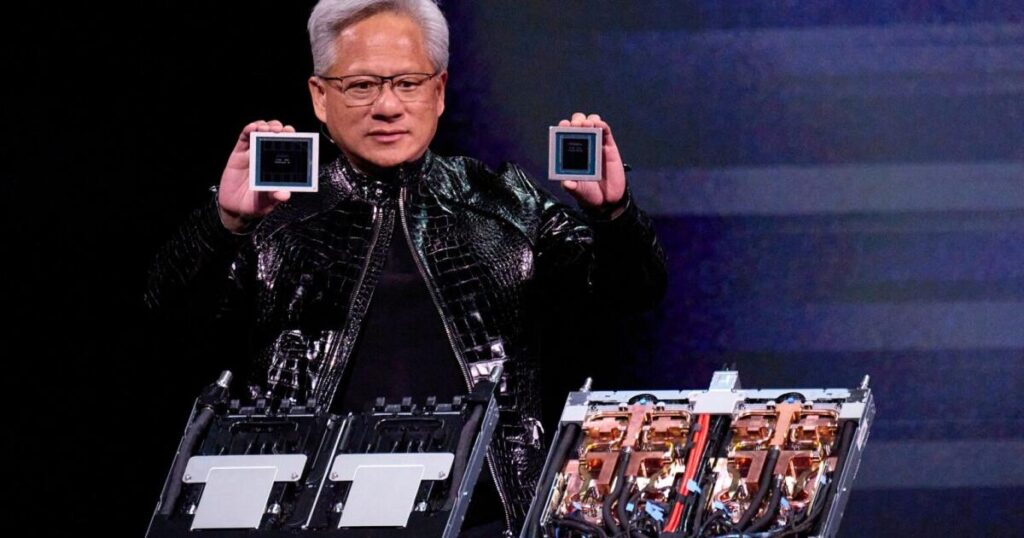
Nvidia Corp.’s latest sales forecast drew a bearish response from investors, signaling that concerns over a potential bubble continue to weigh on the dominant maker of artificial intelligence processors.
The shares fell Thursday after the chipmaker gave a first-quarter outlook that easily beat the average analyst estimate and Nvidia delivered a 73% surge in fourth-quarter revenue.
While explosive sales growth has turned Santa Clara, California-based Nvidia into the world’s most valuable company — sending shares up about 44% in the last 12 months — investors are seeking stronger assurances that the booming spending can be maintained.
Shareholders still have questions “over whether the current AI spending wave can sustain growth beyond the next few years, and whether Nvidia will remain as dominant as AI shifts from training models to running everyday tasks,” analysts at Hargreaves Lansdown said in a note after the results.
Chief Executive Officer Jensen Huang pushed back on the concerns during Wednesday’s call, arguing that customers are already making money from their newly acquired computing power. That’s why clients will keep investing at elevated levels, he said.
“You need compute capacity, and that translates directly to growth, and that translates directly to revenues,” Huang said. “I’m confident their cash flows are growing.”
Chief Financial Officer Colette Kress tried to defuse other concerns raised by analysts, including the specter of supply constraints. The company has secured enough components to be able to meet growing demand, she said.
It remains a challenge to produce enough of Nvidia’s most advanced chips, she told analysts. But the company’s current Blackwell lineup — and an upcoming successor, called Rubin — will still beat earlier sales projections, Kress said. Nvidia had previously said that the chips would generate $500 billion by the end of 2026.
“We believe we have inventory and supply commitments in place to address future demand, including shipments extending into calendar 2027,” she said.
Nvidia still faces uncertainty in China, the largest market for chips. The government has granted licenses to ship a small amount of H200 processors to customers there, but Nvidia doesn’t know if the Chinese government will give its approval, Kress said. For now, the company will continue to exclude data center revenue in China from its forecasts.
The small-scale license provided by the Trump administration requires the chips to go through a US inspection before they can be shipped to customers, Nvidia said. And the processors are subject to a 25% tariff when they come into the US.
Nvidia is the dominant seller of accelerator chips, processors designed to handle the huge amounts of data needed to create artificial intelligence models. The semiconductors are also used to run the software — a stage known as inference — when it carries out tasks in response to real-world inputs.
Santa Clara, California-based Nvidia has branched out into general-purpose processors, networking and full computer systems, giving it an even greater hold on customers.
Fiscal first-quarter revenue will be about $78 billion, the chipmaker said. Though the average prediction was $72.8 billion, some analysts had projected numbers approaching $80 billion, according to data compiled by Bloomberg.
In the fiscal fourth quarter, which ended Jan. 25, revenue gained 73% to $68.1 billion. Profit was $1.62 a share, excluding certain items. Analysts had predicted $65.9 billion in sales and $1.53 a share in earnings.
Adjusted gross margin, the percentage of revenue remaining after deducting costs of production, was 75.2%. That also edged past estimates.
“We aren’t sure what else investors want to hear at this point. But we like what we heard,” Bernstein analyst Stacy Rasgon wrote in a note after results.
Nvidia’s data center unit, which is responsible for its industry-leading AI accelerator and networking products, had revenue of $62.3 billion in the quarter. That compares with an average analyst estimate of $60.4 billion.
Other areas weren’t as strong. Gaming, which offers graphics chips that once provided the majority of Nvidia’s revenue, generated $3.73 billion in sales. The average estimate was $4.01 billion. Automotive-related sales were $604 million, with Wall Street predicting $643 million.
One cloud is hanging over the tech industry: a shortage of memory chips. Like much of the electronics industry, Nvidia’s products are reliant on a steady supply of these components, which provide short-term storage in everything from smartphones to supercomputers. Constraints have sent memory prices soaring and made it harder to ship as many devices this year.
That crunch has held back the gaming division, and Kress said she doesn’t know whether the problem will ease enough this year to let the business grow.
In any case, data center chips for AI have become a far bigger focus. Earlier this month, Nvidia announced that Meta Platforms Inc. has agreed to deploy “millions” of Nvidia processors over the next few years, tightening an already close relationship between two of the biggest companies in AI.
Nvidia’s main rival, Advanced Micro Devices Inc., announced this week a similar long-term deal with Meta. That chipmaker said the transaction would be worth multiple tens of billions of dollars.
A flurry of such megadeals, aimed at locking down long-term commitments for computing capacity, has been offered by the chipmakers as evidence that the AI economy is strong.
But the cozy nature of these transactions — with suppliers and customers sometimes taking financial stakes in one another — has drawn criticism about circular deals potentially inflating demand.
King writes for Bloomberg.
The post Nvidia’s strong earnings fail to ease investor concerns about AI bubble appeared first on Los Angeles Times.