Ever since its defeat in World War II, Japan’s place in the world has been shaped by a deliberate policy of restraint.
Under its pacifist postwar Constitution, Japan has for decades kept its military budget modest, sheltered under the U.S. security umbrella, and has avoided directly provoking an increasingly assertive China. Japan’s people, scarred by the trauma of World War II, supported that approach.
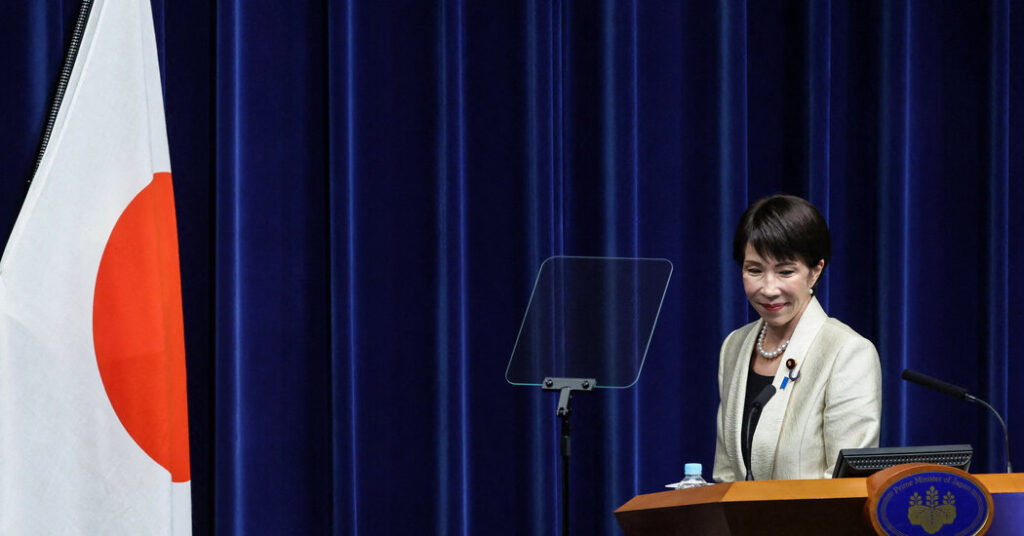
But this month’s landslide electoral victory by the hard-line Prime Minister Sanae Takaichi — who openly advocates a tougher approach to China and a more robust Japanese military — suggests that era may be ending. The implications for the region could be profound.
Caught between a more aggressive China and a less predictable United States, the realization has dawned in Japan that caution is no longer enough to guarantee its security. If this trajectory continues, it is likely to result in a U.S. ally that is more assertive, militarily capable — and central to deterring China. It is crucial that the United States encourages this evolution while ensuring that it strengthens, rather than weakens, regional stability.
The changing Japanese mind-set did not begin with Ms. Takaichi.
It has been years in the making, as the global landscape has shifted, particularly with China’s rise as an assertive military power. China increasingly sends ships into Japan-administered islands in the East China Sea and carries out threatening military maneuvers around Taiwan. Chinese expansionism or a conflict in the region would endanger the sea lanes and supply chains upon which Japan’s trade-dependent economy relies.
With these threats in mind, Japan, under former Prime Minister Shinzo Abe, reinterpreted its Constitution in the mid 2010s to broaden the circumstances under which it could use military force. Mr. Abe also created a National Security Council to strengthen decision-making on military matters and increased defense ties across the Indo-Pacific region. His successors, especially Fumio Kishida, continued this arc, approving the largest defense buildup in the postwar era and endorsing Japan’s ability to strike back if attacked — a shift once considered politically unthinkable.
Ms. Takaichi has indicated a willingness to take things even further.
In November, she implied that Japan could intervene militarily if China attacked Taiwan, the self-governing island democracy that Beijing claims as its territory. It was one of the clearest public signals by a Japanese leader in years that the country could come to Taiwan’s aid, and Beijing responded angrily with punitive economic measures.
Japanese voters were not intimidated, handing Ms. Takaichi and the long-ruling Liberal Democratic Party a supermajority of two-thirds of the seats in the 465-member lower house of Parliament earlier this month — the first political party to achieve that in the postwar era. That represents a historic mandate in a country whose prime ministers typically govern with narrow margins and must make deep compromises to their agenda to appease party or coalition factions.
Ms. Takaichi may now have the political leverage needed to succeed where Mr. Abe — her mentor — fell short: revising Japan’s Constitution to loosen constraints on its military. Article 9 of the Constitution renounces war and forbids maintaining a “war potential.” Japan has, in fact, built highly capable Self-Defense Forces over the decades, but Article 9 long served as a political guardrail, sustaining informal limits on military spending, offensive capabilities and overseas deployments.
Revising the Constitution wouldn’t mean an overnight change. But the eventual consequences could be far-reaching — formally recognizing a more conventional role for the military and clearing the way for higher spending and expanded operations beyond Japan’s shores.
I’ve spent years talking to policymakers in Japan, where revision of Article 9 was always discussed cautiously as a distant, future aspiration. Now, in the wake of Ms. Takaichi’s election win, there is a different feeling. In meetings across Tokyo that I took part in last week, Liberal Democratic Party lawmakers and cabinet officials spoke about constitutional revision as a plausible near-term objective. Japanese television commentators who once treated the topic as an abstraction now debate timelines.
Ms. Takaichi still must tread carefully, given lingering political sensitivity over the issue. Her room for maneuver could narrow further if her expansionist economic plans add to rising inflation. But the tone in Tokyo has clearly shifted.
A normalized Japanese defense posture would force Beijing to reassess its behavior in the region, including its coercive activities aimed at Taiwan. Up to now, China has felt free to increasingly flex its muscles, knowing that one of America’s closest allies — and one of the world’s richest economies and most advanced democracies — was constitutionally prevented from exercising its full military potential.
No one in Asia is eager for an arms race, and a more militarily capable Japan will inevitably stir painful memories in places that suffered under Japanese wartime occupation, particularly China and the Korean Peninsula. But today’s strategic choices must be governed by present geopolitical realities.
A constrained Japan may have been in America’s interest in the decades following World War II, but not anymore. A Japan that is willing to share more of the responsibility and cost of ensuring security in its neighborhood is likely to be welcomed by President Trump, who has pushed for U.S. allies to do just that. This is especially important at a time when American power is stretched by threats to peace around the globe and the nation is politically divided. Washington should embrace the potential for greater Japanese strategic autonomy as a sign of an alliance adapting to modern realities.
A stronger Japan is not a cure-all. If accompanied by nationalist rhetoric or provocative actions, it could unsettle the region rather than steady it. The aim should instead be to project quiet, credible strength. This will require restraint in Tokyo, discipline in Washington, and close, careful coordination between the two allies.
An early chance to display unity will come in March, when Ms. Takaichi is expected to make her first visit to the White House for talks with Mr. Trump. That trip will come ahead of a planned visit to China by Mr. Trump later in the month. The two leaders already have hit it off — Mr. Trump offered his “total endorsement” of Ms. Takaichi before her Feb. 8 snap election win — and a strong show of solidarity in Washington should be used to make clear to Beijing the emerging new realities.
The question is not whether Japan will act more like the power it already is — global changes are already pushing it in that direction — it is how that momentous change is managed in Tokyo, Washington and across the region.
Joshua W. Walker is president and C.E.O. of Japan Society and the author of “Alliance at a Crossroads,” which examines the history of U.S.-Japan relations.
The Times is committed to publishing a diversity of letters to the editor. We’d like to hear what you think about this or any of our articles. Here are some tips. And here’s our email: [email protected].
Follow The New York Times Opinion section on Facebook, Instagram, TikTok, Bluesky, WhatsApp and Threads.
The post Japan Is Redefining Its Place in the World appeared first on New York Times.