The third round of nuclear talks between the United States and Iran has begun in Geneva, as much of the world holds its breath to see if the massive military force President Donald Trump has assembled in the Middle East is a threat designed to bring the Iranians to heel or a promise to attack if negotiations don’t immediately produce a deal to his liking.
“I don’t think a final decision has been made yet,” said Sen. Mark R. Warner (D-Virginia), one of a small group of senior congressional leaders briefed on the president’s plans just hours before Trump delivered the annual State of the Union speech Tuesday evening before a joint session of lawmakers.
“Now whether you believe that or not is a totally different question,” said one person familiar with the administration’s outreach to lawmakers who spoke on the condition of anonymity regarding sensitive discussions.
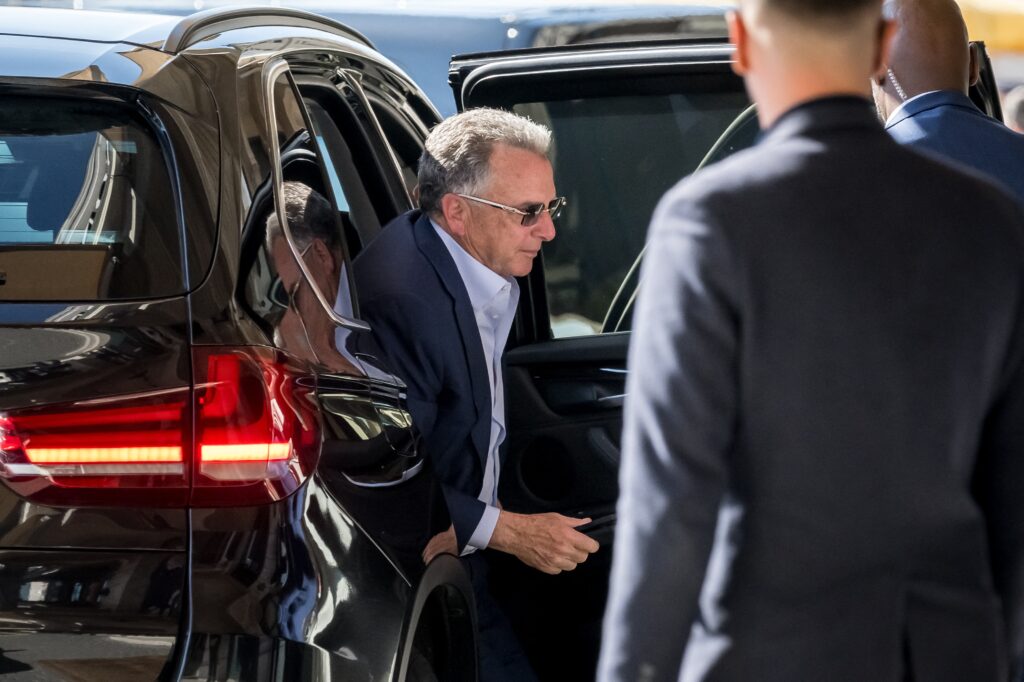
Chief U.S. negotiator Steve Witkoff and his fellow negotiator, Trump’s son-in-law Jared Kushner, arrived Thursday morning in Geneva and were seen meeting with Omani Foreign Minister Badr Albusaidi, who is serving as an intermediary in the indirect talks between the U.S. and Iran.
Trump’s address Tuesday provided few if any clues as to his ultimate intentions. He repeated claims to have “obliterated Iran’s nuclear weapons program” with airstrikes in June but said the Iranians were starting to rebuild it and “are at this moment pursuing their sinister ambitions.” He said Iran has refused to pledge never to have a nuclear weapon and was already working on intercontinental ballistic missiles (ICBMs) “that will soon reach” the continental United States.
All of those assertions have been questioned by international nuclear inspectors, who have assessed that most of Iran’s underground nuclear facilities remain intact, although their entrances are buried under rubble from the June bombings and have not yet been reached. Iran has amassed a worrisome amount of highly enriched uranium for which there is no other use but a nuclear weapon, although it has repeatedly said it has no intention of producing one.
Whatever Iran’s intentions may be, there is no evidence of an active plan to build a bomb, Rafael Mariano Grossi, head of the International Atomic Energy Agency, said last week in an interview with French television. Grossi was expected to attend Thursday’s Geneva meeting to provide the IAEA assessment and the parameters of inspections under any new agreement.
A report last year by the U.S. Defense Intelligence Agency — before the June U.S. and Israeli strikes — said that while Iran has missiles capable of targeting the Middle East and Europe, it could only produce a “militarily-viable” ICBM by 2035, “should Tehran decided to pursue the capability.”
Israel and the United States have said that much of Iran’s missile launch sites were destroyed during the June attacks.
As the drumbeats of possible war have increased, the administration has offered several different rationales for a U.S. attack: protecting Iranian civilians protesting the regime, Tehran’s refusal to agree to U.S. terms for a deal and defending some 35,000 U.S. soldiers based in the region from a possible attack.
While Trump has consistently said his goal is to prevent Iran from having a nuclear weapon, others in the administration have said Tehran must end all nuclear enrichment, surrender some 900 pounds of highly enriched material that is close to weapons-grade, curtail its ballistic missile program and end support for proxy militias in the region such as the Houthis in Yemen and Hezbollah in Lebanon.
Tehran has chosen to take Trump at his word, saying that the current talks are only about a verifiable pledge that Iran will not produce nuclear weapons in exchange for U.S. lifting economic sanctions.
Ali Shamkhani, an adviser to Iran’s supreme leader, said an agreement was “within reach” if the talks stick to Iran’s pledge not to build a nuclear weapon, adding on social media Thursday morning that Iran’s foreign minister has “sufficient support and authority” to come to a deal in the negotiations.
The new proposal Iran has said it is bringing to Geneva includes “token enrichment” — which Tehran says is its sovereign and legal right under the Nuclear Non-Proliferation Treaty — for medical purposes and other research, according to two people familiar with the negotiations who spoke on the condition of anonymity about closed-door diplomacy.
When an earlier round of talks took place last spring, Witkoff said publicly that Iran would be limited to 3.67 percent enrichment, the level agreed to in the 2015 deal under the Obama administration that Trump withdrew from during his first term. But within weeks, after some Republican lawmakers publicly rejected that option, Witkoff quickly pivoted, telling ABC in a May interview: “We cannot allow even 1 percent of an enrichment capability.”
Under the 2015 agreement, Iran shipped its then-existing enriched uranium stockpiles to Russia. This time, Tehran has said it will not allow the material to leave the country, although some officials have suggested they might be open to “diluting” enriched uranium to a lower level.
A number of Republicans and Democrats have said that military pressure on Iran can be useful if it leads to a nuclear deal. “What they’re doing right now, which is what I think is smart, is diplomacy backed up by force,” said Sen. Dan Sullivan (R-Alaska), a member of the Armed Services Committee.
Sen. Jeanne Shaheen (New Hampshire), the senior Democrat on the Foreign Relations Committee, said that “if the result of the buildup means that we can get people to the table and they can negotiate a diplomatic end to the current situation, that would be good — good for the United States, good for Iran, good for the region.”
But the question, raised by Democrats and foreign policy analysts, is what exactly the administration sees as a minimum viable deal and whether Trump will pull the trigger before negotiations have run their course.
“What I heard was real concern about, if you take out the ayatollah and take out their regime, what happens next?” Shaheen said, referring to Iran’s supreme leader and her conversations with foreign leaders. “Do you have the IRGC [Islamic Revolutionary Guard Corps] take over? Do you have all out civil war across the country? It’s really not at all clear. That’s why the lack of a strategy on the part of the president and the administration is so distressing.”
At the same time, “the president hasn’t explained why now is the moment for another war in the Middle East,” said Rep. Jim Himes (Connecticut), the ranking Democrat on the House Intelligence Committee. “If anything, he has done the opposite by continuing to insist publicly that previous strikes ‘obliterated’ the Iranian nuclear sites.”
“If this administration intends to take military action against Iran,” Himes said, “it must articulate a clear objective to the American people and seek constitutionally mandated congressional authorization.”
Amid the negotiations, Iran has responded with threats, vowing in public statements to retaliate in kind to any U.S. attack. On Wednesday, Tehran accused Trump of telling “big lies” in his Tuesday speech, including his assertion that 32,000 Iranians had been fatally shot by security forces during the 10 days of street protests that swept the country last month.
The U.S.-based Human Rights Activists News Agency says more than 7,000 people were killed during the demonstrations. Iranian officials have said about 3,000 people were killed, at least 200 of them police officers, by “terrorist” groups that took over peaceful demonstrations, but thousands of cases are still under investigation.
“We will enter the negotiating room with sincerity and goodwill,” said Deputy Foreign Minister Majid Takht-Ravanchi, a member of the negotiating team led by Foreign Minister Abbas Araghchi, in an interview with NPR. “If there is political will on all sides, I believe the deal can be reached as soon as possible.”
Ellen Francis, Ellen Nakashima and Susannah George contributed to this report.
The post Iran, U.S. resume nuclear negotiations as Trump’s war clock ticks down appeared first on Washington Post.