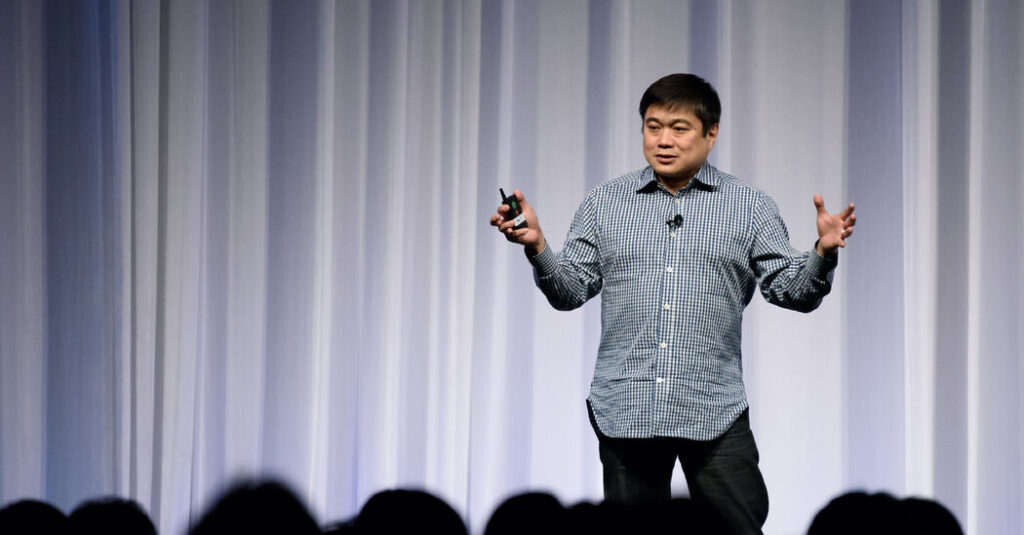
After a disgraced exit from the top ranks of American tech and media circles, an entrepreneur who had deep ties to the convicted sex offender Jeffrey Epstein secured a second act in Japan with the help of powerful allies in the Japanese government.
Joichi Ito, the entrepreneur, resigned in 2019 from a prominent position at the Massachusetts Institute of Technology after revelations about his efforts to conceal millions of dollars he raised through connections to Mr. Epstein. He also quit a position at Harvard University and board seats at the MacArthur Foundation and The New York Times.
Six years later, in Japan, Mr. Ito is helping lead a government initiative championed by Prime Minister Sanae Takaichi and her inner circle. The project, a strategic priority for the government, has more than $400 million in public funding and seeks to team up with top U.S. and Japanese universities to create a start-up hub in Tokyo.
Within the next few months, the Japanese government will decide whether to authorize the project, known as the Global Startup Campus Initiative, as a legal entity, the final step required for it to move ahead.
But Mr. Ito’s involvement caused universities including M.I.T., Harvard, Carnegie Mellon and Keio in Japan to distance themselves from the initiative after being approached as potential partners, according to interviews with government and university officials, as well as internal documents and emails reviewed by The Times. The project has fallen behind its own timeline targets.
And that was before the latest tranche of Epstein files released by the Justice Department shed new light on the depth of Mr. Ito’s ties to Mr. Epstein. These latest revelations are likely to further deter some potential partner organizations, said six government and university officials who spoke on the condition of anonymity to discuss their groups’ internal views.
Mr. Ito was a prolific correspondent with Mr. Epstein. A Times analysis shows that Mr. Ito and Mr. Epstein exchanged more than 4,000 emails through the years. The emails show that Mr. Ito was a frequent visitor to Mr. Epstein’s private Caribbean island, and the two were so close that Mr. Ito even joked about naming his daughter “Jeffrina.”
Mr. Ito did not respond to requests for comment. The university he heads in Japan declined to make him available for an interview. In previous statements made to local media, Mr. Ito has said he deeply regrets soliciting donations from Mr. Epstein. “I was never involved in, never heard him talk about, and never saw any evidence of the horrific acts that he was accused of,” Mr. Ito said in a statement in 2019.
A spokeswoman for Japan’s cabinet secretariat, which promotes the Global Startup Campus Initiative, said she recognized there were concerns about Mr. Ito. But the secretariat office decided to bring Mr. Ito on as an executive adviser, she said, “as we haven’t confirmed any wrongdoing by him and we believe he is highly knowledgeable.”
Mr. Ito, 59, was born in Kyoto, Japan, and raised in suburban Detroit. After dropping out of both Tufts University and the University of Chicago, he returned to Japan in the 1990s to start a string of early internet service providers.
A master networker, Mr. Ito maintained American connections as a venture capitalist with early stakes in companies like Twitter. In 2011, he was tapped for a prestigious position leading M.I.T.’s Media Lab, a sort of academic skunk works where designers and engineers build futuristic prototypes.
It was through these circles that Mr. Ito began associating with Mr. Epstein, who became a significant, concealed M.I.T. donor. Starting in 2013 — roughly five years after Mr. Epstein was convicted in Florida of soliciting prostitution from a minor — Mr. Ito met frequently with Mr. Epstein, and the financier contributed funding on multiple occasions for Mr. Ito’s ventures.
After a 2019 article in The New Yorker described the measures that Mr. Ito took to conceal Epstein-directed donations made to his lab, Mr. Ito resigned from M.I.T. At the time, he said he had “screwed up” by accepting the money, but that he had done so after a review by the university and consultation with his advisers.
Mr. Ito returned to Japan, taking a position at a little-known private university on the outskirts of Tokyo in 2021.
The next year, in 2022, Fumio Kishida, then the prime minister, introduced the Global Startup Campus Initiative. The plan was to build a research hub focused on technologies, including artificial intelligence and robotics. It was to be anchored by a partnership with M.I.T. and sought to recruit researchers from American universities to collaborate with Japanese entrepreneurs.
Mr. Kishida personally pitched the idea to former President Joseph R. Biden Jr. during a 2023 meeting in Hiroshima. A campus in central Tokyo was supposed to be completed by around 2028.
At its outset, Mr. Ito was not involved with the government group leading the project. But in early 2024, people involved in the initiative received a memo naming Mr. Ito as one of three leaders who would dictate the group’s strategies, along with two high-ranking Japanese government officials.
According to documents reviewed by The Times, the memo was sent by Akira Amari, a longstanding and influential figure within Japan’s Liberal Democratic Party, which has dominated Japanese politics for decades. At least four government and university officials said they were surprised at the time by the appointment of Mr. Ito, given his ties to Mr. Epstein.
Mr. Amari is close with the current prime minister, Ms. Takaichi, who has been known to call him “aniki,” or “big brother.” Ms. Takaichi has endorsed the initiative as one of her administration’s growth strategies. The prime minister and Mr. Amari’s offices did not respond to requests for comment.
In Japan, Mr. Ito’s role in the Global Startup Campus Initiative has gone mostly unnoticed. In 2025, a lawmaker, Satoshi Honjo, raised questions about the appointment during parliamentary sessions. He asked whether it was problematic for a person with ties to Mr. Epstein to, in effect, lead the initiative.
A high-ranking Takaichi administration official, Kiyoto Tsuji, then a cabinet office vice minister, responded by saying Mr. Ito “has provided us with a variety of useful information and advice toward realizing the initiative.” And, he added, “he is merely acting as a part-time adviser.”
But documents suggest Mr. Ito plays a much bigger part. Government officials have told potential partner universities that he plays a “pivotal role” in the initiative, according to internal documents and correspondence. The documents show a framework for the project that is based solely on “ideas from Professor Joichi Ito.”
More than three years after the group’s launch, it publicly lists a few universities — the University of Tokyo, Imperial College London and the National University of Singapore — as “pilot activity” partner organizations. Others have expressed hesitation in associating with a group tied to Mr. Ito.
M.I.T., Harvard and Keio University have each conveyed to Japanese officials that they would be reluctant to work with the initiative if Mr. Ito was involved, according to emails viewed by The Times and four individuals with direct knowledge of the interactions. At the start, M.I.T. was supposed to be a cornerstone partner.
Last year, Martial Hebert, a dean at Carnegie Mellon’s School of Computer Science, wrote in an email to Japanese officials obtained by The Times: “We will not be part of any project that involves Joi.” A spokesman for Carnegie Mellon confirmed that the school is not working with the Global Startup Campus Initiative but declined to comment on its reasoning.
In 2024, Richard K. Lester, then M.I.T.’s vice provost for international activities, told Japan’s minister in charge of economic revitalization that many of the school’s faculty would “find it difficult to cooperate with the Global Startup Campus if Mr. Joichi Ito was to occupy a significant position,” according to internal minutes from the meeting.
Imperial College London, the University of Tokyo, M.I.T., Harvard, and Keio University did not respond to requests for comment. The National University of Singapore said in a statement that it is working with the Global Startup Campus Initiative “under the purview of Japan’s Cabinet Office,” and that it had no relationship with Mr. Ito.
Before Mr. Ito was appointed in early 2024, the Global Startup Campus Initiative was behind schedule.
Two people familiar with its operations said it further lost pace after Mr. Ito joined. The spokeswoman for the cabinet secretariat said Mr. Ito helped introduce new strategies for the project that have enabled the group to “progress rapidly.” The spokeswoman said she could not comment on the progress of conversations with individual universities.
Although the Global Startup Campus Initiative has already been allocated a budget of more than $400 million, it will need to be approved by Parliament as a so-called operating corporation. The group had originally aimed to receive this approval last year. The decision on whether the initiative will be approved is now expected by July.
Some notable names publicly listed as the project’s “pilot activity” partner organizations include the Chan Zuckerberg Initiative, the philanthropy run by Meta’s chief executive, Mark Zuckerberg, and his wife, Priscilla Chan, and Hakuhodo, a major Japanese advertising company.
In a statement, a spokeswoman for the Chan Zuckerberg Initiative said it does not provide funding to the Global Startup Campus Initiative. Hakuhodo did not respond to a request for comment.
The latest Epstein files provide more detail about Mr. Ito’s money transfers with Mr. Epstein. In a May 2014 email exchange, Mr. Ito wrote to Mr. Epstein: “The slush fund, if it’s at MIT is easy. Should I send you the instructions?” Later that month, Mr. Ito confirmed receipt of the capital, writing, “I just got notice that $500K came into my slush fund account. Thanks!”
Mr. Honjo, the politician who questioned Mr. Ito’s appointment in Parliament, said in an interview that it was “an established fact” that Mr. Ito had not properly disclosed Epstein-directed financial contributions to his M.I.T. lab. “He can’t be called the right person for the job,” Mr. Honjo said.
The spokeswoman for the cabinet secretariat said the Global Startup Campus Initiative is moving into its next phase starting in the fiscal year that begins April 1. With regard to Mr. Ito, “we don’t believe there is a problem currently, but we will choose the appropriate people for the next fiscal year’s goals,” she said.
The recently released emails, as well as flight logs, detail at least five instances in 2013 and 2014 in which Mr. Ito planned to or did visit Mr. Epstein’s private island. In 2017, two years before he resigned from M.I.T., Mr. Ito wrote to Mr. Epstein saying he hoped his estate was OK after the devastation of Hurricane Irma. In a separate exchange, Mr. Epstein jokingly asked if “little Jeffrina,” Mr. Ito’s baby, had been born yet.
In Japan, the Epstein files have been treated mostly as a “domestic American issue,” said Chizuko Ueno, chief director of Women’s Action Network, a Japanese advocacy group. The Japanese establishment tends to ignore or bury contentious matters involving high-powered officials if there is no criminal conviction, she said.
Ms. Ueno is also a professor emeritus at the University of Tokyo, one of the institutions publicly associated with the initiative. Ms. Ueno said that Japan and the university had become less tolerant of individuals with histories of possible misconduct, and that she believed the school and government officials would increasingly find they “can no longer ignore it — they have to do something.”
Will Houp contributed reporting from New York.
River Akira Davis covers Japan for The Times, including its economy and businesses, and is based in Tokyo.
The post How a Close Associate of Epstein’s Found Career Redemption in Japan appeared first on New York Times.