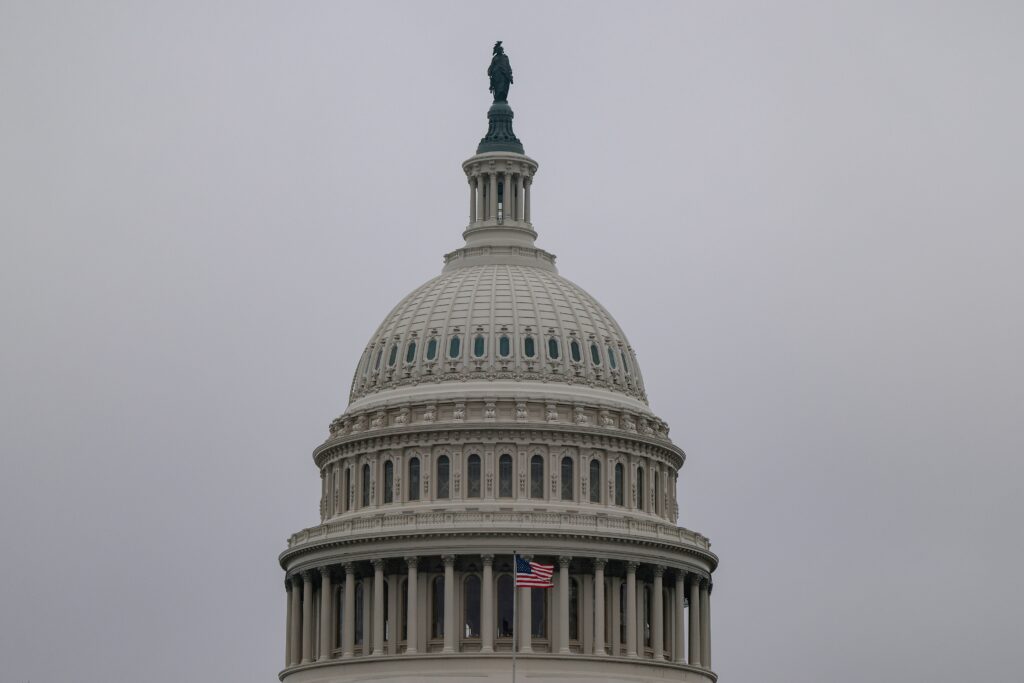
Jazz history. Border helicopters. Oyster shell recycling. Tuna research. Film education.
After one year off, the tradition of tucking millions of dollars for parochial projects into Congress’s annual funding legislation returned.
The 2026 federal funding package passed earlier this month included nearly $15.5 billion across 8,271 projects in lawmakers’ districts and states. An additional $273 million in earmarks are tucked into the Department of Homeland Security appropriations bill, which has not yet passed.
The funding — formally known as “congressionally directed spending” and informally known as earmarks — makes up just 1 percent of the $1.65 trillion in discretionary spending Congress has approved through Sept. 30, but it often receives outsize attention.
Critics argue the narrowly directed spending invites corruption, while proponents say it allows lawmakers to respond to local needs.
Either way, it provides a powerful incentive to keep lawmakers working toward bipartisan, full-year appropriations bills — the process Congress nearly completed earlier this month after extending 2024’s funding levels for all of 2025.
“Members do care. It does provide motivation to get bills to the floor and across the finish line,” said Charles Kieffer, who spent decades in the Office of Management and Budget and working for the Senate Appropriations Committee.
The money will bolster bridges, highways, sewer systems and airport tarmacs; renovate community centers, homeless shelters, housing projects and libraries; fund new hospital equipment, public transit and workforce training programs and more.
The funded projects include $200,000 for an oral history initiative about jazz at Lincoln Center in Manhattan requested by Senate Minority Leader Charles E. Schumer (D-New York). Sen. Susan Collins (R-Maine) secured $129,000 for bluefin tuna research in the Atlantic Ocean. Sen. Cory Booker (D-New Jersey) got $80,000 for film education programs tied to a local film festival. Rep. John James (R-Michigan) received $2.1 million for a “Northern Border Patrol” helicopter for his district that borders Canada, and Connecticut’s Senate Democrats, Richard Blumenthal and Chris Murphy, got $184,000 for an oyster shell recycling program.
The most expensive items were infrastructure projects under the Army Corps of Engineers.
An effort to replace the 86-year-old Chickamauga Lock on the Tennessee River received $213 million at the request of Rep. Chuck Fleischmann (R-Tennessee), and Senate Democrats Patty Murray and Maria Cantwell secured $190 million for a fish passage and water storage project at the Howard A. Hanson Dam in Washington after the Trump administration defunded the project under last year’s funding extension.
The money was spread unevenly across the country. California received the highest sum, at $1.07 billion, but the picture shifts when accounting for population: Alaska got $442 for every resident, Maine $335 and South Dakota $223, while large states like California and Texas got just $27 and $21 per person, respectively. Puerto Rico — with 3.2 million people and no voting member of Congress — got $3 per person.
Both Maine and Alaska will see competitive Senate campaigns for GOP incumbents, including for Senate Appropriations Committee Chair Collins, who has touted her ability to bring funding back as part of her reelection campaign.
In a statement to The Washington Post, Collins said lawmakers understand their constituents’ needs and adhere to rules that promote “transparency and accountability” in the earmark process. “From increasing access to higher education, child care, and affordable housing, to supporting Maine’s hospitals, improving our roads and bridges, and rebuilding police, fire, and EMS stations, these targeted investments will provide real and direct benefits for communities in all 16 counties,” Collins said of her requests.
When submitting requests, lawmakers now must certify that neither they nor their immediate family have any financial interest in the project they’re hoping to fund. Funding cannot go to for-profit recipients, lawmakers must show evidence that projects have community support, and earmarks can’t exceed 1 percent of discretionary spending.
Senators from the Appropriations Committee dominated the top of the rankings. Murray, the top Democrat on the panel, led all lawmakers, with $485 million across 96 projects. More than a third of that came from the dam project. She was followed closely by former Senate majority leader Mitch McConnell (R-Kentucky), at $484 million.
Fleischmann, who chairs the House Energy and Water subcommittee, topped that chamber’s list, at $250 million, almost all from the Chickamauga Lock project.
States that voted for Donald Trump in the 2024 presidential election received $3 billion more funding in total than states that voted for Vice President Kamala Harris, primarily because there are more of them. That funding is spread almost equally on a per capita basis: $46 per person in red states versus $44 per person in blue states.
Just over 27 percent of Republicans in the House and Senate, including some who have derided earmarks in the past, did not request any earmarks. Among Democrats in both chambers, 1 percent did not.
Last March, after a long delay and in a narrowly divided Congress, lawmakers decided to fund the government through the rest of the fiscal year by extending the previous year’s funding. They avoided the hard work of passing their own spending legislation but, in the process, eliminated more than $15 billion in earmarks.
The year-long funding extension and an extended shutdown in November also gave the Trump administration additional leeway to decide where federal funding goes — including by implementing funding cuts in states led by Democrats.
“I’m proud to have secured funding for important local projects across my state,” Murray said in a statement to The Post, adding that it safeguards against such funding cuts. “My constituents will know exactly what I fought for and delivered — I know they want a federal budget that prioritizes child care and affordable housing.”
By the time this year’s funding process came around, even members of the House GOP’s most conservative cohort, the House Freedom Caucus, were demanding leaders include earmarks.
In the years before lawmakers banned earmarks, they cost taxpayers an average of $17.8 billion a year.
A string of corruption scandals — including the “Bridge to Nowhere,” in which an Alaska lawmaker directed $223 million to connect a small town to an island with 50 residents — turned public opinion sharply against the practice. Congress banned earmarks entirely in 2011.
The ban, however, came with unintended consequences: Without the promise of local funding to bring home, lawmakers had less incentive to engage in the bipartisan dealmaking needed to pass annual spending bills on time.
Two of the country’s five major government shutdowns occurred in the ensuing decade, along with more frequent funding extensions. Congress agreed to bring earmarks back in 2021 — along with new rules aiming to increase transparency.
Critics of earmarks argue that lobbyists and special interest groups still have influence over which projects are chosen, and that the specialized spending contributes to wasteful government spending and a ballooning national debt.
Sen. Mike Lee (R-Utah) tried to eliminate earmarks in the most current spending package. “We don’t need this, we don’t want this,” Lee said in a floor speech ahead of the vote. “This is what’s driving the train toward the $38.5 trillion debt that we’re adding to at a rate of $2 trillion a year. It’s unacceptable, it must end.”
His amendment was defeated.
The post How $15.5 billion will be spent on Congress’s pet projects appeared first on Washington Post.