In 2024, Janice Daniel-Hodge received a call from a real estate agent on the Caribbean island of Nevis. Would she be interested in selling her late father’s land?
She was. Her father was the first premier, or leader, of the island after St. Kitts and Nevis gained independence from Britain in 1983. His estate included 25 acres on Nevis’s undeveloped south, and Ms. Daniel-Hodge signed an agreement to sell the land at some future date.
She didn’t know who the buyer was and didn’t think much more about it until late last summer, when she began hearing rumors that a wealthy Bitcoin tycoon had designs on the area.
Then, in October, came what locals have come to call simply “The Video.”
In it, Olivier Janssens, a 40-ish man with chin-length hair, a thousand-yard stare and a Teutonic accent, spends more than 15 minutes introducing viewers to Destiny, his planned semiautonomous paradise. Mr. Janssens, a Belgian cryptocurrency baron, delivers his pitch over an Enya-inspired soundtrack. Sweeping shots of yachts and sunsets off the Nevis coast give way to computer-generated images of people enjoying themselves by infinity pools on grassy terraced hillsides.
This beachfront fantasy comes with a special twist: If Destiny receives the necessary government approvals, it will live by its own rules and regulations, though the precise structure of its government remains unclear. While Mr. Janssens insists that Destiny would respect the Constitution of St. Kitts and Nevis, its special status could grant it privileges such as no taxes, the ability to conduct everyday transactions in cryptocurrency, and its own labor laws and police force.
This innovative form of governance, he said, would augur a new era of prosperity in this quiet corner of the Caribbean. “Europe has Monaco, and the Middle East has Dubai,” he says. “But the Americas still lack their own equivalent.”
Mr. Janssens offered up some sweeteners, as well, promising Nevisians part of the abundance: scholarships; revenue sharing, once the development sells enough housing units; and a $50 million investment in local infrastructure.
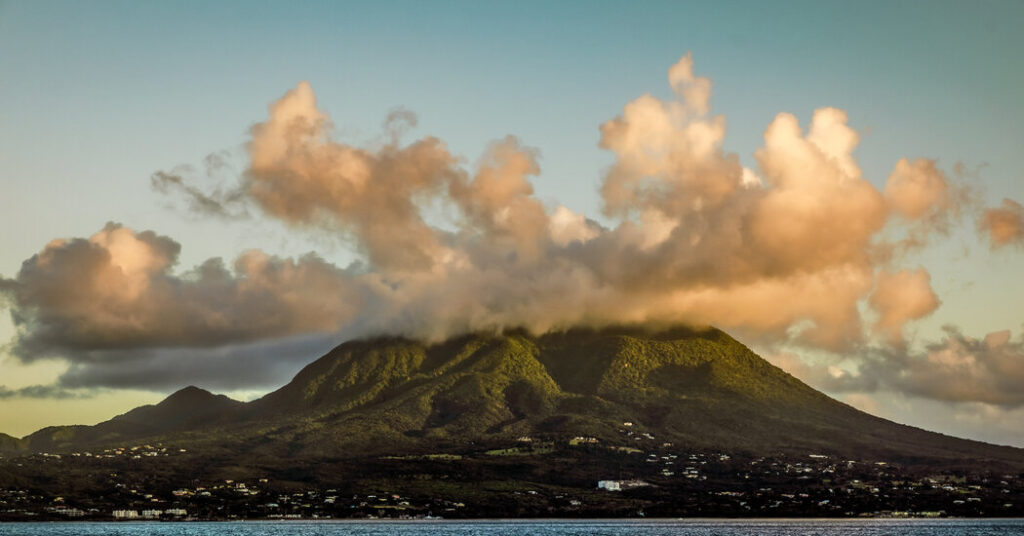
Nevis, the greener, calmer half of the two-island nation, has just 13,000 residents spread across 36 square miles; in a place that small, everyone knows everyone. In The Video, Mr. Janssens spoke to “my fellow Kittitians and Nevisians,” as he had become a citizen of St. Kitts and Nevis under a program that allowed tens of thousands of foreigners to buy the country’s passport. Still, none of the people interviewed for this article had met or seen him around. Neither Mr. Janssens, who lives in Monaco, nor his press team responded to multiple requests for comment.
If Mr. Janssens’s pitch was meant to persuade Nevisians to embrace his modern Eden, it seems to have had the opposite effect. “We don’t even have streetlights. We only have a few stop signs,” said Pam Barry, who for decades ran a hotel called the Golden Rock Inn. Ms. Barry, 80, and her former hotel business partners were also approached about selling land. “We were fending them off!” she said, laughing.
Locals love Nevis for its nature and peacefulness and worry that a large new real estate project will spoil that. But Destiny’s ambitions in particular have stirred up a deep-rooted skepticism of foreign influence: The island, whose Afro-Caribbean population is in large part descended from enslaved Africans, had been under colonial rule for much of its history.
Mr. Janssens is not proposing to recolonize Nevis, which is best known in the United States as Alexander Hamilton’s birthplace. Still, the idea of a Bitcoin bro administering portions of their island as his own fief felt like a step back, not forward.
“They’re creating an enclave with separate rights,” said Kelvin Daly, a local activist. “They come here with the belief that we are dimwits and we don’t know what these things mean. Well, we went to school, too!”
Perks, but No Passports
Olivier Janssens keeps a low profile, but he has publicly revealed three of his passions: Elon Musk, cryptocurrency and libertarianism.
He was one of many investors who helped Mr. Musk buy X in 2022, and he claims to have bought shares in Tesla and SpaceX, too. (“Buy anything Elon Musk,” he advised his followers on X in December 2024.)
Mr. Janssens’s crypto bona fides run deep. He was an “early ETH whale,” buying and holding Ether, the digital currency, said Vitalik Buterin, one of its founders. When it came to Bitcoin, he took a more active role, serving as a board member of the Bitcoin Foundation, established in 2012 to help rehabilitate the currency’s image after a series of scandals.
During his tenure at the foundation, he clashed with Brock Pierce, the child actor turned Bitcoin enthusiast who was the board’s chairman at the time. Mr. Pierce pressed for Mr. Janssens’s removal from the board in 2015, but despite their differences, Mr. Pierce now describes Mr. Janssens as “a courageous pursuer of his views on liberty.”
Mr. Janssens is so committed to libertarianism that he sued Deloitte, the accounting firm, in Rotterdam, the Netherlands, after an employee told him that his politics did not align with the company’s and declined his business. (Deloitte declined to comment.) In a separate court case against the firm, Mr. Janssens persuaded a Dutch human rights tribunal that he was the victim of discrimination based on his beliefs.
Those beliefs include a zeal for escaping government intrusion. To that end, in 2017 Mr. Janssens and Roger Ver, an entrepreneur better known as Bitcoin Jesus, revealed a vision for creating Free Society, “the world’s first libertarian country.” The pair announced a plan to buy sovereignty outright from an undisclosed nation looking to pay down its debts.
That joint effort apparently ran aground. In 2024, Mr. Ver was arrested on charges of criminal tax evasion. (He settled last year with the Trump administration, agreeing to pay a $50 million fine, and said he is not involved in Destiny.)
Starting a nation from scratch — much like the Free Society effort — is the gold standard for libertarian sovereignty enthusiasts. But like other wealthy libertarians, Mr. Janssens appears to have moved on to a more feasible alternative called a special economic zone: a territorial carve-out in an existing country with concessions for taxes, regulation, policing, zoning or labor.
Deep-pocketed proponents of this approach include Peter Thiel and Marc Andreessen, who have invested, via a fund called Pronomos Capital, in Próspera, an embattled Honduran enclave. Like Destiny, Próspera has grand ambitions; for now, though, its biggest selling points are Bitcoin acceptance and experimental drugs for longevity seekers.
Balaji Srinivasan, a crypto entrepreneur, has promoted what he calls Network State conferences, which are geared at creating virtual nations with the hope of eventually inhabiting physical territories. Tim Draper, the venture capitalist, has proposed a cryptocurrency-backed Special Economic Zone in Papua New Guinea, among other far-flung ventures.
In his public statements, Mr. Janssens says Destiny will emulate carve-out zones that exist around the world, from Shenzhen to Saudi Arabia. Most of these special zones are glorified ports or office parks with perks for corporations. Some have become havens for criminals; others house hedge funds. All allow for special treatment that creates a parallel regulatory system largely serving wealthy global citizens and their business interests.
In November, after The Video had gained infamy on Nevis, alarming some residents, Mr. Janssens tried to do damage control by addressing a group of his prospective neighbors sitting around a large table at Palm Gardens, an upscale event venue on the island. He did not address them in person, appearing instead in a white T-shirt on a wall-mounted screen.
One man asked Mr. Janssens about his earlier libertarian ideals, apparently referring to the Free Society effort. That plan was an “older idea,” Mr. Janssens responded. “I’m not saying it was completely crazy,” he continued, “but over the years you learn that running a proper country is not a simple thing to do.”
Destiny, he said, would not seek to emulate Próspera (which he called “a joke”) so much as the Dubai International Financial Center — a development indistinguishable from a mixed-use complex like New York’s Hudson Yards but for its specialized courts and arbitration tribunals that operate separately from the Emirati legal system. Expats, for example, are able to register their wills there so that their final wishes do not default to Islamic inheritance laws.
Mr. Janssens said this kind of setup offered some of the perks of nationhood and more “efficient” laws without all the burdensome responsibilities, like U.N. membership and passports.
From a nondescript room with pale yellow walls and an open interior door, Mr. Janssens politely took questions from the listeners at Palm Gardens, taking pains to make Destiny seem both grandiose and nonthreatening. Nevis could be the next Dubai, he said, but Destiny’s governance would be similar to a condominium association. Even so, his politics were hard to miss. He wanted a place that would protect personal safety and individual property, he said, a place where “you can do whatever you like as long as you don’t violate someone else’s rights.”
An Island Uproar
Special economic zones can be permissive, but they are hardly lawless. They typically obtain a legal mandate to operate from an existing state, and rely on that state’s legitimacy as a basis for their own.
To that end, in August, the National Assembly of St. Kitts and Nevis passed a law called the Special Sustainability Zone Act, which allows for the creation of semiautonomous enclaves. The law did not approve Destiny’s plans — more approvals are required for that — but it laid the groundwork on the national level.
In Nevis, Destiny’s loudest cheerleader has been Mark Brantley, the island’s highest-ranking elected official. His wife, Sharon Brantley, was the real estate agent who had reached out to Ms. Daniel-Hodge and other landowners on behalf of Destiny.
Ms. Daniel-Hodge is an environmental consultant who leads the opposition in the Nevis island assembly. She did not have a good feeling about the national legislation that allowed special zones; nor had she realized, when she sold the rights to her father’s land, that the buyers were angling for maximum autonomy. “Some people refer to it as a state within a state, subject to different laws than the rest of Nevis,” Ms. Daniel-Hodge said.
Livingstone Williams, a mechanic who owns property in the area, said he had turned Destiny down because he was put off by the intrigue around the project. “They want to live away from the general population,” Mr. Williams said, “and I have a problem with that.”
His concern was shared by many who wrote letters to officials, posted on social media and showed up for public meetings throughout the fall.
One such event was held at St. Paul’s Anglican Church, a pretty brick building surrounded by lush palms and bright pink bougainvillea near the Nevisian capital, Charlestown. Civil society groups gathered residents to discuss the project’s “merits and demerits.” But rather than looking to the future, their conversation turned to the past.
Glenn Griffin, a native Nevisian and professor emeritus at Occidental College in Los Angeles, gave a lecture on colonialism. “Destiny” — the crypto enclave, not fate — “is the culmination. It’s the extension. It is really the full fruiting of a desperate economic practice that we set up — really a practice that has not ever escaped colonialism,” he said.
The sentiment was summed up in a widely shared diss track that described the saga against a bouncy piano riff. It concludes: “Call it development, but it smells like chains.”
Even money doesn’t seem to be convincing Nevisians. So many landowners have turned Destiny down that the development, originally intended to cover 2,400 acres, has had to scale back.
Mark Brantley did not respond to several emails and WhatsApp messages. Publicly, he has described the unusually high level of public engagement as “democracy at work” and has assured constituents that Destiny’s residents would not have the right to vote in St. Kitts and Nevis elections. Destiny, he has said, positions Nevis “as a destination for high-end investment.” All of this, he says, would be a net positive for the island.
Still, the commotion, not to mention a poll that found Nevisians were overwhelmingly against the law and Destiny, led Terrance Drew, the prime minister of St. Kitts and Nevis, to appoint a panel to review the law to ensure transparency and accountability.
Democracy at Work?
The loud democratic process might have come as a shock to Mr. Janssens, who had spent much of the last year courting the Nevisian authorities behind the scenes.
His team had lobbied hard for concessions, going as far as to ask for the right to prosecute crimes committed in the zone. In a recording of a meeting with the local hoteliers association in October, Mr. Brantley can be heard saying he had pushed back, proposing to let Destiny prosecute its own cases only if the local authorities retained the power to step in. “It’s a kind of halfway, one foot in and one foot out,” Mr. Brantley said.
Destiny spared no expense on its building plans: Skidmore, Owings & Merrill, the firm behind One World Trade Center, drew up the architectural plans. Its judicial adviser is Mark Beer, the legal mind behind the Dubai International Financial Center’s courts. Another known quantity, at least in libertarian circles, is Tom W. Bell, a law professor who advised Próspera, the semi-sovereign Honduran enclave, on its laws. Mr. Bell recently pitched legislation on “freedom cities” to the Trump administration. (SOM did not respond to requests to comment. Beer and Bell declined to comment on their work with Destiny.)
The reaction to Destiny among ideological allies beyond the company’s ranks has been measured. Mark Lutter, the founder of the Charter Cities Institute, a think tank that promotes free zones, said Destiny could well succeed, but he warned that such projects “fail as often from bad ideas as from unresolved trust gaps.”
Mr. Pierce noted that Mr. Janssens had the cash to build. “The question is,” he said, “can he work with government in a way that will be successful?”
In January, three wooden shipping crates addressed to Sharon Brantley were shipped to Destiny’s Nevis office. The shipping label indicated the pallets each contained a Bitcoin ATM machine. Within hours, a photograph of the delivery was circulating on island WhatsApp groups. The phone number listed on the label was Ms. Brantley’s. Reached at that number, she declined to comment.
The law allowing special zones is only the first step toward approval. Late last year, Mr. Brantley sent Prime Minister Drew the final draft of an agreement he had reached with Destiny; he expects the prime minister to approve it “in short order,” as he said at a press conference. Destiny must also obtain the go-ahead from the country’s Parliament and the Nevisian Assembly, which Mr. Brantley’s party controls.
Janice Daniel-Hodge is hopeful the federal government will block the project. Still, she regrets signing the sale agreement back in 2024. Her feeling, she said, is compounded by her family’s legacy in Nevisian politics.
“My father was one of the architects of its Constitution, he fought to get Nevis rights to determine our own destiny,” she said.
The post Dubai of the Caribbean, With Crypto? Locals Aren’t Buying It. appeared first on New York Times.