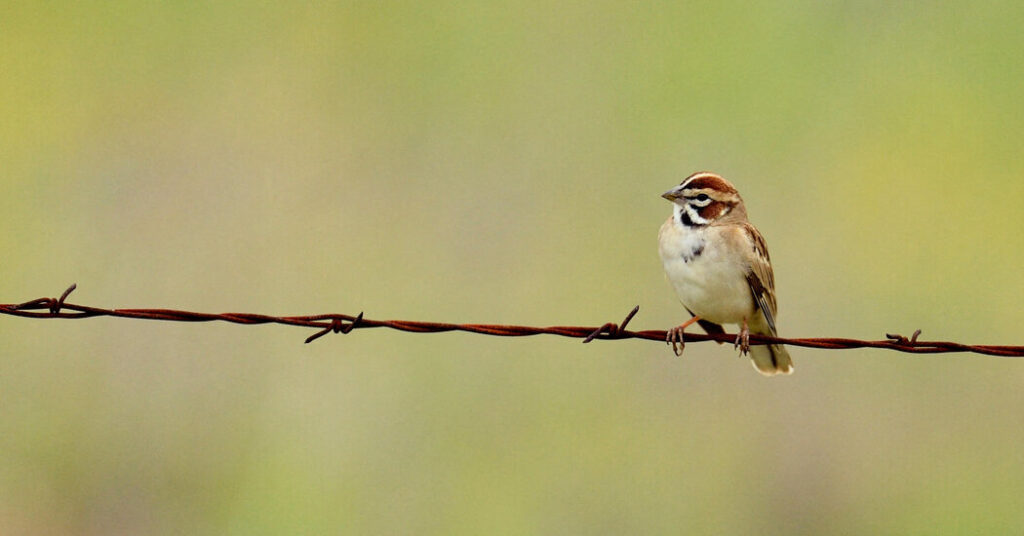
Birds in the United States are not only declining, but they are declining faster, especially in areas with intensive agriculture, according to new research. Overall drops in bird population, measured from 1987 to 2021, were sharpest in warm and warming areas, suggesting that climate change may play a role.
The study, published on Thursday in the journal Science, shows only correlation with intensive agriculture and temperature, not causation. It does not factor in other circumstances that may be affecting birds along migratory routes or while they are overwintering. But it adds to an ever more robust body of evidence that birds — one of the best measured families of animals on Earth, and a sentinel for the health of other species — are not OK.
Whatever the specific drivers, the accelerating losses make sense given society’s focus on economic growth, which often comes at a cost to the natural world, said Peter P. Marra, an ornithologist and dean at Georgetown University who specializes in bird populations and was not involved with the new research.
“The American dream turns into the American nightmare as we start to look at what we’re doing to biodiversity and systems that we depend on as humans,” he said.
In 2019, Dr. Marra and a team of scientists published landmark findings that the number of birds in the United States and Canada had fallen by 2.9 billion, or 29 percent, since 1970.
Thursday’s study relied on one of the same data sources, the North American Breeding Bird Survey, a monitoring project led in part by the United States Geological Survey. Observers count birds along designated routes of roughly 25 miles each. To analyze rates of decline, the new research was limited to 1,033 routes that offered yearly or almost yearly counts, and ultimately included 261 bird species.
In 1987, the team found, each route had 2,034 birds on average. By 2017, that average had decreased by 304 birds per route, or 15 percent. The steepest losses were seen in Florida, Texas, Louisiana and Arizona. Generally, they correlated with warm places and, to a lesser degree, with places that saw rising temperatures over the past 30 years.
The researchers also found that bird declines have sped up over time. On average, each route lost what amounted to an additional quarter of a bird per year compared with the previous year. While that change may sound small, accelerating declines can quickly snowball. For example, a 25-mile route that lost roughly 10 birds per year early on was losing around 19 birds annually by the end of the 34 year period, said François Leroy, a postdoctoral macroecology researcher at Ohio State University and the study’s lead author.
When the team analyzed and mapped the rates of decline, hot spots of acceleration lit up in California, the Midwest and the Mid-Atlantic region.
“We were quite surprised to see those patterns,” Dr. Leroy said. The team decided to add further analysis, using statistical modeling to look for associations. Among 20 metrics, they looked at fertilizer use, pesticide use and area of cropland. “What we found is that any metric of agricultural intensity was always the best predictor of acceleration of the decline.”
But the authors themselves and scientists who were not involved in the work emphasized that more study was needed to determine what was actually driving the losses.
“We want to be very careful here,” said Marta Jarzyna, one of the authors and a professor at Ohio State who specializes in macroecology. “It’s very difficult to really get the mechanism of change with a large-scale, continental-scale correlative study such as ours.”
In 2023, a study on European birds tried that, finding that agricultural intensification, in particular pesticides and fertilizer use, was the main driver for most population declines, especially in birds that ate invertebrates such as insects.
Many scientists believe that trouble in the insect world, where declines are much harder to quantify, is creating trouble for birds. Most terrestrial bird species in North America depend on insects at some point in their life cycles, often when they are young. One study found that the 2.9 billion birds lost since 1970 came from species that depended on insects. Those that did not rely on insects actually increased by 26 million, an 111-fold difference, it found.
But there are lots of other pressures facing birds. They get eaten by cats, slam into glass windows during migration and face habitat loss. Climate change is affecting insects, birds and the timing of natural cycles.
In a bright spot from the research, forest-dwelling bird populations were found to be stable or increasing, perhaps related to an expansion in habitat as unused farmland in certain areas returns to woods.
Morgan Tingley, an ornithologist and quantitative ecologist at the University of California, Los Angeles, praised the study’s use of sophisticated statistical modeling, particularly in finding the accelerating declines.
“While this study is not definitive of the causes why” Dr. Tingley said, “it at least suggests, pretty convincingly, that it’s not just one thing.”
Catrin Einhorn covers biodiversity, climate and the environment for The Times.
The post Birds Aren’t Just Declining. They’re Declining Faster, a New Study Finds. appeared first on New York Times.