SEOUL — In the seven years since President Donald Trump and North Korean leader Kim Jong Un walked away from nuclear negotiations, Kim’s nuclear ambitions and weapons arsenal have only grown more potent. This week, Kim left room for restarting talks with Washington — but only on his own terms.
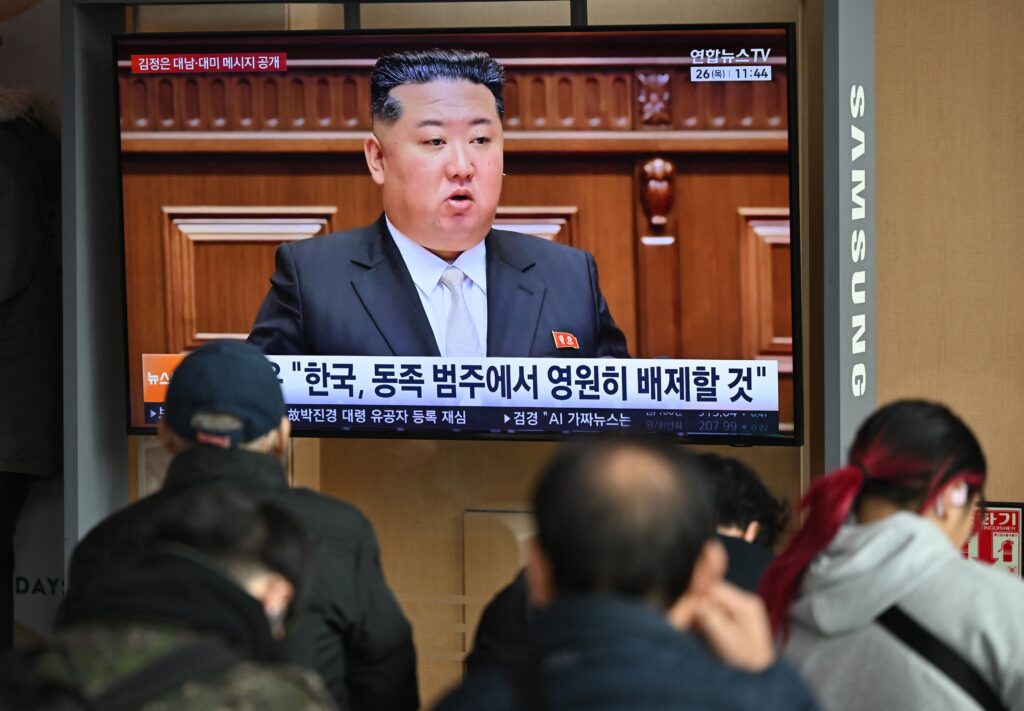
In remarks laying out his policy priorities for the next five years, Kim declared North Korea’s nuclear program — which he has been advancing despite international sanctions — as “permanent” and “completely and absolutely irreversible,” vowing to expand his nuclear-capable munitions and arguing that the weapons are necessary to protect North Korea’s interests in a quickly shifting geopolitical landscape.
Kim also announced new weapons systems that he plans to pursue, including sea-launched long-range ballistic missiles capable of reaching the continental U.S., multiple-launch rocket systems aimed at South Korea, and artificial intelligence-powered unmanned systems.
“It is our party’s firm and unwavering will to further strengthen state nuclear forces and thoroughly exercise nuclear-armed state status,” the Korean Central News Agency (KCNA) on Thursday quoted Kim as saying as he concluded the ninth congress of the ruling Workers’ Party of Korea, the first such meeting since 2021.
North Korea now has about 50 nuclear warheads and has enough fissile material to produce up to 40 more, according to the Stockholm International Peace Research Institute, which tracks the global arms trade.
Kim said North Korea is open to restarting talks with Washington only if the United States ends its “hostile” policies and accepts Pyongyang’s nuclear status — a tall order, given the long-standing U.S. policy to pursue North Korea’s denuclearization.
Pyongyang views U.S. joint military drills with South Korea and U.S.-led international sanctions as hostile acts, and has repeatedly demanded the U.S. change course as a precondition for a return to talks with Washington.
“The prospect of the DPRK-U.S. relations depends entirely on the attitude of the U.S. side,” state media quoted Kim as saying, using the abbreviation for North Korea. “Whether it is peaceful coexistence or eternal confrontation, we are prepared for everything, and that choice is not made by us.”
Trump has said he wants to meet with Kim and, during a trip to Asia last October, offered to extend his trip if Kim agreed to meet. But Kim did not respond.
Instead, in his remarks this week, Kim bashed the “America First” foreign policy under Trump, blaming Washington for its “hegemonic ambition” and “arbitrary practices that make the world noisy and uneasy,” state media reported.
“The world at present is completely different from the one five years ago, and international relations have been plunged into the vortex of chaos and upheaval,” Kim said, according to state media. “Due to the U.S. hegemonic policy, a serious change is taking place in the existing international order and structure of international relations based on the multilateral system, and the standard of justice and the value of strength are being reevaluated.”
Kim’s stance underscores his growing self-confidence as a leader whose standing in the world has vastly changed since the Russian invasion of Ukraine, analysts say. North Korea has been one of the strongest — and among only a few — backers of Moscow, dispatching at least 12,000 troops to fight in Vladimir Putin’s war against Ukraine.
That support, in return, has made Kim suddenly relevant internationally, rubbing elbows with Putin and Chinese leader Xi Jinping in a show of defiance against U.S. global power. North Korea may have also received much-needed cash, oil and military technology from the Russians, U.S. officials say, despite sanctions that ban such support.
“North Korea is in a very different place now, and most of us who follow North Korea understand that. They’re not interested in engagement in the way they were in the past,” Joel Wit, a former State Department official who helped negotiate a 1994 nuclear agreement with North Korea, said Thursday at an event for his book “Fallout: The Inside Story of America’s Failure to Disarm North Korea.”
“They have new allies, certainly Russia, and they’ve always had China. Their nuclear and missile forces have grown,” Wit said, adding that Kim is “feeling like he’s a player on the world stage now.”
In week-long party meetings, Kim emphasized the need to strengthen the nation’s economy as well as its conventional and nuclear forces, and shook up his party leadership structure to strengthen his grip on power. His teenage daughter, who South Korean intelligence officials believe is being trained to become his successor, accompanied Kim at a military parade in Pyongyang where thousands of goose-stepping soldiers marched through Kim Il Sung Square.
Kim also doubled down on his hard-line stance toward South Korea. In recent years, Kim has declared the South an enemy state and formally abandoned the long-standing North Korean goal of reunification.
In his remarks, Kim said North Korea would be justified in using nuclear weapons against South Korea — the most explicit nuclear threat Kim has made against South Korea, said Rachel Minyoung Lee, senior fellow at the Washington-based Stimson Center’s Korea Program and North Korea state media specialist.
Instead, Kim called on his country to build stronger relationships with “anti-imperialist independent countries,” probably a reference to Pyongyang’s recent efforts to strengthen ties with Russia’s key allies and partners, including Belarus, and socialist nations in Southeast Asia, such as Laos and Vietnam.
North Korea’s troop deployment to Russia appears to have “fundamentally transformed” how it sees its role on the world stage, Lee said. Russia appears to have given North Korea the recognition it seeks as a nuclear state, and China has stopped publicly calling for North Korea’s denuclearization in recent years — reinforcing Kim’s views and “giving North Korea even less incentive to engage Washington,” Lee said.
“It is precisely this self-confidence, or what many would describe as an emboldened Kim Jong Un, that poses the greatest hurdle to North Korea’s reengagement with the United States and the West,” Lee said.
The post An emboldened Kim flaunts nuclear ambitions while leaving room for U.S. talks appeared first on Washington Post.