If you’re a high school teacher in the United States right now, you don’t need a news report to tell you that artificial intelligence companies want you to prepare your students for an “A.I.-driven future” — or that more than half of teenagers are already using chatbots for their schoolwork.
That’s why this fall, when we opened our annual multimedia contest for students — this one focused on “Growing Up With A.I.” — we knew that it was critical to invite the voices of educators too. In fact, our hope, was that teachers and students might tackle some of our big questions together.
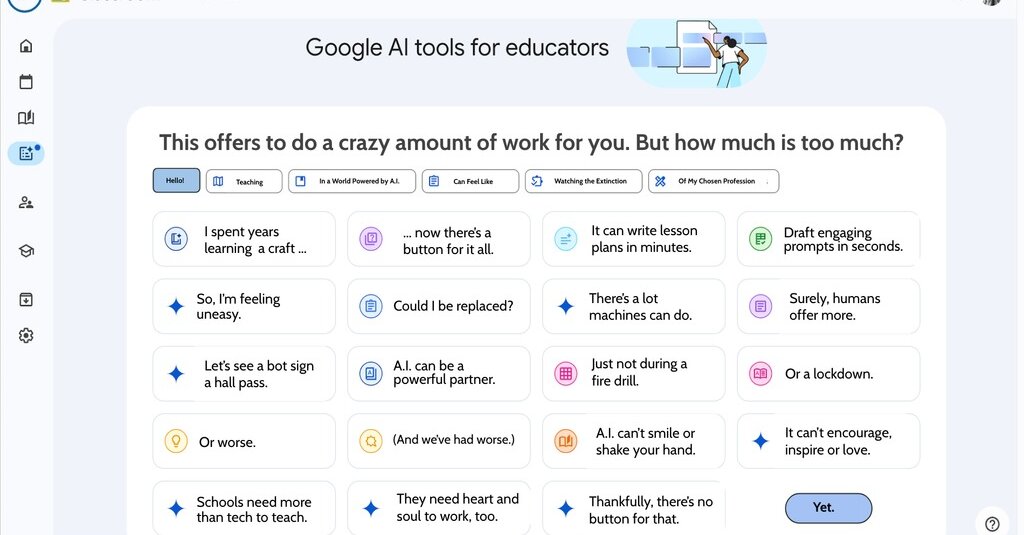
Altogether, we heard from over 2,500 people, and you can find the winning student submissions here. Below, we’ve compiled our favorite educator responses, which pose big questions of their own, including — as you can see in Evan Grossman’s image, above — “Could I be replaced?”
We invite you to read these pieces alongside the student work, and leave comments for both the teens and the adults. What did you notice? What did you learn? What will stay with you?
No Colossus
By Michelle Hintz
Bloomsburg Area High School, Bloomsburg, Penn.
In study hall, I watched a kid use Snapchat to take pictures of his computer screen. He was working on IXL skills. His Snap A.I. friend sent an immediate reply. He then clicked the answer on his screen. The next question popped up, he took a picture and got an answer. He swiftly went through the whole session this way. His right hand held the phone, he tapped the camera button, glanced at the reply, and his left hand entered the answers on his laptop. He didn’t know I was watching, but I saw the gold medal of 100 percent mastery bloom on his screen. I told the teacher who assigned the IXL. She didn’t realize Snapchat had an A.I. that would do her homework. It can answer all the questions.
I experimented with my own Snapchat account. I customized its avatar and personality. I took pictures of the various quizzes, comprehension worksheets, and essay prompts I assign to students. In seconds, my A.I. friend responded correctly to everything I fed it. Creative writing assignments proved to be more challenging, and it kept responding with a weird “snake appears in a car then car crashes” scenario. How many of my students do school this way? It’s so easy. I took pictures of my colleagues’ math problems and science labs. Those answers appeared, too. It’s an old rerun: Kids find ways to cheat. Teachers feel defeated.
I’ve noticed for several years how student writing is getting more grammatically correct and yet becoming increasingly impersonal, yet flowery. I used to struggle to get kids to capitalize letters, now capitalization is perfect. Lofty adjectives punctuated with commas and phrases offset by em dashes fluently flow — feats in writing never before performed consistently. Essays are gelling into a generic Jell-O mold of expression. If I run a student’s work through A.I. detectors, I may get three different results. One may say 17 percent human, or maybe 100 percent A.I., and another will read 100 percent human. Usually, if I show the student the detector proclaiming their work is A.I., they fess up.
I’ve become more suspicious of my students’ work. How do I grade it? When is using A.I. cheating? When is it a resource? It feels absurd, but I ask A.I. how to make my assignments A.I. proof. Do we take all technology out of their hands? It’s futile. I’m straddling an old curriculum that supports standardized testing and this new generative landscape. But I am no Colossus. I teach English in rural Pennsylvania, and my power is limited. I’m muddling through and trying to figure it out. I want my students to want to write something of their own. Create, kids, don’t peep about dishonorably. Create.
Teaching What A.I. Can’t: The Human Work of Art Education
By Inyoung Seoung
Art tutor, Los Angeles
What does it mean to teach in an age when artificial intelligence can answer almost any question? As an art teacher, I see the answer in the students who enter my studio with neat prompts and a dangerous trust in the machine.
Students used to be called the “Google generation” or the “smartphone generation.” Now, overnight it feels like the “A.I. generation.” They type a prompt and treat the output as if it were their own thought. This isn’t harmless efficiency; it’s a training in passivity. Rather than testing, pushing or complicating an answer, many students accept it. They stop practicing the habit that mattered before: clarifying what they truly want and wrestling to express it. In a world where A.I. can supply polished results faster than any human, the real question becomes who has the direction, the voice, the questions that matter.
Paradoxically, the students we call “prodigies” are often the least flexible. I’ve watched technically gifted painters refuse to explore new tools or methods, convinced that skill alone defines value. They cling to craft while the world’s measures of intelligence shift toward ideation and toolful collaboration. Meanwhile, students who once worried they couldn’t draw learn to develop ideas that adapt, grow and surprise. Those forever-evolving students invent things worth noticing. That adaptability is the human edge in an A.I. age.
Traditional classes teach basics, but they rarely prioritize training students to ask richer questions of the world and of themselves. That is the work of art. Art education trains students to shape a viewpoint and translate an inner question into a projection. In my classroom, A.I. is a brainstorming partner: It offers variation and unexpected directions. But it becomes valuable only when a student interrogates those suggestions, mixes them with memory and feeling, and then edits with stubborn hands. That labor turns machine prompts into personal language.
This is not a plea to abandon technology. It is a call to change schooling. In many American schools, art is an afterthought. That is a tragic mismatch. If the future rewards those who can imagine direction and use tools to realize it, then art should be central, not peripheral. Teach students to ask better questions before they ask the machine. Teach them to use A.I. to deepen their voice, not to replace it.
I’ve witnessed it firsthand: One student who always claimed she “couldn’t draw” used an A.I.-generated sketch only as a springboard. By interrogating it, she created a project more personal and powerful than anything she had produced before. Art trains students to lead the tool so that it may aid them in making something truly their own. In the A.I. age, nothing is more revolutionary than that.
Beyond the Bots: Teaching Analysis in the Age of A.I.
By Susan Carney
River Dell High School, Oradell, N.J.
As new students arrive each fall, I frantically match names with faces and learn students’ personalities so I can build a vibrant and accepting classroom community. Mixed in among the class clown and the anxious kid this year is a new presence. This presence speaks like a human, gains skills at record pace and pretends it has all the answers.
That presence is A.I.
Most tech products, including many school-based platforms, now boast “A.I. integration.” There is a subtle, scary message underlying these shortcut A.I. apps: Time spent reading and thinking is time wasted. The lesson I outline in my video interrogates that.
At the end of the lesson, students discussed the flat, limited A.I. analysis of the painting. As the class read about the artwork on various websites, I heard, “Wait, what?!” as they discovered parts of the painting they (and A.I.) had not explored. As a teacher, I live for those moments, and I won’t let A.I. rob my class of discovery and wonder.
While I can’t banish the new presence in the room, I will let it sit in the back and wave its hand in the air for a while. I refuse to let it monopolize our class discussions.
Why I’m Excited About Generative A.I. in Education
By Evelyn Nam
Seoul International Academy, Seoul
I am part of a team building a new international school in South Korea. As I look ahead, I am excited that A.I. is here: For the first time, the South Korean education system will need to value good questions more than it values memorization. For a country with such zeal for education, South Korea has fallen behind in leadership for one glaring reason: Our students grow up knowledgeable but lack the courage to ask necessary — and creative — questions at the right (or wrong!) time.
With A.I., South Korea will now have to confront a reality and a conclusion that we’ve been wanting to avoid for long: Machines are far superior at memorizing and storing knowledge, so let’s have human people ask questions, debate endlessly and communicate freely.
Who can forget, in 2012, when President Barack Obama asked if there were any question to a group of press in South Korea and no one raised their hands? Who can forget, in 2011, when government regulators approved a humidifier disinfectant without asking basic safety questions, leading to over 1,500 deaths? Even our globally praised Covid-19 response — successful because of compliance and collective action — revealed the double-edged sword of not asking questions.
South Korea is marked by questions we did not ask throughout history. And it’s not that I don’t feel sympathetic. Our tendency to not ask questions intensifies in the face of crisis, as a country that has been threatened by so many external forces ever since its birth; we have mistaken unity for sameness and silence for strength. I get it; we believed both were necessary for our survival.
But as an educator, I don’t want my students to live in a survival mode anymore. I want them to say what they want, ask what they want, challenge who they want, and speak up when they want. I want them to stop surviving like we had to — I want them to start thriving, especially in a world where Korea finally has the world’s attention through K-pop, K-drama and K-beauty.
A.I. is our chance to change. I’m excited that A.I. is here and that it’s reshaping our high school education. I’m excited to let students explore generative A.I. with different questions and let them see what type of answer they get to each question. That feels like the liberty we are long overdue to give our students. And I’m ready to build that system, one step at a time, an education system that does exactly that.
For Good, Not Evil: Teaching in the Dawn of A.I.
By Valerie Boehm
Pickens High School, Jasper, Ga.
I believe that the endless possibilities of A.I. have added more vitality and creativity to my teaching, and I am thrilled to be teaching at a time when it’s still possible to shape how A.I. is used in the classroom. However, I believe that our core purpose in education should remain unchanged.
Hey, A.I., Leave Our Mistakes Alone.
By Travis Gasper
The John Cooper School, The Woodlands, Texas
As an eighth grade English teacher, my thoughts about A.I. keep returning to the increasing discomfort the average adolescent has with vulnerability. Students have been sharing the ways that they use generative A.I. to smooth the rough edges of adolescence. They ask it to refine their text messages, solve fights with friends, explain their math, explain their reading and give them workout advice. They are driven into interacting with generative A.I. at the precise time when they should be reaching out to others. Adolescence is the stage of life where we learn who we are through trial and error. It is when our voice cracks in the classroom, and we want the world to swallow us up. But it is also when we realize that everyone is going through it, and no one remembers that voice crack two weeks later.
Students now make their mistakes in private, with a sycophantic parrot that squawks empty encouragement. They are offloading the rough edges of life into LLM’s — and OpenAI appreciates the engagement.
In the classroom, this translates into vulnerability avoidance. When my eighth graders came up with their classroom norms this year, “Don’t judge,” or some variation, was the most-repeated standard. They fear making mistakes in front of each other. So, I decided to harness the sycophantic parrot in a classroom celebration of mistakes. Students interviewed a partner on a past mistake of their choosing. Partners then wrote song lyrics about that mistake (from scratch or with A.I. assistance). They asked their partner for a musical style that they enjoy before handing all of the information back to me. Finally, I used Suno to create a mixtape of mistakes.
Students laughed together instead of at each other. Their songs have become a part of our classroom community celebration of mishaps. It is an audio record of an important lesson of adolescence: It can suck, but you can make it, and it sucks less when you make it together. At the same time, it allows me to model an approach to A.I. that spotlights using the tool to push us toward one another in the common space of the classroom rather than getting dragged into the pit of solo engagement and dependency.
A David Brooks quote I have taped to my desk states, “A key job of a school is to give students new things to love.” As A.I. continues to rapidly influence education, I think that we will also begin to give students old things to love. And, while I don’t think any eighth grader will leave my class loving vulnerability, my hope is that they leave appreciating its importance in shaping our minds and our hearts.
The Co-Lab Story: The Power of Collective Curiosity
By Nate Green
Sidwell Friends School, Washington, D.C.
We didn’t set out to start a movement. But we had to do something.
In the summer of 2024, a small group of teachers from different independent schools came together on Zoom because we felt a growing urgency: Artificial intelligence was already reshaping education, and our schools had no coherent plan for how to respond. The professional development available to us was fragmented and shallow — tech speakers, app demos, policy conversations — nothing that addressed the real challenge: how teachers should adapt to a new world where A.I. aces our courses.
There are no manuals. No one-size-fits-all solutions. Just us, facing questions that felt overwhelming and unavoidable.
Innovation requires use. Progress requires resilience. And both thrive when teachers build community and stand in solidarity.
So we created Co-Lab.
In Co-Lab, there are no experts; we are all learners. Every Co-Lab cycle starts with a teacher-designed exploration and a teacher-led introduction call. We seek ideas and connections with those who actually have experience teaching in the generative A.I. age (not consultants, professional organizations or salespeople).
Co-Lab is part laboratory, part collaboration. Each month, we explore a real classroom use of A.I. on our own, then come together to share what we did, what worked and what didn’t. We ask one central question: To what extent will this use of A.I. enhance teaching and learning? This simple but powerful question keeps the focus on pedagogy not hype. Our discussions highlight the potential and call out the pitfalls of A.I. use in our classrooms.
In March, we launched “A.I. for Feedback” by testing research-backed prompts designed to help students improve their skills. The exploration revealed both the promise and the limits of using A.I. to support formative learning. When we came together to share how we might apply this with students, the discussion built common ground across classrooms and strengthened our collective confidence to bring these insights back to our schools. As one participant said, “I’m just scratching the surface, and it makes me want to dig in.” That spirit of curiosity is exactly what we hope to inspire in our students.
In just a few months, Co-Lab grew from nine people to hundreds of educators from across the country, all of us committed to exploring A.I. with honesty, humility and curiosity. Co-Lab has created something teachers rarely find: a space for growth and encouragement. Our success depends on all of us learning and developing critical A.I. literacy together to address the complex challenges created by the rise of generative A.I.
Co-Lab was born because nothing else gave teachers what we needed. It continues because our solidarity fuels us, and it matters because the decisions we make now will shape our students’ futures. They need us.
The post Adapting to a New World: Teachers on How A.I. Is Reshaping the Classroom appeared first on New York Times.