On Thursday, the United States and Iran will meet for a high-stakes round of nuclear negotiations in Geneva. The outcome may determine whether they go to war or strike a deal.
President Trump, in his State of Union address on Tuesday, said he preferred to resolve the standoff with Iran through diplomacy. But he added, “I will never allow the world’s top sponsor of terror, which they are by far, have a nuclear weapon, can’t let that happen.”
Iran, however, has said it will never totally give up nuclear enrichment. “Our fundamental convictions are crystal clear: Iran will under no circumstances ever develop a nuclear weapon; neither will we Iranians ever forgo our right to harness the dividends of peaceful nuclear technology for our people,” said the foreign minister, Abbas Araghchi, in a social media post.
Iran’s proposal was designed to maintain some level of enrichment while also allowing Mr. Trump to declare victory. Four Iranian officials who were not authorized to speak publicly said Iran would offer a suspension of nuclear activity and the enrichment of uranium for three to five years. After that, the country would join a regional nuclear consortium while maintaining a very low level of enrichment, 1.5 percent, for medical research.
It would also offer to dilute the 400 kilograms of highly enriched uranium it still maintains in phases, while allowing access to inspectors from the United Nations atomic agency to oversee all steps and monitor compliance.
What happens on Thursday?
Mr. Araghchi, leading his country’s negotiating team, and the U.S. special envoy, Steve Witkoff, and Mr. Trump’s son-in-law, Jared Kushner, will hold meetings mediated by Oman. This will be the third round of talks since negotiations resumed this month following Mr. Trump’s threat to intervene militarily in the midst of an uprising in Iran against the government in January. Iran cracked down with lethal force, killing at least 7,000 protesters, according to rights groups.
In the talks, Iran must convince Americans that it has no intention to weaponize its nuclear program and also give Mr. Trump enough leeway to claim he achieved more than his predecessors ever did in dealing with Iran. The U.S., in turn, has to incentivize Iran with some tangible rewards, like lifting both the threat of war and economic sanctions on Iran’s international banking and oil sales that have contributed to the near collapse of its economy.
Iranian officials have also said publicly that their proposal to the United States will include a pledge to buy American goods, such as passenger airplanes, and an invitation to American companies to invest in Iran’s energy, oil and gas industries and gain access to mines with minerals like lithium. Iran’s supreme leader, Ayatollah Ali Khamenei, had banned American companies from entering Iran in the first deal but has now granted permission, Iranian officials said.
“A large economic cooperation between Iran and the U.S. could function as a catalyst for building trust,” said Hossein Mousavian, a former senior diplomat and spokesman for Iran’s nuclear negotiating team in 2015, in an interview.
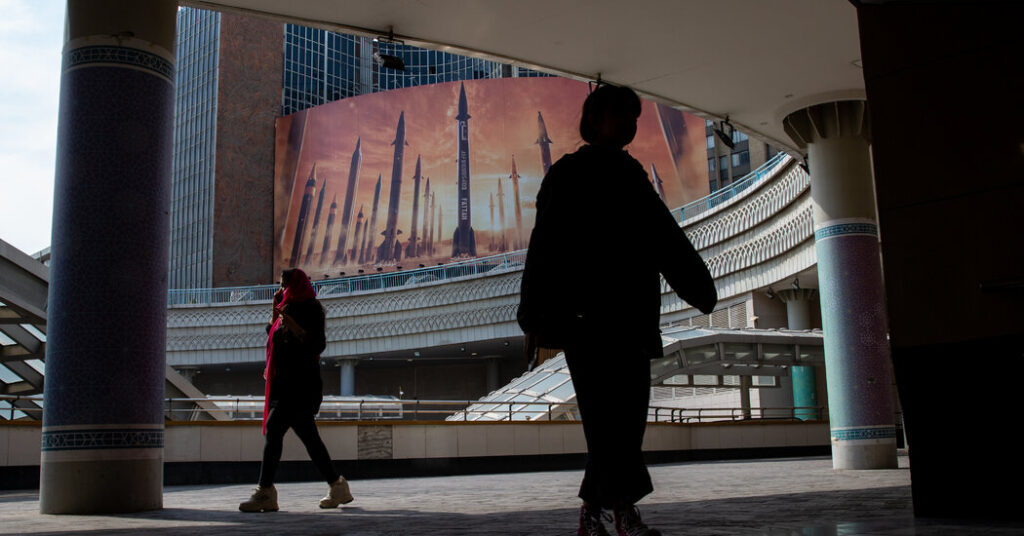
Iran’s missile program, specifically the range of its ballistic missiles, which at 2,000 kilometers can reach Israel and all the U.S. bases in the region, and its support of militant groups in the region, are not currently on the table.
“Iran refuses- refuses- to talk about the ballistic missiles, to us or to anyone and that’s a big problem,” said secretary of state Marco Rubio on Wednesday to reporters. He said eventually Iran and the U.S. would need to have conversations beyond the nuclear program.
How did Iran and the U.S. get to the brink of war?
In 2018, during his first term in office, Mr. Trump followed through on a campaign promise and withdrew the United States from a nuclear deal between Iran and world powers secured during President Obama’s term in 2015.
Under the deal, called the Joint Comprehensive Plan of Action, Iran’s enrichment was capped at 3.5 percent, a civilian grade, and it shipped its stockpile of enriched uranium to Russia. The U.N.’s International Atomic Energy Agency and American intelligence agencies determined that Iran was in full compliance with the deal.
Mr. Trump imposed tough economic sanctions on Iran, targeting its oil sales and blocking its international banking transactions. European countries that were party to the deal, France, Britain and Germany, complied with the U.S. sanctions. Those efforts effectively left Iran with little to no rewards under the deal.
Iran gradually increased its enrichment from 3.5 percent to 60 percent, which is close to the 90 percent weapons-grade, and amassed enough of a stockpile of highly enriched uranium to be able to build several nuclear bombs if it chose to do so with a breakout time of several weeks, according to Rafael Grossi, the head of the U.N.’s atomic agency. Iran has maintained that it’s nuclear program is for peaceful purposes.
In June, Iran and the United States were engaged in negotiations when Israel launched a surprise attack on Iran, starting a 12-day war. It culminated with the U.S. dropping bunker bombs on Iran’s three main nuclear facilities, significantly damaging the structures and effectively bringing Iran’s nuclear program to a halt.
Iran’s stockpile of enriched uranium is believed to be buried under the rubble of one of the nuclear sites, according to Iranian and American officials.
What happens next?
In the past few weeks, the United States has built up a massive military presence around the Middle East and near Iran’s borders, positioning itself in case Mr. Trump orders military strikes on the country. The United States has also boosted defenses at its military bases around the region and deployed a Navy warship to Israel’s shores to help against possible Iranian retaliation.
It’s the largest American military buildup in the Middle East since the U.S. invasion of Iraq in 2003. Mr. Trump is considering several military options if talks fail, according to U.S. officials, including an initial strike that would be limited to military targets, sustained and more widespread strikes against Iran’s nuclear and missile facilities, and creating conditions on the ground for the removal of Iran’s supreme leader Ayatollah Ali Khamenei.
Iran has vowed to retaliate immediately and said it would target all U.S. bases and facilities in the region and Israel with a barrage of ballistic missiles. Mr. Khamenei warned that Iran would attempt to sink America’s warships. Analysts and senior American military figures such as retired Gen. David Petraeus, who commanded U.S. forces in Iraq and Afghanistan and served as the director of the C.I.A., have warned that the war with Iran could be lengthy and destructive, could inflict harm on American soldiers and would deplete America’s military resources.
So all eyes are on Geneva throughout the region and beyond.
“This is going to be the decisive round, if Iran doesn’t show enough willingness to compromise and the U.S. doesn’t show willingness to provide enough sanctions relief, things are going to explode,” said Sanam Vakil, the director of the Middle East and North Africa program at Chatham House. “They are going to lay out all their cards on Thursday.”
Farnaz Fassihi is the United Nations bureau chief for The Times, leading coverage of the organization. She also covers Iran and has written about conflict in the Middle East for 15 years.
The post A Deal or War? Crucial Talks to Begin Between U.S. and Iran appeared first on New York Times.