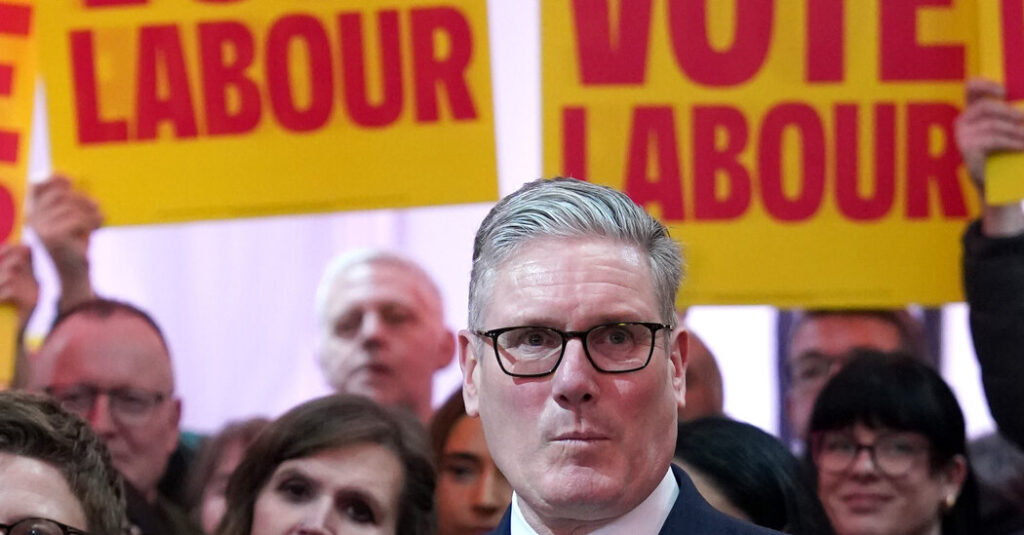
For decades, the communities of Gorton and Denton, southeast of Manchester, England, have been Labour Party strongholds. Filled with a mixture of working-class voters, students and university graduates, and home to a large ethnic minority population, they are the kind of places that helped make Keir Starmer prime minister in 2024.
So it will be especially striking if Mr. Starmer’s party comes third in a special election there on Thursday, a defeat that would add to the political crises that have recently rocked Mr. Starmer’s government. Polls in the district show Labour essentially tied with Reform U.K., a right-wing populist party, and the Green Party, which backs a progressive, left-wing agenda.
The candidates for all three parties are claiming an edge as they clash in what has become an increasingly nasty period of electioneering. Accusations have been flying of broken campaign laws, expressions of racial hatred, misrepresented polling numbers and bad faith promises to the voters.
This week, the leader of the Green Party called Labour “irrelevant” in the election. Labour leaders accused the Green candidate of trying to “manipulate” voters by circulating campaign materials written in Urdu that urged Muslims to “punish Labour for Gaza.” A Reform activist who had campaigned in the area was suspended by the party for online posts deemed racist and antisemitic.
In Parliament on Wednesday, Mr. Starmer ignored the threat from the Green Party. Instead, portraying the race in Gorton and Denton as a face-off between Labour and Reform, he lashed out at Nigel Farage, Reform’s leader.
“His party has nothing to offer the country but grievance and division,” Mr. Starmer said, noting that Matt Goodwin, the Reform candidate, had suggested that someone’s race or ethnicity could affect whether they should be considered British, by saying that “it takes more than a piece of paper to make somebody ‘British.”
Mr. Starmer said: “That does not represent our country, and anybody who wants to stand against that hatred and division should vote Labour on Thursday.”
Mr. Starmer campaigned on Monday in the district, which is a roughly four-hour drive north of London. Most experts say it can be divided into two distinct parts, with contrasting demographics. One part is about 60 percent nonwhite, and about 40 percent of the population are either students or university graduates, according to census data compiled by Rob Ford, a professor of political science at the University of Manchester. The other part of the district is over 80 percent white, with a large share of working-class voters.
Andrew Gwynne, the lawmaker who currently represents the area, announced last month — citing health reasons — that he would step down. That triggered the vote, which is known in Britain as a parliamentary by-election.
If Mr. Goodwin wins, it will be another in a string of victories that has boosted Reform’s profile despite having just eight lawmakers in the 650-seat House of Commons. It would also suggest that Mr. Starmer has failed to woo Reform voters with tougher immigration policies.
A victory by Hannah Spencer, the Green Party candidate, would be seen by many as an expression of dissatisfaction with Mr. Starmer among left-leaning voters. Many view his 18 months in office as a lost opportunity to further a progressive agenda and are frustrated over what they view as the government’s lack of support for Palestinians.
A victory by the Labour candidate, Angeliki Stogia, could deliver a setback to the Green Party, whose support has been rising in opinion polls, and would be a blow to Mr. Farage’s efforts to portray his party as marching toward victory in Britain’s next general election, which must be held by the summer of 2029.
But it is Mr. Starmer who has the most to lose if his party stumbles. His approval rating is the lowest on record for a British prime minister, due partly to policy missteps and flip flops that have contributed to his reputation as a weak and indecisive leader.
“It would be a major blow to an already staggering leadership, because this seat started out as one of the safest Labour seats from the last general election,” said Professor Ford, of the University of Manchester, who once collaborated on a book with Mr. Goodwin.
“I mean his approval rating graph is — if you’re a Labour M.P. — it’s a terrifying sight,” he said, referring to the prime minister.
Special elections in Britain, as in the United States, often draw few voters. And because of the country’s “first past the post” system, whoever gets the most votes wins, even if they are far from a majority of the ballots cast.
With just one seat up for grabs, such votes rarely change parliamentary math in a significant way. But the outcome can send shock waves through politics, destabilizing losing parties and galvanizing the winners.
Opposition parties have achieved many by-election victories over the decades by mobilizing public dissatisfaction with the government of the day. Last year, Reform snatched victory from Labour in Runcorn and Helsby, a district in the northwest of England, by just six votes. That win, along with victories in municipal elections and favorable opinion polls, helped shape a narrative that Reform was a serious political force to be reckoned with.
Failing to win can have implications, too. In May 2021, the Labour Party, then in opposition, lost in Hartlepool — a seat considered one of its strongholds in the northeast of England — to the governing Conservatives. That prompted Mr. Starmer to consider quitting as Labour leader.
“In the end I reflected on it, talked to very many people and doubled down,” he later said in an interview.
Mr. Starmer’s position strengthened in July that year, after another special election in Batley and Spen, in Yorkshire, that Labour narrowly won.
Now, however, Mr. Starmer is politically weaker, worn down by his checkered time in Downing Street. Two weeks ago, the leader of the Scottish Labour party called for him to step down amid revelations about the ties between Peter Mandelson, whom Mr. Starmer had appointed to be ambassador to the United States last year, and Jeffrey Epstein, the convicted sex offender.
Mr. Starmer survived that moment thanks to support from members of his cabinet. Professor Ford said the prime minister’s rivals in the Labour Party are likely to wait to challenge him formally until after large-scale elections in May, when voters will elect lawmakers to the Scottish and Welsh Parliaments and choose local council members across parts of England.
But Professor Ford said that if Labour lawmakers wake up to a big loss on Friday morning, they may be spooked enough to move more quickly.
“One should never underestimate the role of herd psychology and panic,” he said. “Leadership challenges often go from looking very unlikely to looking inevitable in the course of the day.”
Michael D. Shear is the chief U.K. correspondent for The New York Times, covering British politics and culture and diplomacy around the world.
The post A British Special Election Could Hardly Have Come at a Worse Time for Starmer appeared first on New York Times.