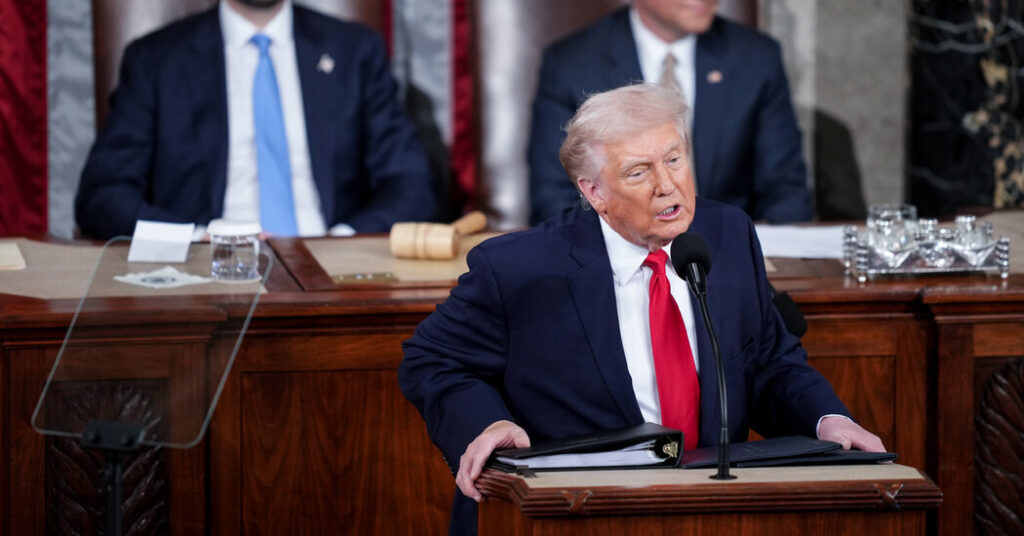
President Trump is sounding a lot like President Joseph R. Biden Jr. these days, at least in one respect.
In a State of the Union address on Tuesday night that sought to reframe his first-year economic record before a midterm election that threatens to upend Republican majorities in Congress, Mr. Trump told a skeptical U.S. public that the economy was doing great, despite what many Americans may believe.
“Inflation is plummeting,” Mr. Trump declared on Tuesday. “Incomes are rising fast.”
“Wages keep going up,” Mr. Biden had said two years ago in his final State of the Union address. “Inflation keeps coming down.”
Telling voters that the economy is better than they believe is a risky strategy, as Mr. Biden found out in his own truncated re-election campaign. He had spent months with an on-again, off-again branding exercise to sell “Bidenomics” as an economic miracle that never quite stuck. It did not matter that he was armed with a blizzard of macroeconomic data. Voters felt squeezed.
Now, with polls showing that a majority of Americans think that Mr. Trump’s policies have made life less affordable, he was the one trying to sell the idea that America has entered a “golden age.”
“The roaring economy is roaring like never before,” the president said, bragging about what he characterized as the stock market’s rise, the drop in gas prices and lower mortgage rates.
For former top Biden economic and White House advisers, Mr. Trump’s pitch feels like a bad case of déjà vu.
“I would be lying if I didn’t say fellow alums didn’t laugh when Trump says the same things that used to come out of our White House,” said Kate Berner, a White House communications adviser during the Biden administration.
“He is telling people to ignore their lived experience and that economic indicators and what the elites are saying should overpower what they feel or see,” Ms. Berner added. “Trump would slam us for saying it, and now he’s doing the exact same thing.”
The two presidents even have a familiar and favored scapegoat — each other.
“I inherited an economy that was on the brink,” Mr. Biden said two years ago, blaming Mr. Trump.
“I had just inherited a nation in crisis with a stagnant economy,” Mr. Trump said on Tuesday, blaming Mr. Biden.
And both presidents claimed credit for a turnaround that voters had not bought into.
“Now our economy is literally the envy of the world,” Mr. Biden said in 2024.
“Now we are the hottest country anywhere in the world,” Mr. Trump said on Tuesday.
That is not how voters see it.
Overall, 70 percent of voters viewed the economy as only fair or poor, according to the most recent poll from The New York Times and Siena University, down from 74 percent in February 2024, shortly before Mr. Biden delivered his speech.
In 2024, 40 percent of voters said the economy was worse than a year before; last month an almost identical 41 percent said the economy was worse than it was a year ago. (The share who said the economy was getting better has ticked up this year to 31 percent, up from 23 percent two years ago.)
Bharat Ramamurti, a deputy director of the National Economic Council under Mr. Biden, saw Mr. Trump falling into the same trap as Mr. Biden in telling people the economy is better than they think.
“It is like quicksand,” Mr. Ramamurti said. “It feels like the more you struggle and say ‘No, it’s really good!’ the more you get sucked in,” he said. “I wish I knew the answer to get out of it. But I don’t.”
Sean Duffy, Mr. Trump’s transportation secretary, said in an interview on CNN after the speech that the difference between the arguments by Mr. Biden and Mr. Trump was that “the results are real for President Trump.”
“You do have to talk about what you’ve done and why it’s positive for the American people,” Mr. Duffy said.
Another similarity included the pledges that Mr. Trump and Mr. Biden made about prescription drug prices — an issue that political strategists say is deeply resonant with voters.
“Americans pay more for prescription drugs than anywhere in the world,” Mr. Biden said in 2024. “It’s wrong, and I’m ending it.”
“Americans who have for decades paid by far the highest prices of any nation anywhere in the world for prescription drugs will now pay the lowest price anywhere in the world,” Mr. Trump said on Tuesday.
Jared Bernstein, a chairman of the Council of Economic Advisers under Mr. Biden, said that Mr. Trump, like his predecessor, had a host of favorable economic data that he could cite. But those metrics, he said, are a long way from affecting the public’s sense of affordability.
“Productivity growth, which is economists’ holy grail in terms of economic progress, appears to be picking up some,” Mr. Bernstein said. “He has some macroeconomic tailwinds that he could legitimately brag about. The problem is people don’t eat productivity or pay their rent with G.D.P.”
The echoes extended to the rebuttals that the opposition parties gave then and now.
“The American people are scraping by while President Biden proudly proclaims that Bidenomics is working,” Senator Katie Britt of Alabama said two years ago in the official Republican response to Mr. Biden’s speech. “Goodness, y’all. Bless his heart. We know better.”
Gov. Abigail Spanberger of Virginia, who delivered the Democratic response to Mr. Trump’s speech on Tuesday, had a similar rejoinder.
“Is the president working to make life more affordable for you and your family?” she asked of Mr. Trump. “We all know the answer is no.”
Shane Goldmacher is a Times national political correspondent.
The post Who Said It Better? How Trump’s Economic Pitch Echoes Biden’s. appeared first on New York Times.