It made headlines in 2018 when the U.S. ambassador to Israel made an official visit to an Israeli settlement in the West Bank, breaking a longstanding foreign-policy taboo. Most of the world views the settlements as illegal, and U.S. officials had steered clear to avoid lending them legitimacy.
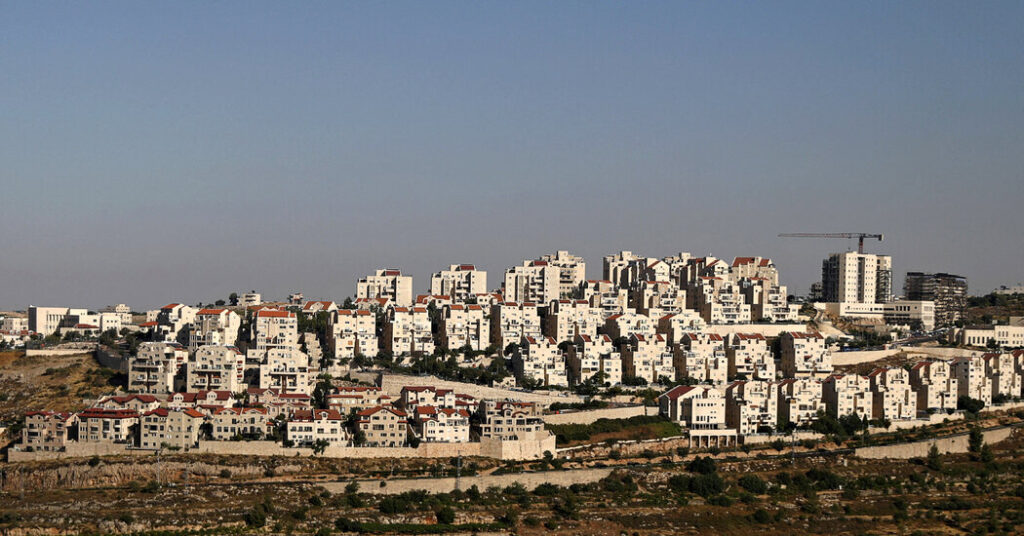
Another barrier is about to be broken. On Friday, the U.S. Embassy in Jerusalem has announced, it will set up shop in Efrat, a fast-growing Jewish settlement, to offer American citizens assistance with their passports. The embassy plans to do the same in Beitar Illit, an ultra-Orthodox settlement, in the coming months.
Such one-day consular pop-ups have operated before in Palestinian towns in the West Bank like Ramallah and Taybeh. Others are also planned in the Israeli cities of Haifa, Beit Shemesh and Netanya. But officials said Friday would be the first time consular services were delivered in an Israeli settlement.
An embassy spokesman insisted that the move did not represent a change in U.S. policy.
But Israelis and Palestinians, in an unusual convergence of opinion, agreed that it did.
On the Israeli right, Foreign Minister Gideon Saar called the embassy’s move an “important decision,” and Yuli Edelstein, a settler, lawmaker and former Knesset speaker, praised it as “a blessed step of tremendous importance.”
Mr. Edelstein said it “adds to the international legitimacy of our right to the regions of our homeland in Judea and Samaria,” using the biblical names for the West Bank. He added that Israel needed to take “the next step” and apply its sovereignty there as well.
Hamas issued a statement calling it a “dangerous precedent” and a “de facto recognition of the legitimacy of settlements and the occupation’s control over the West Bank.”
The settlements are Jewish communities on territory Israel seized in the 1967 war, envisioned by much of the world as part of a future Palestinian state.
Most countries consider the settlements illegal. International law bars an occupying power from transferring its population into occupied territory, and from confiscating that land for reasons not necessary for its own security or benefiting the occupied population.
In Ramallah, the Palestinian Colonization and Wall Resistance Commission said the move violated the “principle of nonrecognition of illegality.” It flew in the face of American commitments to support a two-state solution by “entrenching a settlement reality,” the commission said, and amounted to an effort to grant the settlements “additional political cover.”
And on the Israeli left, Michael Sfard, an expert on international human-rights law, said that bringing consular services to residents of Efrat gave an unmistakable new stamp of approval. There was simply no rationale for it otherwise, he said.
“It’s a very small bedroom community,” he said of Efrat, which has nearly 13,000 residents and sits barely eight miles south of the embassy in Jerusalem. “All their services they get from Jerusalem. If they want to see a movie, they go to Jerusalem. This cannot be construed in any way other than as a political statement of legitimization of Israeli settlements in the West Bank.”
Liberal critics of the embassy’s announcement also noted that it was at odds with President Trump’s repeated statements rejecting Israeli annexation of the West Bank, and that Ambassador Mike Huckabee is a longtime supporter of annexation.
“The Trump people are so focused on Gaza that they completely miss what’s happening to the West Bank,” said Nadav Tamir, executive director of the Israel office of J Street, the liberal pro-Israel lobby. “Huckabee is supposed to be their representative in Israel, but he has a completely different worldview.”
An embassy spokesman declined to make Mr. Huckabee available for an interview.
Mr. Tamir characterized the consular pop-ups in settlements as a “creeping recognition of sovereignty,” much as Israel’s moves to enhance its grip on the West Bank are often likened to “creeping annexation.”
“Because Trump said no to annexation, they’re looking for small things that they can get away with that are kind of under the radar,” he said.
Daniel C. Kurtzer, who was a U.S. ambassador to Israel under both Republican and Democratic presidents, said holding consular events in settlements reflected continuing recognition by the first and current Trump administrations “of Israel’s galloping annexationist policies and actions in the occupied territories.”
Recalling the first Trump administration’s statement in 2019 that settlements were “not per se inconsistent with international law,” and the shuttering of a U.S. consulate in Jerusalem that had long focused on the Palestinians, Mr. Kurtzer added that he thought such actions “make a mockery of Trump’s professed opposition to Israel’s annexation intentions.”
The White House did not immediately respond to a request for comment.
David M. Halbfinger is The Times’s Jerusalem bureau chief, leading coverage of Israel, Gaza and the West Bank. He also held that post from 2017 to 2021. He was the politics editor from 2021 to 2025.
The post U.S. Will Offer Embassy Services in a West Bank Settlement for the First Time appeared first on New York Times.