Ahead of the midterm elections, an emboldened President Trump has shown an increased eagerness to leverage the full investigative, prosecutorial and legislative powers of the federal government to bend election mechanics to his will.
With his words and deeds, the president — who pushed to overturn his 2020 defeat but declared his 2024 victory legitimate — appears to be undermining Americans’ trust that the midterms will be free and fair.
As the political environment darkens for his party, Mr. Trump is again warning Republicans that Democrats are going to rig the results. At the same time, he is taking actions that make Democrats fear that Republicans are actually going to subvert the election.
Mr. Trump has shown himself unbound by precedent in his second term, and with prominent election deniers in powerful federal posts and top cabinet officials on the hunt for evidence of voter fraud, his moves have heightened anxieties about potential interference.
He has called for Republicans to “nationalize” elections, though the Constitution leaves their administration to the states. The newly politicized Justice Department is suing states for private voter rolls. The F.B.I. has seized ballots from the 2020 election from a Georgia election center — and Mr. Trump was so personally invested that he praised some of the agents by phone.
“Beginning on his first day in office and continuing for the past year in plain view of the American people, Donald Trump has orchestrated and led a sweeping federal government effort to subvert the midterm elections,” said J. Michael Luttig, a conservative retired federal appeals court judge who has emerged as a Trump critic.
The election maneuvering comes as Mr. Trump has pushed the limits of his executive authority elsewhere, deploying troops to blue states against the will of Democratic governors to help carry out his immigration agenda, killing people he accuses of drug smuggling in the Caribbean without due process and directing the Justice Department to prosecute his political foes.
Mr. Trump himself has hedged his willingness to recognize the midterm results — only “if the elections are honest,” he said last month. He has insisted that he is only trying to make sure that elections are secure, pushing restrictions like voter ID — which polls in the past have shown has broad support — and seeking to limit voting by mail.
The issue is vital to Mr. Trump because it weaves together two threads that are enormously important to him — his belief that he didn’t lose in 2020 and his desire for his party to keep power this fall. On Jan. 6, 2021, his effort to force Congress to reject an unwelcome election result led to a riot at the Capitol.
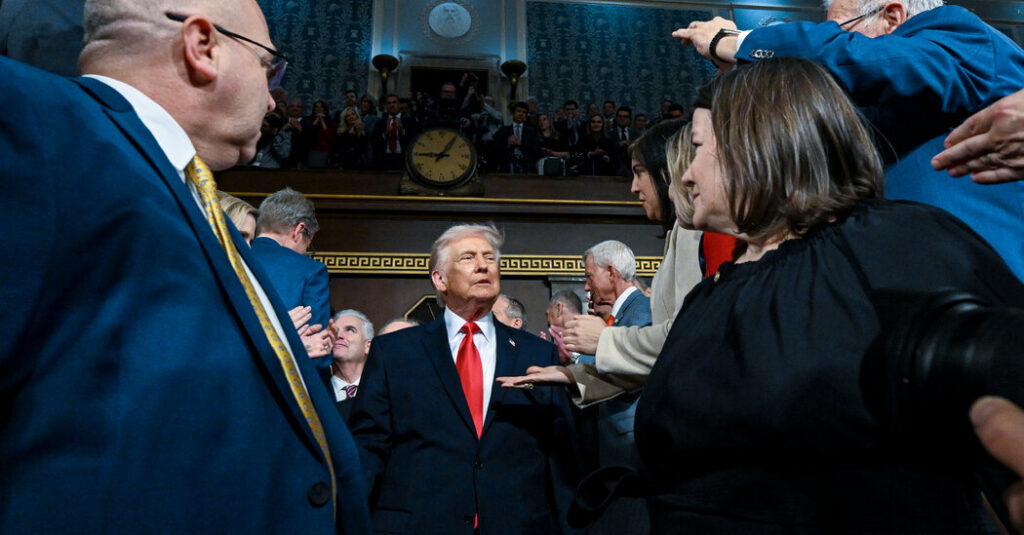
Speaking from the symbolic seat of American democracy on Tuesday, Mr. Trump suggested during his State of the Union address that “it should be my third term” and declared that the “only way” that Democrats “can get elected is to cheat.”
His homeland security secretary, Kristi Noem, recently pointed to the administration’s zealousness to root out voter fraud.
“We’ve been proactive to make sure we have the right people voting, electing the right leaders to lead this country,” she said at an event on election security in Arizona.
Threats and Government Action
Mr. Trump often shouts fraud before an election that he fears losing, but this year he has intensified his drumbeat of threats, warnings and false claims about voting.
He began the year musing about canceling the midterms altogether (just a joke, aides assured), then pivoted to the idea that Republicans should unconstitutionally nationalize them (again, aides walked it back before the president doubled down on the notion of the federal government getting “involved”).
On social media and in public remarks, Mr. Trump has indulged, with increasing frequency, debunked theories about how the 2020 election was stolen.
Now those words are sometimes accompanied by government action.
His warning last month that there would be new prosecutions stemming from the 2020 election was followed, days later, by the F.B.I.’s search for nearly six-year-old ballots in a Democratic stronghold in Georgia.
The president has pushed Republicans in Congress to pass restrictive new voting laws, and warned of more executive orders to impose them himself, even as courts have ruled against some of his past efforts. At the direction of the White House, homeland security officials are intensifying efforts to investigate voting by noncitizens.
Control of Congress hangs in the balance this fall, and Mr. Trump has warned that he will be impeached for a third time if Democrats regain control of the House.
The White House is pushing every lever to hold power, especially in the House. Last year, that included Mr. Trump’s unusual drive for Republican-controlled states to redraw congressional maps to squeeze out more G.O.P. seats — setting off an ongoing nationwide redistricting war.
Mr. Trump’s team is also preparing a more traditional campaign: traveling, raising money and trying to address affordability.
But the active undermining of faith in the election’s outcome is playing out in parallel — and the specter of a forceful federal intervention hangs over November.
“The federal government should get involved,” Mr. Trump said in the Oval Office this month when asked about his suggestion that Republicans should nationalize elections. Naming three Democratic-dominated cities, he added, “If they can’t count the votes legally and honestly, then somebody else should take over.”
He was surrounded by congressional Republicans as he spoke, including Speaker Mike Johnson, who stood just behind Mr. Trump’s left shoulder, his fingers fidgeting as they gripped a red Trump hat.
“If a state can’t run an election,” Mr. Trump said, “I think the people behind me should do something about it.”
Democratic Fears
Democrats are sounding alarms — and sometimes sounding downright alarmist — as they war-game for extreme subversion scenarios.
They warn that the Trump administration could deploy federal agents to target polling places and distort turnout, that the Justice Department could misuse private voter roll data, or that the government might seize voting machines. And they worry that congressional Republicans could refuse to seat Democratic winners (the Constitution gives Congress notable leeway to seat new members).
“We will have to prepare in ways that differ from prior cycles for the possibility that Trump and Republicans will try anything and everything to artificially maintain their majority,” Representative Hakeem Jeffries of New York, the Democratic minority leader, said in a recent interview.
Mr. Jeffries said he had been heartened that the Supreme Court ruled that Mr. Trump did not have unfettered ability to deploy National Guard troops, calling that “the biggest tool that an authoritarian-type leader would have.”
In 2020, Mr. Trump had considered using the National Guard to seize voting machines. Looking back, he told The New York Times last month, “Well, I should have.”
Behind the scenes, Democratic state attorneys general have been preparing for dire potential scenarios and drafting legal documents to head off federal intrusion, such as removing armed forces from polling locations.
Even moderate Democrats who are not prone to hyperbole are expressing deep worries.
Senator Catherine Cortez Masto of Nevada warned in a recent interview with The New York Times that federal immigration agents could be deployed differently. “The concern,” she said, “is that next is they’re going to bring them out around our election process. They’re going to try to claim the election is being stolen.”
Abigail Jackson, a White House spokeswoman, dismissed Democratic concerns and said Mr. Trump was “committed to ensuring that Americans have full confidence in the administration of elections.”
“No one should take this Democrat pearl-clutching seriously when they have spent years undermining and denying the results of free and fair elections — including the election of President Trump,” she said, adding that Mr. Trump was simply committed to “totally accurate and up-to-date voter rolls free of errors and unlawfully registered noncitizen voters.”
Election-Skeptical Trump Allies
Whatever guardrails existed around Mr. Trump during his first term appear frayed or absent. He is now largely surrounded by pliant advisers and party officials.
It turned out that it was a Trump appointee, Kurt Olsen, who had set off the recent Georgia investigation that resulted in the F.B.I. raid in Fulton County, according to a recently unsealed search warrant. And Mr. Trump’s director of national intelligence, Tulsi Gabbard, was unexpectedly at the scene. She connected him on the call with the agents.
Steve Simon, the Democratic secretary of state in Minnesota, called the federal actions “largely sloppy, unreliable, even menacing.” The Trump administration recently and explicitly linked a demand for sensitive voter information in the state with the restoration of law and order.
“I never thought in the year 2026, I would be saying that the federal government is an impediment right now to smooth elections, and not an ally,” Mr. Simon said.
Some right-wing activists who fanned the conspiratorial flames of fraud in 2020 are no longer outside agitators. Instead, they occupy powerful seats inside the federal government.
They include Kash Patel, the F.B.I. director, who was a prominent promoter of the conspiracy theory that the riot at the Capitol on Jan. 6, 2021, was planned and instigated by the F.B.I.; Attorney General Pam Bondi, who traveled in 2020 to Pennsylvania, where she claimed to have “evidence of cheating” that never fully materialized in court; and Harmeet Dhillon, who was a leader of a Trump lawyers coalition in 2020 and is now the assistant attorney general for civil rights.
Mr. Olsen went from advising Mr. Trump privately in the run-up to Jan. 6 to being named Mr. Trump’s director of “election security and integrity.” Others are burrowed deeper in the bureaucracy.
On Capitol Hill, Mr. Trump’s congressional allies are planning a series of votes on legislation to impose stricter voting requirements. The measures are not expected to become law, but they amplify the false accusations about widespread fraud.
Democrats have little faith in Mr. Johnson to stand up to Mr. Trump. In 2020, Mr. Johnson, then a low-profile lawmaker from Louisiana, played a pivotal role in justifying Mr. Trump’s false claims of widespread fraud.
Just this month, Mr. Johnson was talking conspiratorially in the Capitol about California’s standard but unusually long process of post-election ballot counting. The leads of Republican candidates, he claimed, had “just magically whittled away.”
“It looks on its face to be fraudulent,” Mr. Johnson said. “Can I prove that? No.”
Democrats hope the courts could prevent some overreach by the Trump administration. A sweeping executive order by Mr. Trump on election rules last year has largely been blocked by federal judges, including one last month who explained his reasoning succinctly.
“The Constitution,” he wrote, “assigns no authority to the president over federal election administration.”
Shane Goldmacher is a Times national political correspondent.
The post Trump’s Push for Election Power Raises Fears He Will ‘Subvert’ Midterms appeared first on New York Times.