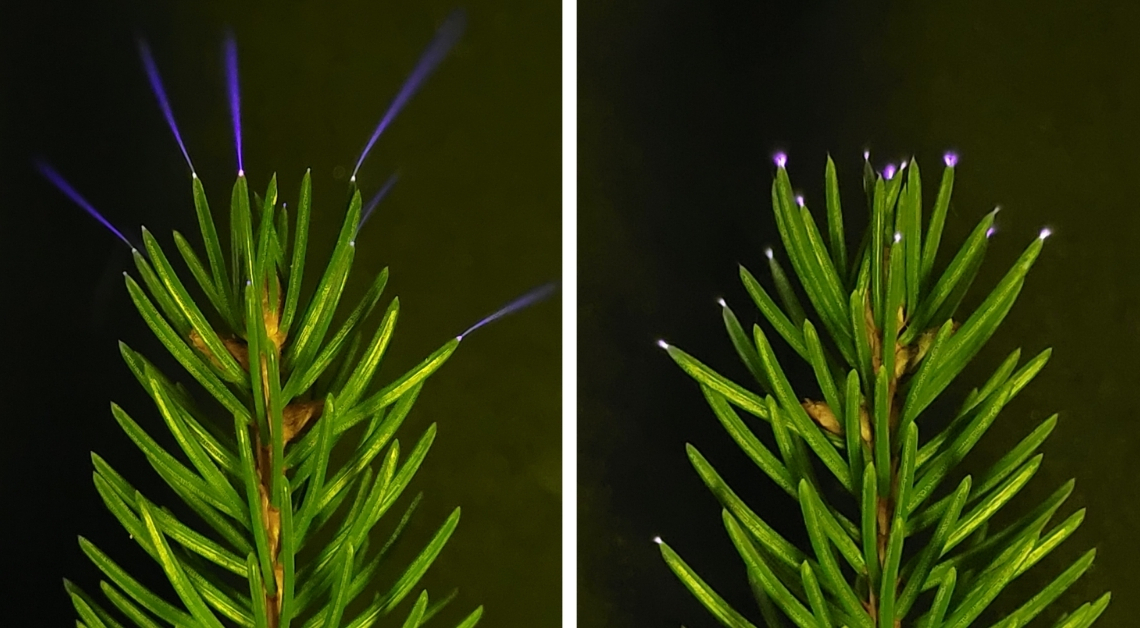
Thunderstorms already have a lot going on. Lightning, sideways rain, the neighbor’s patio furniture doing parkour. Now add one more detail that makes the whole scene slightly more supernatural. Scientists have finally captured direct evidence that treetops give off faint electrical glows during active storms. You can’t see it with your eyes. But a camera can.
The phenomenon is called a corona discharge. When a charged storm passes overhead, the electric field can push charge up through a tree and concentrate it at the sharpest points, like leaf tips and needles. Under the right conditions, that charge leaks into the air in tiny discharges that emit ultraviolet light. Researchers have kicked this idea around for decades, but field proof has been missing for one boring reason. Daylight and even storm-dark sky brightness bury the signal.
A team led by Penn State meteorologist Patrick McFarland got around that by building a mobile observing system inside a 2013 Toyota Sienna. A trusty minivan. It carried an electric field detector, a roof-mounted periscope feeding an ultraviolet camera, and storm-chasing energy that makes you question everyone’s hobbies. “The most fun part was taking a jigsaw and cutting a twelve-inch hole in the roof,” McFarland said in a press release. “Totally killed the resale value, but that’s fine.
Thunderstorms Make Trees Glow, and Scientists Just Caught It on Camera
During a summer 2024 storm in Pembroke, North Carolina, the team aimed the system at a sweetgum tree and later counted dozens of brief corona events that flickered for up to a few seconds and hopped around the leaves. They saw similar behavior on a nearby loblolly pine and during other storm intercepts between Florida and Pennsylvania. That repetition across species and locations suggests this is not a one-off oddity.
The big idea is scale. The camera watches a slice of canopy, but a storm rolling over a forest has a lot of canopy. McFarland said, “These things actually happen; we’ve seen them; we know they exist now. To finally have concrete evidence [of] that…is what I think is the most fun.”
If this glow is widespread, it could come with consequences. The press release notes lab work suggesting corona can singe leaf tips, and the researchers want to know whether repeated exposure affects canopy health over time. There’s also chemistry. Penn State has previously reported that corona-related processes can boost production of hydroxyl radicals near treetops during storms, molecules that drive a lot of atmospheric “cleanup” reactions.
So the next time a thunderstorm rolls through a forest, picture the treetops putting on a light show that no one gets to see, except a scientist in a minivan.
The post Trees Glow During Thunderstorms, and Scientists Finally Caught It on Camera appeared first on VICE.