Well, that wasn’t much of a comeback.
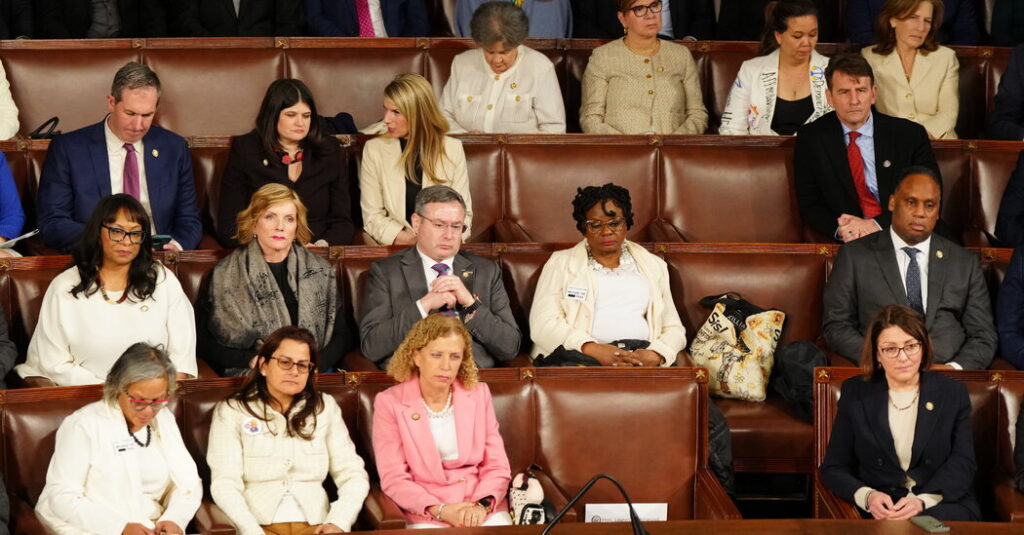
At President Trump’s State of the Union address on Tuesday evening, the congresswomen of the resistance — or, to be exact, some of the congresswomen of the Democratic Women’s Caucus — once again wore white to signal their dissent. It was the fifth such sartorial protest the caucus has staged, after the white-ins at Mr. Trump’s State of the Union addresses in 2019, 2020 and 2024, as well as his address to a joint session of Congress in 2017.
But in the wake of a relatively ineffective attempt to pivot to pink for Mr. Trump’s address last year, the return to white seemed less like a powerful statement of solidarity than a halfhearted retreat to an old gesture — and yet another example of the Democrats’ problems in agreeing on new strategies for opposing the president.
Part of the problem was numerical: Just over a dozen of the 96 members of the caucus were expected to wear the color going into the event, versus 106 in 2019. There were also competing forms of protest. Some congresswomen ceded their seats to survivors of Jeffrey Epstein’s abuses, while others boycotted Mr. Trump’s speech to attend various competing protest events. Representative Pramila Jayapal of Washington, for example, wore a white top and skirt but joined a MoveOn rally; Representative Maxine Dexter of Oregon wore white to the so-called State of the Swamp rally to protest Mr. Trump’s address.
As a result, the potential sea of white in the Capitol was reduced to a puddle of white. Or polka dots of white amid a sea of classic dark suits.
It didn’t make any more of an impression than did the star-spangled shoes worn by Representative Ashley Hinson of Iowa or the United States men’s hockey team in their American flag sweaters and gold medals. It didn’t have the visual impact that it had taken on in 2016, when Hillary Clinton donned a white pantsuit to accept her historic nomination as the first woman to become the presidential nominee of a major political party.
Then, her choice was less a statement of defiance aimed at Mr. Trump than a gesture of continuity, connecting her nomination to the work of the suffragists who came before. Mrs. Clinton’s supporters adopted the look in her wake and wore white to the polls.
After Mr. Trump’s election, the look spread to the women of Congress, who wore white en masse to Mr. Trump’s State of the Union speeches, and Nancy Pelosi, who wore white in 2019, when, as speaker of the House, she announced that Congress was drafting articles of impeachment against Mr. Trump. Kamala Harris wore a white pantsuit when she became vice president-elect in 2020, and Cassidy Hutchinson, a former aide in the first Trump White House, wore white when testifying in 2022 before the House committee that investigated the Jan. 6. attack on the Capitol.
At such moments, the white represented an expression of sisterhood and was the signifier of a movement gathering momentum and meaning, like a secret handshake. But by 2024, as the election loomed, white began to seem like a cliché, and when Ms. Harris stepped into the spotlight as the Democratic nominee, she eschewed white deliberately as a sign that it was time to “chart a new way forward.”
Not any more, apparently.
As to why the caucus went back to white — or tried to, anyway — Representative Teresa Leger Fernández of New Mexico, who heads the group, told CBS News, “This year, there are specific attacks on women’s ability to vote.” She was referring to the SAVE America Act, a bill recently passed in the House that could make it harder for married women to vote. “The Democratic Women’s Caucus is wearing white both to honor that fight that women have always had,” Ms. Leger Fernández said, “and to signal we are still in the fight.”
Fair enough. The problem is that such a signal needs both critical mass and coordinated action behind the coordinated separates to resonate. Otherwise, a white suit risks looking awfully similar to that other piece of white cloth: a flag of surrender.
Vanessa Friedman has been the fashion director and chief fashion critic for The Times since 2014.
The post The White Pantsuit Protest That Wasn’t appeared first on New York Times.