All that’s left of T. J. Semmes Elementary School is the scattered slabs of the building’s brick foundation. The otherwise empty lot on the corner of Jourdan Avenue and North Rampart Street, in the Lower Ninth Ward of New Orleans, is covered in clovers and dandelions, and surrounded by barbed-wire fencing contorted by time and neglect. Built in 1900 and named after a Confederate senator, the school remained open until 1978, when it closed due to financial problems. Hurricane Katrina accelerated the building’s dilapidation, and in 2019 it was demolished.
But in 1965, when the building still stood and the school still operated, my mother was a 6-year-old student at Semmes, a child with books in her hand and butterflies in her stomach as she entered her new school for the first time. She remembers walking with her big brothers down a sidewalk fractured by the roots of old oak trees while children played hopscotch on the playground. She remembers going outside and clapping erasers together so that plumes of chalk dust rose above her head. And she remembers being told that she was attending a school that many white parents had taken their children out of just a few years earlier because they didn’t want them sitting in class with Negroes.
She shared these stories with my children and me earlier this month, during a visit to my hometown for Mardi Gras. One day, before we made our way out to the parades, my mother and I took my children to the house where she’d lived as a child, and then to the former site of Semmes, down the street. I wanted my children to understand that Black history is not just something that exists in books, or that involves only the major figures they learn about in school: Martin Luther King Jr., Frederick Douglass, Harriet Tubman. Black history is something that involved the people they know and love. Their grandmother, after all, had been among the first wave of Black children to integrate her elementary school, when she was the same age that my daughter is now.
[Clint Smith: Those who try to erase history will fail]
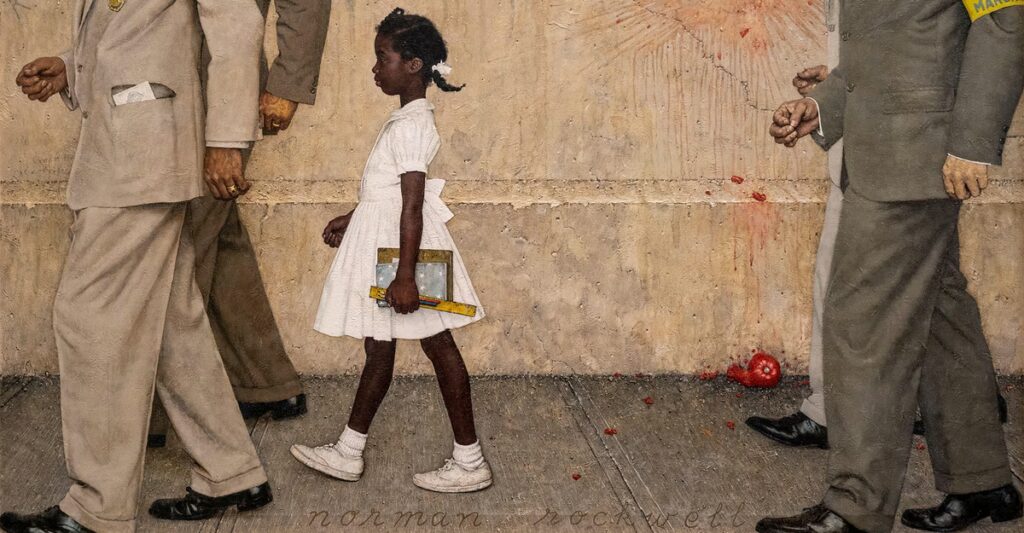
After the Supreme Court deemed segregation unconstitutional in Brown v. Board of Education, many school districts around the country found creative strategies to avoid complying with the ruling, engaging in years of court battles, slow-walking, and attempts to find legislative loopholes. New Orleans was among these battlegrounds; many white families there fundamentally rejected the idea that their children should be part of what they saw as a misguided social experiment. In 1960, the city became the center of national controversy when Ruby Bridges, Tessie Prevost, Gail Etienne, and Leona Tate—who came to be known as the New Orleans Four—desegregated two different public schools; Prevost, Etienne, and Tate together at McDonough 19, and Bridges alone at Frantz Elementary. Bridges’s journey into the school was immortalized in a famous Norman Rockwell painting titled The Problem We All Live With, in which a young Bridges walks, in a white dress with books and ruler in hand, between two pairs of federal agents. NIGGER is spelled behind her on the wall, and the guttural red residue from a tomato that has just been thrown drips beneath the word. A print of this painting sits in the hallway of my grandfather’s home. Looking at it, I am struck by the fact that federal agents today are being deployed in American cities as aggressors rather than protectors.
So many white parents took their children out of McDonough 19 that before long, it became an all-Black school. With the help of a local NAACP lawyer, Tate’s, Prevost’s, and Etienne’s parents petitioned the school district to send their children to a new school. Soon, the girls were reassigned to T. J. Semmes, where they, along with six other children, became the school’s first Black students. At Semmes, they were left to fend for themselves, without the protection of federal marshals.
In a 2019 interview with Pacific Standard, Leona Tate shared her experience that first year: “At Semmes, the students hated us. And there were teachers that hated us.” The reporter continued, “The small group of black students were spit upon and punched. Two teachers held their noses each time black students passed, implying that they smelled. The girls faced constant insults and physical aggression from white students, who were often egged on by adults within the school.”
Somehow, I had never fully realized before my recent visit how close my mother had been to the history of local and national school-desegregation efforts when she was a student at Semmes, beginning just three years later, in 1965. New Orleans schools integrated on a grade-by-grade basis. She was stepping into a school still in the midst of a harrowing transition.
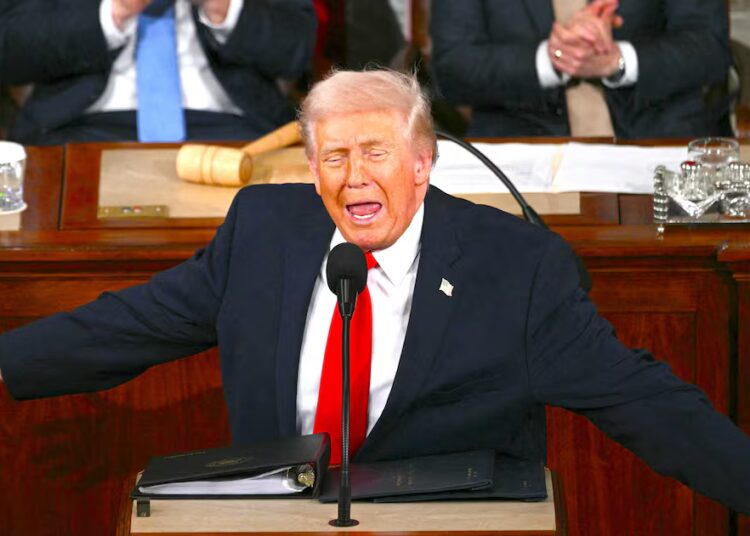
This trip to the lot of my mother’s old school felt especially poignant during Black History Month, at a time when Donald Trump and his administration have been incessantly attacking, downplaying, distorting, and removing Black history from American public life in ways large and small. The president has said, for example, that the Smithsonian museums spend too much time talking about slavery. His administration has told schools and universities that they should focus on a “patriotic education” that illuminates the uplifting parts of our country’s history while sidestepping anything perceived as too negative.
[Adam Harris: Black History Month is radical now]
The downstream cultural and societal impacts of such pronouncements from the White House have been stark. Schools, libraries, and corporations that once publicly celebrated Black history, both during February and beyond, have now gone quiet. Last year, the Waterloo, Iowa, school district canceled an event celebrating Black authors for fear that it would put federal funding at risk. Last month, Colorado Springs, Colorado, declined to issue a statement recognizing Black History Month, despite having done so for nearly a decade. (After public backlash, the city issued a Black History Month statement earlier this month.) As my colleague Adam Harris has written, in the age of Trump, celebrating Black History Month has become a radical act.
Hannah Scott, a senior agent at Lyceum, a speaking agency that represents some of the nation’s foremost Black writers, including Jesmyn Ward, Imani Perry, Jacqueline Woodson, Mitchell S. Jackson, and Tayari Jones, told me that the firm has noticed a marked drop in speaking requests over the past year or two. She speculated that whereas some companies and organizations that once would have wanted to host these speakers have pulled back from such programming for fear of reprisal, others may have been forced to do so because of state and federal funding cuts. “There are huge numbers of literary and cultural organizations that relied on funding from the National Endowment for the Humanities, that relied on funding from their state humanities councils,” Scott said. When budgets shrink, events like Black History Month programming can be the first to go.
Black history has been erased and distorted in this country from the beginning. In February 1934, during what was then known as Negro History Week, W. E. B. Du Bois gave a speech in New Orleans based on his forthcoming book, Black Reconstruction in America, in which he lambasted white historians for twisting and misrepresenting the past in ways that undermined the public’s ability to understand the present. According to these historians, Du Bois said, slavery was “nobody’s fault,” and “at the close of slavery, the Negro was given the vote”—then “failed dismally.” But this story “is entirely false in interpretation,” he said, “and is entirely misleading.”
The goal of such stories, Du Bois told the crowd, was to justify the second-class social, political, and economic status of Black Americans. He urged his listeners to arm themselves with the truth, and to reject racist narratives. Only by learning their own history could Black Americans fully understand that their social and economic condition had been created by law and policy, and was not a reflection of their capability and worth.
[From the December 2023 issue: How Black Americans kept Reconstruction alive]
The story of Du Bois’s 1934 speech is relayed in a new book, I’ll Make Me a World: The 100-Year Journey of Black History Month, by the Harvard historian Jarvis R. Givens. A major impetus behind establishing a monthlong commemoration of Black history, Givens writes, was to provide “usable histories that inspire black people to see the full range of their humanity and hopefully to help others see it in the process.” This has always required a delicate balancing act. Black History Month must at once demonstrate the various ways that Black Americans have been exploited and oppressed and remind Black Americans that they and their histories are not singularly defined by such barbarism. It must lift up all that Black Americans have achieved, created, and built despite, and in the midst of, centuries of interpersonal and structural violence. These lessons may come in the form of Zora Neale Hurston novels, or in the stories that your grandmother told you in her kitchen. They may come in the form of a Norman Rockwell painting of Ruby Bridges, but they may also come in a story told to you by your mother on the empty lot that was once her school.
Perhaps embracing that duality is the best way to honor Black History Month this year. The Trump administration can attempt to remove exhibits from museums, ban books from libraries, and challenge curriculums in schools. But it cannot control what we do in our communities and with our families. We don’t have to wait on the government to give us permission to learn a history we can reach for ourselves.
When you buy a book using a link on this page, we receive a commission. Thank you for supporting The Atlantic.
The post The Trump Administration Can’t Kill Black History Month appeared first on The Atlantic.