An armada of U.S. warships and fighter jets sat menacingly off Venezuela’s waters, and the Pentagon had already devised plans to capture or kill the country’s leader.
But as 2025 ended, President Nicolás Maduro seemed surprisingly relaxed, celebrating New Year’s Eve with a small group of family and friends at home in Caracas, the capital, according to several people close to him, including one guest at the party.
They shared traditional Venezuelan dishes like hallacas and pan de jamón. They listened to gaitas, fast-paced Venezuelan Christmas songs.
The next day, as usual, Mr. Maduro sent greetings to his senior officials. “Happy New Year to you and your family,” read one message viewed by The New York Times.
The United States threatened to attack Venezuela if Mr. Maduro didn’t resign. Still, people close to him said he repeatedly asserted that the Trump administration would not dare attack Caracas.
Mr. Maduro knew that spies were working against him and feared betrayal from inside his ranks. Yet, in late December, he told friends and allies he still had time to negotiate a deal to stay in power, or leave office at a time of his choosing, they said.
To Maduro’s entourage, a U.S. raid seemed far-fetched, people close to him said. When explosions ripped through the Fuerte Tiuna military base in Caracas on Jan. 3, some in his circle thought it was a coup, not an American attack.
It was a remarkable miscalculation by Mr. Maduro, an autocrat who had outwitted opponents again and again during his 13-year rule, holding onto power through electoral losses, mass protests, armed plots and assassination attempts.
Mr. Maduro had already been informed that he should step down by a Brazilian billionaire who had met with Secretary of State Marco Rubio, according to people familiar with the exchange. But Mr. Maduro shrugged off the warning, failing to grasp the urgency.
His misreading of the Trump administration’s intentions had profound consequences: It resulted in the first foreign attack on Venezuelan soil in more than a century, landed Mr. Maduro and his wife in a Brooklyn jail and changed the course of his country’s history.
It also helped reshape the U.S. role in Latin America, ushering in a new, unpredictable era of gunship diplomacy.
This account of the final weeks of Mr. Maduro’s presidency is based on interviews with a dozen of his senior officials, friends and allies. Most spoke to him in the days before the American attack, and several were in touch just hours earlier.
Their accounts have been confirmed by interviews with people close to Mr. Trump and other key figures, including Delcy Rodríguez, Mr. Maduro’s replacement, who has struck a forced alliance with the United States. They were not authorized to speak publicly.
Unsettled Scores
Throughout the standoff with the White House, Mr. Maduro remained consumed by defiance and hubris, a man who had overestimated his own powers and underestimated his opponents’ resolve, some of his close associates said. Like the declining autocrat in Gabriel García Márquez’s novel “The General in His Labyrinth,” Mr. Maduro, 63, watched his power slip as he failed to navigate the cascading economic and political crisis in front of him.
“After years in power, you tend to overestimate your capabilities,” said Juan Barreto, a former government official who was once a Maduro ally. “You end up only listening to people who want to please you.”
Mr. Trump had tried unsuccessfully to oust the Venezuelan strongman during his first term in office, sanctioning the country’s oil industry and recognizing an opposition leader as the president. When Mr. Trump returned to the White House last January, he viewed Venezuela as unfinished business, American officials say.
Mr. Trump began warning of an “invasion” by a deadly Venezuelan gang operating at Maduro’s direction, even though American intelligence agencies concluded that wasn’t true. His administration tightened sanctions and then began blowing up boats in the Caribbean, saying it was targeting drug smugglers.
Venezuela effectively became besieged.
Mr. Trump and Mr. Maduro had a chance to settle the conflict on Nov. 21, the day the two leaders had their only known direct conversation. Mr. Trump spoke cordially with Mr. Maduro by phone for 5 to 10 minutes, according to four people familiar with the call.
“You have a strong voice,” Mr. Trump told Mr. Maduro lightheartedly, according to the people.
Mr. Maduro joked back, saying through a translator that Mr. Trump would be even more impressed if he ever saw him in person, properly showered and dressed, three of the people said.
Mr. Trump invited Mr. Maduro to Washington, a proposal the Venezuelan president politely turned down, fearing a trap, the people said. Mr. Maduro, instead, proposed meeting at a neutral location outside the United States, which Mr. Trump refused.
The call ended without concrete agreements or threats, the three people said. But the two leaders left with starkly different conclusions, setting off a chain of misunderstandings that culminated in the spectacular U.S. attack.
Mr. Maduro thought his folksy banter had won over an American president known for an unguarded communication style, the people familiar with the call said. The Venezuelan leader, they said, thought he had bought himself time to negotiate an agreement, bolstering his belief that the American military buildup in the Caribbean was a pressure tactic to force a deal.
Mr. Trump thought otherwise, said a U.S. official familiar with the call. The president made the call expecting Mr. Maduro to lay out a specific plan to leave office, the official said. But Mr. Maduro’s nonchalance signaled to Mr. Trump that the Venezuelan leader was not taking him seriously, contributing to Mr. Trump’s decision to use force.
Unheeded Ultimatums
A few days later, Mr. Maduro received a warning: He needed to leave, now.
The message was relayed to Mr. Maduro in person by Joesley Batista, a Brazilian billionaire with businesses in both the United States and Venezuela who had recently met with Mr. Rubio, according to three people familiar with the exchanges.
Mr. Rubio had made it clear to Mr. Batista that the United States wanted the Venezuelan leader to strike a deal and leave the country. But when Mr. Maduro heard this, he interpreted it as an ultimatum, bristled at the notion of leaving office and dismissed the threat, the people said.
Mr. Batista and Mr. Maduro’s lawyer declined to comment, and Venezuela’s information ministry did not respond to detailed questions. A senior American official said Mr. Maduro was given multiple chances to reach an agreement and resign.
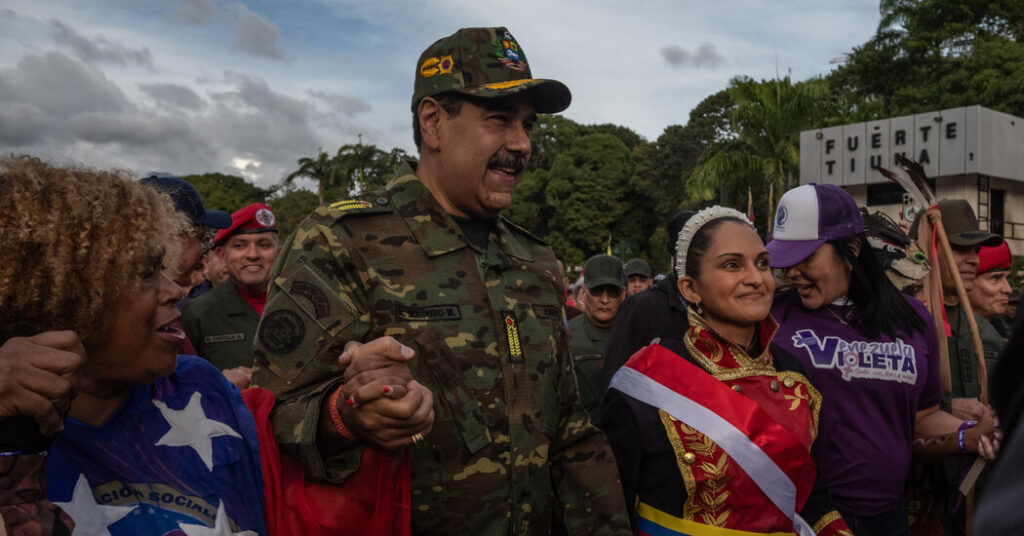
Instead of capitulating, Mr. Maduro took to the streets to convey control. He started making nearly daily unscheduled appearances at public events, dancing, singing and chanting slogans in exaggerated, pidgin English.
“Please, please, please: yes peace, not war,” Mr. Maduro’s recorded voice repeated as he bounced to an electronic beat at the presidential palace on Nov. 21, the day of his call with Mr. Trump.
When Mr. Trump was shown a video of Mr. Maduro dancing some time after their call, the U.S. president was visibly annoyed, according to a person familiar with the matter. Mr. Trump saw the Venezuelan leader’s antics as mockery, tilting the scale further toward a military incursion, the person added.
The U.S. pressure added to the internal divisions already plaguing Mr. Maduro’s rule, some of the people close to him said.
The rifts were rooted in Mr. Maduro’s decision to ignore the results of the 2024 election, which he had lost decisively, stripping him of any remaining legitimacy and deepening his international isolation.
Now, the threats from the United States made Mr. Maduro even more dependent on hard-liners in his ruling Socialist Party. That entrenched faction, led by Interior Minister Diosdado Cabello, called for greater domestic repression to remain in power and greater state control over the economy.
At the same time, Mr. Maduro was growing suspicious of his more pragmatic vice president, Ms. Rodríguez, some of the people close to him said. She was tightening her grip on the national purse strings, sidelining rivals and pushing for economic liberalization. She ended up holding the posts of vice president, oil minister and finance minister, simultaneously.
Mr. Maduro considered firing her, some of the people said, but he knew he needed Ms. Rodríguez’s managerial expertise to keep the besieged economy afloat, they added.
Mr. Maduro also felt hemmed in by his international alliances, particularly by the economic burden of providing aid to Cuba, some of the people said. Cuba’s state-run energy importer received about $2 billion-worth of Venezuelan oil in the first 11 months of last year under arrangements that provided no cash for Mr. Maduro’s government, according to internal data from the Venezuelan state oil company.
Mr. Maduro understood that his ties with Havana, one of Mr. Trump’s main adversaries, complicated his own efforts to find a compromise with Washington, the people said. But he was unwilling to end the oil deliveries, seeing them as a point of honor and loyalty to the ruling party’s founder, Hugo Chávez, a protégé of Fidel Castro.
That alliance has been unwinding since the U.S. attack, as Mr. Maduro’s replacement scrapped oil deliveries to Cuba, fired Cuban allies from senior posts and ended commercial flights to the island.
Power at All Costs
All the people interviewed for this article agree that Mr. Maduro never seriously considered resigning, despite U.S. threats, advice from intermediaries like Turkey and Qatar and, eventually, subtle appeals from some of his own officials and relatives.
Some say Mr. Maduro remained committed to upholding Mr. Chavez’s revolutionary legacy. Over time, some of the people said Mr. Maduro came to see that legacy in very narrow terms: keeping his Socialist Party in power at any cost.
Others say the thought of leaving behind relatives and friends who had worked with him for decades weighed heavily on Mr. Maduro. He considered exile to be a form of betrayal, those people said.
Still, others insist that Mr. Maduro simply misjudged the risks Mr. Trump was willing to take to remove him.
Mr. Maduro, according to people close to him, was prepared for the Trump administration to escalate its military campaign, and he understood that the standoff could cost him his life. But he thought the most likely outcome was an American strike on Venezuelan oil facilities or locations connected to drug smuggling.
He never thought that Mr. Trump would mount a large attack on Caracas, the people said, much less the swarm of 150 aircraft involved in the American operation on Jan. 3.
And Mr. Maduro was confident that his military, armed with billions of dollars worth of Chinese and Russian weaponry, could inflict lethal casualties, making an attack politically unpalatable for Mr. Trump.
After all, even the U.S. operation in 1989 to capture Manuel Noriega, then the president of Panama, a much smaller country, left 26 Americans dead, members of Mr. Maduro’s inner circle pointed out in discussions with him.
Mr. Maduro seemed satisfied with the upbeat reports from his generals on the state of the country’s air defenses, according to the people close to him, even though the military installations were largely Potemkin Villages.
Mr. Maduro, they said, was also encouraged by statements from the leftist presidents of Colombia and Brazil, who denounced U.S. warmongering. He believed the risk of destabilizing the region and turning it against the United States would deter Mr. Trump.
The Venezuelan president remained confident in the loyalty of his security detail and inner circle, but he grew increasingly worried about American efforts to infiltrate the government and the military. One close friend recalled that Mr. Maduro called him in late December to say he feared betrayal and asked the friend not to answer calls or messages from unknown numbers because spies were working against him.
Despite the staged bravado of public events, Mr. Maduro understood he faced a new threat. He scaled back on social gatherings and canceled planned appearances. Most of his nearly-daily broadcasts on local radio and television were prerecorded messages presented as live speeches.
Two days after speaking with Mr. Trump in late November, Mr. Maduro broke with his custom of hosting a sizable birthday party for himself, and instead had a much smaller celebration with his family at the Fuerte Tiuna military compound.
To avoid detection by satellites or spy planes, Mr. Maduro spent more time under the protection of a small contingent of his 1,400-strong Presidential Guard, some of the people close to him said.
But the decision, made to obfuscate his location, ultimately left the Venezuelan leader with less protection from an American raid, they added.
Last Chances
On Dec. 10, the U.S. drastically stepped up the conflict by detaining a tanker carrying Venezuelan oil, beginning a partial blockade that paralyzed the country’s main source of revenue.
The blockade idled Venezuela’s tankers and forced oil firms to redirect fuel to limited storage facilities. Some firms began shutting wells. The country’s oil industry neared collapse.
In official meetings and personal conversations, Mr. Maduro remained calm, according to people who spoke to him in December, convinced a deal with the United States was still possible.
The U.S. decision to label Mr. Maduro a “narco-terrorist” who led two drug cartels puzzled the Venezuelan president, the people said. To Mr. Maduro, the Trump administration’s description of him as a kingpin who personally oversaw the deployment of criminals and drugs to the United States in order to kill Americans was a stretch and had to be hiding a more pragmatic demand, according to some of the people.
Until the end, Mr. Maduro refused to accept that Mr. Trump saw him personally as the main problem, the people said. Instead, he thought he just needed to find an economic spoil that Mr. Trump actually wanted.
But by mid-December, Venezuela’s economic situation had become so precarious that Mr. Maduro started considering his own eventual exit. He told one person that he might offer early elections, as early as 2026, and step aside in favor of another ruling party candidate.
Washington, however, insisted on his immediate resignation.
On Dec. 23, the White House made its final offer. At Washington’s request, the Turkish government told Mr. Maduro that the United States would not pursue him or target his wealth if he went into exile, according to a person familiar with the matter. (A Turkish official said Turkey was not discussed as a potential destination).
Mr. Maduro rejected the offer, according to the U.S. official, setting in motion final preparations for the attack. The operation was initially scheduled for the last weekend of December but got postponed for various reasons, including the unusually rainy weather in Caracas.
On Dec. 30, Ms. Rodríguez met with Mr. Maduro to try to convey the scale of the impeding economic collapse precipitated by the U.S. blockade, according to three people familiar with the meeting. Mr. Maduro discounted her concerns, the people said.
By then, the Trump administration had identified Ms. Rodríguez as someone they could potentially work with, but there’s no indication that Ms. Rodríguez was privy to the Pentagon’s military plan.
Mr. Maduro seemed determined to fend off the American pressure. He envisioned resorting to a grass roots struggle, abandoning oil production and growing all food domestically, if necessary, said one of the three people.
Instead, during the early hours of Jan. 3, U.S. military aircraft swept across Venezuela’s borders, attacked four military bases, overpowered Mr. Maduro’s bodyguards and captured him and his wife, Cilia Flores, killing more than 100 Cubans and Venezuelans.
At the time of the U.S. attack, Ms. Rodríguez, like many other senior officials, was vacationing on Venezuela’s resort island of Margarita, known for its Caribbean beaches packed with tourists, restaurants and imposing villas for the Venezuelan elite. Minutes after Mr. Maduro’s capture she received a phone call, according to people familiar with that conversation.
U.S. officials communicated to her that the Pentagon would immediately begin a broader series of strikes on Venezuela if she refused to cooperate. After demanding and obtaining proof that Mr. Maduro was alive, Ms. Rodríguez eventually agreed.
She flew to Caracas on a private jet and assumed what she declared to be the temporary role of interim president.
Two days later, Mr. Maduro stood before a U.S. judge in New York at his arraignment on drug charges. “I am the President of Venezuela,’’ he said, “and I consider myself a prisoner of war.”
Eric Schmitt contributed reporting from Washington, Ben Hubbard from Istanbul, Ana Ionova from Rio de Janeiro and Jonah E. Bromwich and Benjamin Weiser from New York.
Anatoly Kurmanaev covers Venezuela and its interim government.
The post The Fall of a Strongman: Inside Maduro’s Last Days in Power appeared first on New York Times.