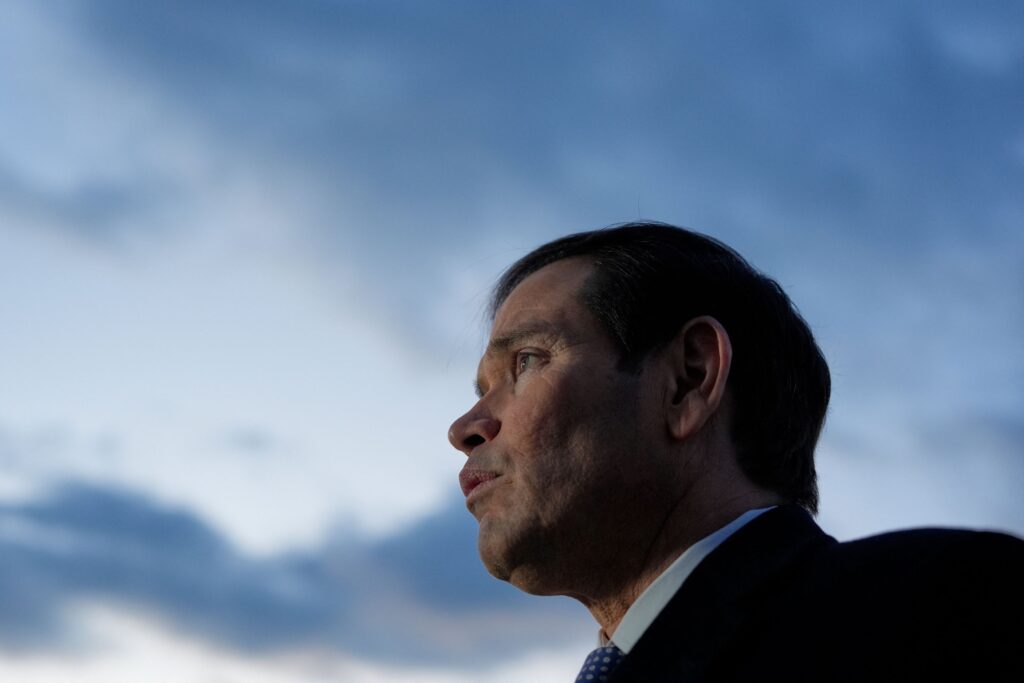
BASSETERRE, St. Kitts and Nevis — Secretary of State Marco Rubio arrived on the Caribbean island of St. Kitts early Wednesday for what is intended to be a showcase of the Trump administration’s focus on the Western Hemisphere after the U.S. military’s capture of Venezuelan President Nicolás Maduro last month.
Rubio’s brief visit to St. Kitts, where he will attend a meeting of the leaders of the Caribbean Community, or CARICOM, comes as the administration’s focus on this region is being tested by the large buildup of U.S. military assets in the Middle East and the looming threat of significant strikes against Iran if talks over Tehran’s nuclear program fail to make progress.
The U.S. delegation touched down here bleary-eyed after a late departure following President Donald Trump’s lengthy State of the Union address Tuesday evening. Rubio is scheduled to return to Washington on Wednesday evening.
The State Department declined to say why Rubio will not stay longer at the summit, which continues until Friday. The United States is not a member or official observer of CARICOM, which has 15 full members, mostly former British colonies.
Experts said that during his visit to the Caribbean, Rubio will encounter deep uncertainty about the Trump administration’s intentions in the region. “Trump’s second term has offered more questions than answers for Caribbean leaders,” said Jenna Ben-Yehuda, a former State Department official who served in numerous policy and intelligence roles in the Western Hemisphere.
Caribbean countries have been split over the U.S. military’s deadly campaign against alleged drug smugglers. Last year, amid escalating strikes on boats, CARICOM issued a statement calling the region a “zone of peace” that should be free from military intervention. Trinidad and Tobago, which has offered practical and rhetorical support to the administration’s moves, declined to sign the agreement.
Since then, the operation to arrest Maduro, as well as U.S. warnings and an oil embargo aimed at the government in Cuba, have added to a sense of regional instability.
There is a “strategic anxiety right now within Caribbean states about what’s going to happen in the next few months, maybe the next couple of years” in the region, said W. Andy Knight, an expert on Caribbean politics at the University of Alberta.
Most Caribbean nations want more U.S. engagement but they are “yet to see how the promise of increased attention will translate into policy action that directly benefits them,” said Ben-Yehuda, executive vice president of the Atlantic Council, a Washington-based think tank.
Previewing the trip earlier this week, State Department spokesman Tommy Pigott said Rubio would engage with Caribbean leaders on shared priorities, including “strengthening regional security, deepening cooperation to combat illegal immigration and illicit trafficking, and promoting economic growth, health, and energy security across the Caribbean.”
Rubio, a former senator from Florida whose parents were from Cuba and who grew up adjacent to the Caribbean enclaves of Miami, is seen as a key figure in the Trump administration’s focus on the Western Hemisphere. Most notably, he took on a leadership role in the operations that resulted in Maduro being arrested and taken to New York City to face drugs and weapons charges.
The administration dubs this focus the “Donroe Doctrine,” likening it to the 1823 position put forward by President James Monroe that formalized opposition to European colonialism in the hemisphere. Under Trump, it’s been held up as a justification for everything from electoral support for Argentina President Javier Milei to the president’s public threat to seize the Arctic territory of Greenland.
Rubio is scheduled to have several bilateral meetings while at the summit, including with St. Kitts and Nevis Prime Minister Terrance Drew and Trinidad and Tobago Prime Minister Kamla Persad-Bissessar.
Drew, the event’s host, recently announced that St. Kitts and Nevis had reached an agreement with the United States to accept deportees from other countries. He was criticized, however, for stating that his nation would not accept Haitians deported from the United States. Haiti is also a member of CARICOM.
Knight, with the University of Alberta, said that divisions with CARICOM were a major concern for the region as the organization has served as an “anchor” for small nations in the Caribbean who were weaker on their own. “Small states thrive under a situation where there are rules and where there are norms,” he said.
Now, he added, “those norms are being attacked by the world’s most powerful country.”
The post Rubio heads to Caribbean as Trump’s Iran gambit nears tipping point appeared first on Washington Post.