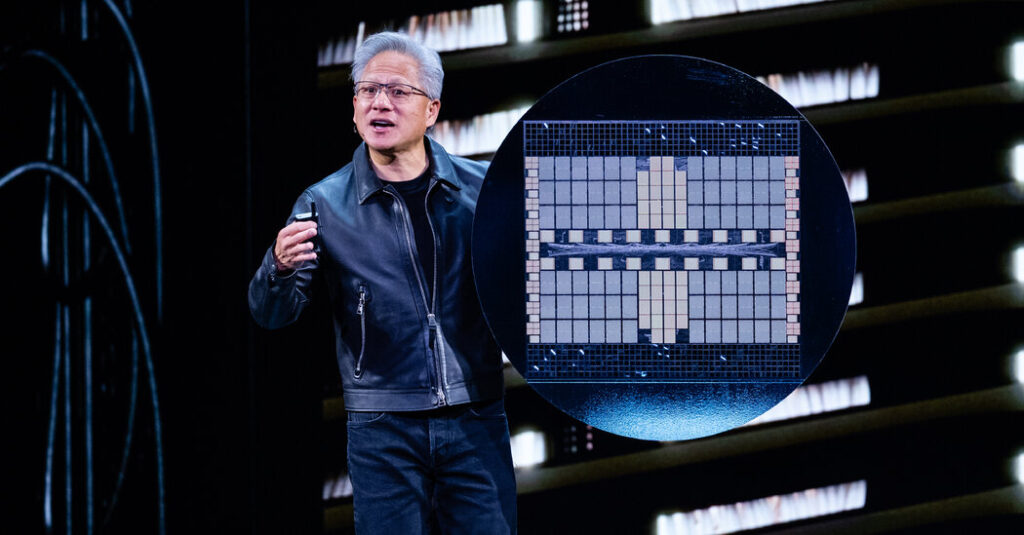
Nvidia’s profit for the last 12 months topped $100 billion, the chip giant said on Wednesday, providing ample evidence that it is cashing in on the tech industry’s artificial intelligence boom more than any other company in the world.
Only a handful of companies, including Alphabet, Microsoft and Apple, have made as much money in a year. And none of them have grown as quickly. Just three years ago, Nvidia’s profit was $4.4 billion.
Nvidia controls about 90 percent of the market for the cutting-edge semiconductors that power A.I. projects. More than anyone else, it will benefit from the plans of Google, Amazon, Microsoft and Meta to spend more than half a trillion dollars this year building A.I. data centers.
That spending is starting to unsettle Wall Street, and Nvidia’s share price has been relatively flat in recent months. But the financial results reported by the company on Wednesday showed that demand for Nvidia’s chips was still growing at an astonishing rate.
In the three months that ended in January, the company said, sales of its chips for A.I. data centers rose 71 percent to $61.7 billion. The business helped lift Nvidia’s total revenue for the period to $68.1 billion, surpassing Wall Street’s expectations of $66.2 billion.
Total profit for the period nearly doubled from a year earlier to $43 billion, which raised the profit for the company’s recently completed fiscal year to $120 billion.
Nvidia more than reassured investors that it can keep up its momentum. It projected revenue in the current quarter to rise 77 percent from a year ago to $78 billion. That exceeded Wall Street’s predictions of $72 billion.
The company’s share price rose more than 3 percent in after-hours trading.
“Enterprise adoption of agents is skyrocketing,” Jensen Huang, Nvidia’s chief executive, said in a statement. “Our customers are racing to invest in A.I. compute.”
Each year, Nvidia introduces a new chip that reduces the cost of delivering A.I. data. Its Blackwell chip, released last year, was a fraction as expensive per token — a term for a chunk of data — as its predecessor. Its Rubin chip, which will arrive this year, will reduce prices even further.
Speaking at the CES tech conference in Las Vegas in January, Mr. Huang said demand for the Blackwell and Rubin chips was “very high.” He will be looking to build on that next month by unveiling new chips and technology products at the company’s annual conference in San Jose, Calif., known as GTC.
Nvidia’s success has galvanized rivals. Over the past four months, Advanced Micro Devices, or AMD, a leading PC chip maker, has struck deals to sell more than $100 billion in chips to Meta and OpenAI in exchange for their option to take up to 10 percent stakes in the chip maker. Broadcom and MediaTek, two other chip makers, have worked with Google to develop A.I. chips, called tensor processing units, for the search giant.
The competition has raised questions about how much of the A.I. chip market Nvidia will control as the business expands and changes.
Nvidia sought to shore up its position by spending $20 billion to license technology from Groq, an A.I. chip start-up. It has also been pushing its suppliers, like Taiwan Semiconductor Manufacturing Company, which makes its chips, to increase production.
“The cost of staying king is catching up with them,” said David Wagner, the head of equity at Aptus Capital Advisors, an investment firm in Alabama. While there is plenty of demand for Nvidia chips, he said, the question has become: Can Nvidia make enough chips to satisfy customers and prevent customers from turning to alternatives from Google, AMD or others?
Mr. Huang is also focused on trying to secure clearance from the U.S. government to begin selling Nvidia’s second-most-powerful chip to China. President Trump approved the sale of the chip, the H200, in December, but the administration has not yet provided a license to execute those sales. There is also a question about whether China will permit its companies to buy the chips.
The U.S. government has limited Nvidia’s sales to China over concern the technology could help Beijing militarily and economically. Last year, Nvidia lost more than $5.5 billion in sales when the administration banned A.I. chip sales to China because of national security concerns.
At CES last month, Mr. Huang said that demand in China was “huge” and that the last licensing requirements from the U.S. government were being completed.
“I’m looking forward to the purchase orders,” he said.
Tripp Mickle reports on some of the world’s biggest tech companies, including Nvidia, Google and Apple. He also writes about trends across the tech industry like layoffs and artificial intelligence.
The post Nvidia’s Quarterly Profit Hits $43 Billion on Strong A.I. Chips Sales appeared first on New York Times.