He has lost his royal title and honors and he was asked to leave his 30-room mansion near Windsor Castle. Last week he was arrested and released on suspicion of misconduct in public office after accusations that he shared confidential information with Jeffrey Epstein.
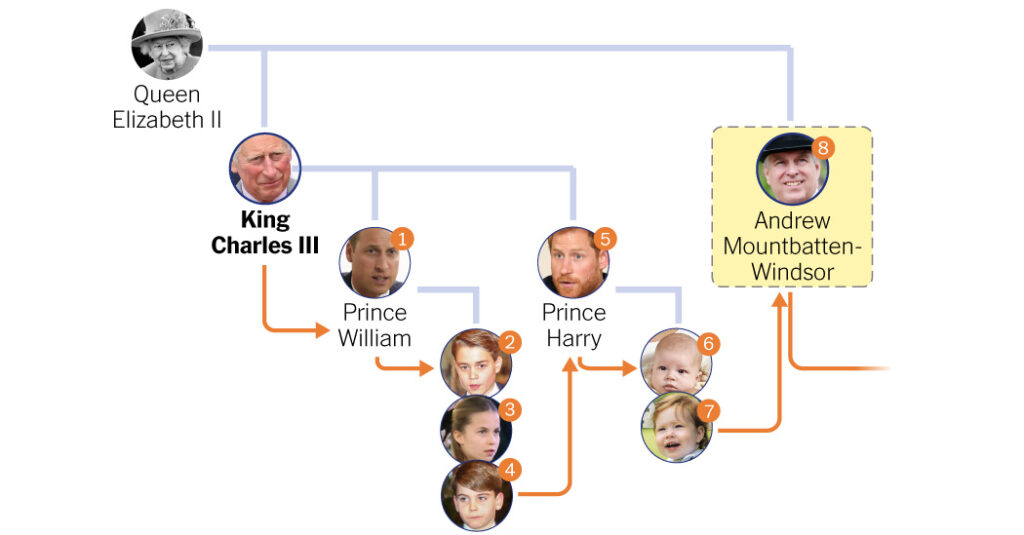
But the former Prince Andrew — now known just as Andrew Mountbatten-Windsor — remains eighth in the line to the British throne.
The British government said last Friday that it was considering changing the line of succession once the police have finished their investigation into Mr. Mountbatten-Windsor, who has not been charged and who has always denied wrongdoing.
Luke Pollard, a defense minister, told the BBC that the government had been working with Buckingham Palace on plans to stop the former prince from “potentially being a heartbeat away from the throne.”
Here’s what you need to know.
What is the line of succession?
It is the order in which members of the royal family would ascend to the British throne. That position also makes its holder the ceremonial head of state in 14 other Commonwealth countries, including Canada, Australia and New Zealand.
Normally succession is straightforward: When Queen Elizabeth II died in 2022, the crown passed swiftly to her eldest son, Charles. (Mr. Mountbatten-Windsor was her middle son.)
But, over the centuries, things have not always been so clear-cut. The origins of the line of succession rules lie in the late 17th century, when Parliament asserted the right to regulate who takes over the monarchy.
Buckingham Palace currently lists 25 people in the line of succession, all descendants of Elizabeth II.
Who is above Mr. Mountbatten-Windsor?
Prince William, the Prince of Wales, is heir to the throne, followed by his three children: Prince George, Princess Charlotte and Prince Louis. Then comes William’s younger brother, Prince Harry, the Duke of Sussex, followed by his children, Prince Archie and Princess Lilibet.
That means that it would have taken extraordinary circumstances for Mr. Mountbatten-Windsor’s claim to the monarchy to come into contention, even if he hadn’t been embroiled in the Epstein scandal.
What has to happen for him to be removed?
The monarchy itself cannot remove a member of the royal family from the line of succession — the change requires legislation in Parliament. That makes the process longer and more complicated and also gives lawmakers a chance to ask questions about the monarchy, something Buckingham Palace does not always welcome.
The British government would not act until the end of the investigation and any trial that followed, to avoid a risk of prejudicing legal proceedings.
And any changes would need agreement from other Commonwealth countries where the British monarch is head of state. Few are likely to object to this proposed change in principle. But some might view the question as a distraction from domestic issues, and they might not prioritize giving their official consent.
Anthony Albanese, the prime minister of Australia, has written to his British counterpart, Keir Starmer, to confirm his support for any plan to remove Mr. Mountbatten-Windsor from the line of royal succession. The New Zealand government has indicated the same.
Who would jump up the list if Mr. Mountbatten-Windsor were removed?
Ninth in line, directly below him, is his elder daughter: Princess Beatrice, also known as Mrs. Edoardo Mapelli Mozzi.
She is followed by her two daughters and then her younger sister, Princess Eugenie, and Eugenie’s two sons.
A delicate and as yet unanswered question is whether Mr. Mountbatten-Windsor would be removed from the line of succession alone, or whether his daughters and their children would drop out too.
When Queen Elizabeth II’s uncle, King Edward VIII, abdicated after less than a year on the throne, the legislation that ended his reign specified that his descendants would never succeed to the crown.
That appears less likely in this case, constitutional experts say, in part because the children can hardly be blamed for the actions their father is accused of, but also because they are so far down the line of succession. They would lose their places only if they were mentioned specifically in the legislation, so the ultimate decision would lie with Parliament.
Why would the U.K. government decide to act?
Eighth in line is a long way from the throne. Since Mr. Mountbatten-Windsor was already unlikely to become monarch, the government initially said it had no plans to alter the succession. That position shifted last week after Mr. Mountbatten-Windsor’s dramatic arrest.
The change in tone reflects a growing political and public backlash against the former prince, whose arrest dominated newspaper front pages.
In previous times, most British politicians have tended to be relatively deferential to members of the royal family. The Epstein scandal has changed that.
Speaking in Parliament on Tuesday, Chris Bryant, a government trade minister, described Mr. Mountbatten-Windsor as “a man on a constant self-aggrandizing and self-enriching hustle; a rude, arrogant and entitled man who could not distinguish between the public interest, which he said he served, and his own private interest.”
Josh Holder contributed reporting
Stephen Castle is a London correspondent of The Times, writing widely about Britain, its politics and the country’s relationship with Europe.
The post How Britain Could Remove Andrew From the Royal Line of Succession appeared first on New York Times.