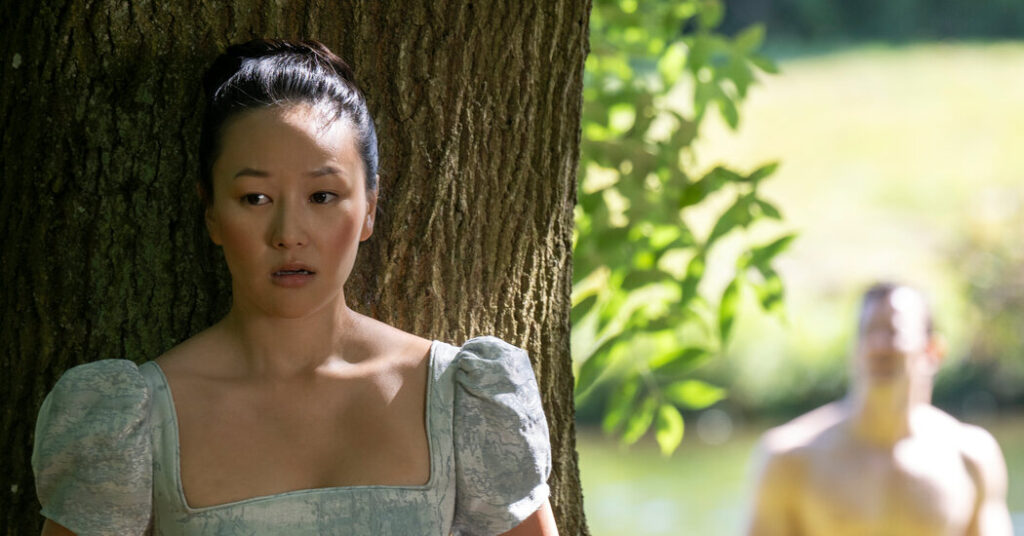
The fourth season of Shonda Rhimes’s “Bridgerton,” which concludes this week, crackles with romantic electricity between two lovers: Benedict, the second son of the wealthy Bridgerton family, and Sophie, his family’s maid. When Benedict, played by Luke Thompson, and Sophie, played by Yerin Ha, are onscreen together, the scenes thrum with their attraction. Their palpable connection is, for me, the best part of the show.
But then the spell breaks and the show moves on to another plot, or subplot, with other characters. And this is why “Bridgerton” will always be frustrating to me. Instead of a study of two characters’ evolving erotic connection, the show is a sprawling soap opera. We are faced with scenes of Francesca Bridgerton’s passionless marriage bed and Violet Bridgerton’s first ever assignation; we see the Featherington housekeeper requesting better pay and Lady Danbury scheming to retire from the queen’s service.
The season’s wandering eye for subplots consistently nudges the central lovers out of frame. Each of these detours is distracting, blocking the climb to the romantic pinnacle we otherwise could have achieved. It also gets in the way of the full consummation of the Shondaland adaptation’s more radical intentions. Along with being sexy entertainment, the show aspires to disrupt expectations about who is allowed to star in our romance fantasies. It set out to repaint the ballroom-wall-to-ballroom-wall whiteness common in historical romance and offer a modern, feminist approach to the genre.
In trying to accomplish that goal while adapting source material, Julia Quinn’s popular romance novels, that lacked such an inclusive vision, “Bridgerton” does not commit wholly to its central romances and, ultimately, also does not fulfill its most incendiary potential.
The pitfalls were on display even in its first season. It stayed true to the first Bridgerton novel’s romance plot, with a meet-cute misunderstanding between Simon and Daphne, their mutually beneficial fake-dating pact and many sex scenes — indoors and outdoors. But it also felt as if we were stealing time with the lovers who were supposed to be the protagonists. Between interludes with them, we had to watch Daphne’s brother Anthony’s energetic liaison with a singer, her sister Eloise’s critiques of gender roles, the neighboring Featheringtons’ absurdities, their unwed cousin’s pregnancy and the work and home life of the Black boxer Will Mondrich. Each thread unlaced the tightly corseted romance plot, albeit to assemble a rich ensemble — the precarious lot of working-class women, the history of Black Britain, the sexual and professional lives of people who were not wealthy, white or straight.
The show offered an in-universe narrative about racial integration — spurred by the interracial love of its king and queen — and scenes of working-class characters, women throwing punches and queer desire. Over time, a wider constellation of characters has been deployed to point quickly at colonialism, class mobility and other forms of sociopolitical marginalization.
But the series has become less precise with its gestures at inclusion. In season two, for instance, Kathani, the leading lady from Bombay (where one might expect Marathi and Hindustani to be the dominant languages), refers to her father as “appa” — a term from languages, including Tamil, spoken in South India — and her sister as “bon” — a Bengali expression. Comically, Kathani is a name so obscure that it comes off more as a concocted exotic approximation of the novel’s Kate (which the character goes by most of the time, anyway). This sort of performative progressiveness feels like a fake orgasm: Everybody knows it’s not sincere and no one is happy.
The fourth season of “Bridgerton” has many of the same problems, but it must now compete in a romance landscape reshaped by “Heated Rivalry,” a show in which neither the orgasms nor the progressiveness come off as fake. Jacob Tierney’s adaptation of Rachel Reid’s popular queer hockey romance series has become a breakout hit, addressing sexual consent, homophobia, immigration and ethnicity — all in the central romance. Devoting attention to two characters’ attraction (one of its six episodes focuses on another queer couple) has contributed to the show’s rapturous reception.
It also does what romance novels can do best: make audiences privy to how lovers feel in their bodies as well as their minds. Any action that does not contribute to this end becomes secondary; all time and events without the lovers get tightly compressed. Dialogue, camerawork, music and lighting tether us to one or both protagonists in every frame, just as a good romance novel does. Mr. Tierney borrows and amplifies Ms. Reid’s particular blend of queer longing and joy, humor and heartbreak, sex and sensibility. It is because of his respect for an already complex source text and its genre that the show has become a flag-bearer for inclusive (and hot) romance.
Much of the success of “Heated Rivalry,” which became a sensation long after the fourth season of “Bridgerton” was crafted, shows another, better way to represent and evoke passion. It zoomed in on its romantic protagonists while offering a vision of happiness for overlooked people that definitely fired up the mainstream public.
If only the remainder of this season of “Bridgerton” were to commit as wholly to its central couple as “Heated Rivalry” did. It could tell a compelling story about the intersection of class, gender, sexuality and race through them. Sophie is a maid and (unlike the novel’s blond, green-eyed heroine) is cast as Asian. Benedict’s queerness complicates his gender, wealth and whiteness. The confluence of their identities — unique to the adaptation — could help elevate this season beyond its hackneyed Cinderella-story source material, as long as the courtship plot remains in focus. That version of “Bridgerton” could finally be a romance adaptation in which the couple also embodies a radical revision of society: racial integration, gender equality, sexual citizenship, bodily acceptance and economic safety.
Politics in romance, like consent, can be sexy and powerful. It is of course possible that, despite the subplots and crowded cast, some viewers could look at Benedict and Sophie’s world and come to critique our present through the familiar made strange. This is, after all, a story set in a country that invades others to extract resources and where the king has lost his mind, the privileged class ignores or exploits its vulnerable and the media tries to please the mighty.
But scattering that politics across too many actors blunts its force and dilutes the romance. Channel the same critiques via two lovers who viewers adore — and there lies tinder for a revolution.
Jayashree Kamblé is a professor of English at LaGuardia Community College, CUNY. She is the author of “Creating Identity: The Popular Romance Heroine’s Journey to Selfhood and Self-Presentation” and has served as the president of the International Association for the Study of Popular Romance.
The Times is committed to publishing a diversity of letters to the editor. We’d like to hear what you think about this or any of our articles. Here are some tips. And here’s our email: [email protected].
Follow the New York Times Opinion section on Facebook, Instagram, TikTok, Bluesky, WhatsApp and Threads.
The post How ‘Bridgerton’ Lost Its Way appeared first on New York Times.